Site visit: Unearthing buffalo spirit stones in Alberta’s Bearpaw Formation
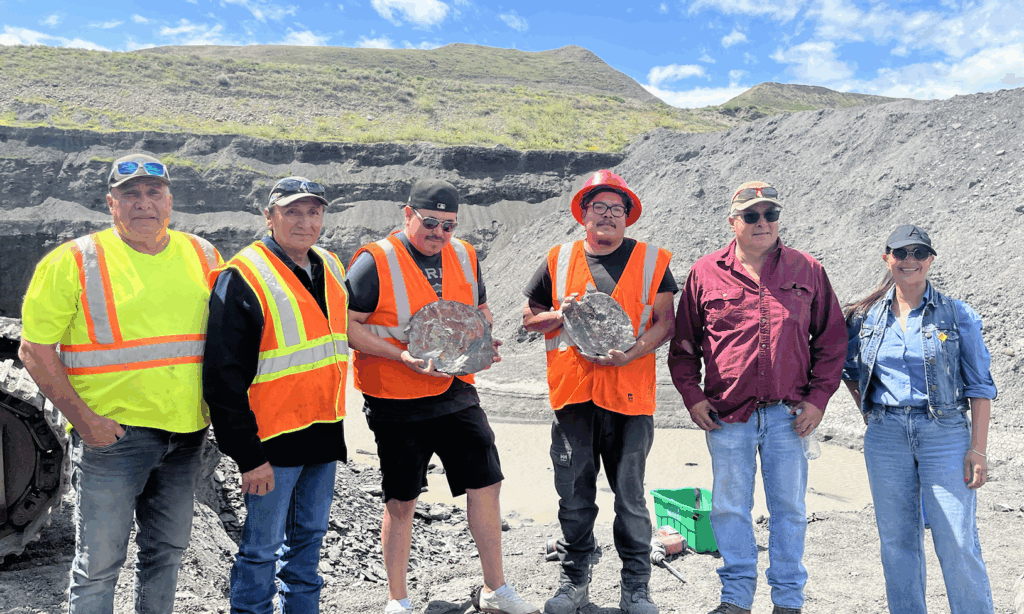
According to the legend, Iniskim – meaning Buffalo Healing Stone in Blackfoot language – brought prosperity back to peoples stricken with famine and starvation on prairie plains.
Long ago, as the story is told, one sister among three out collecting firewood heard singing, leading her to a rock that spoke, telling her the buffalo, a vital source of food and warmth, could hear it — and that it would call the buffalo back, after herds had wandered too far from the camp.
The rock was the ammonite, which the Blackfoot peoples still consider a sacred stone that brings prosperity. The only known reserves in the world are in the Bearpaw Formation, which spans the Canadian provinces of Alberta and Saskatchewan and the US state of Montana, but gem-quality ammolite is found only in Alberta.
Ammolites are rare, rainbow-coloured gemstones derived from the fossils of ammonites — which are actually extinct marine mollusks from the dinosaur-era.
In September 2024, Indigenous owned Buffalo Rock Mining acquired Calgary-headquartered KORITE, North America’s largest producer of ammolite, alongside president Amarjeet Grewal, creating the world’s largest mine-to-market ammolite producer.
Ancient legends aside, the ammonites are currently being unearthed at the company’s two namesake mines in Alberta – bearing the brilliant colours of the rainbow after being buried for over 70 million years.
And ammonite fossils have fetched as much as C$600,000 ($433,000) on Christie’s auctions internationally.
Buffalo Rock Mining, 100% owned by Tracy and Beth Day Chief of the Kainai Nation, acquired KORITE — and its eponymous ammonite mine — with a commitment, it said, to preserving the legacy while expanding its global footprint.
The combined company works with provincial environmental officials to ensure the land is restored to its natural state and is improved during the reclamation process. KORITE has said it will continue to set the ammolite industry standard in environmental mining practices. The mined ammonite is certified by the Federal Department of Canadian Heritage.
The ammonites became extinct at the end of the Cretaceous era. There are three main species of fossils the company extracts: Placenticeras costatum, Placenticeras intercalare and Placenticeras meeki.
The rarest and most sought-after species is Placenticeras intercalare, which displays distinctive ‘horns’ that spiral along the surface. These formations allow for unique surface texturing that is unlike the smooth, flat texture of other Canadian ammonite species, according to the company.
Buffalo Rock & KORITE mines
The drive down to the Buffalo Rock and KORITE mines, located on the Blood Tribe #148 reservation — Alberta’s largest by population and held by the Kanai nation, is smooth and scenic. We encounter cattle grazing, and in the distance see a band of wild horses.
There were heavy rains early that July morning and the skies were still grey. In between deftly navigating portions of flooded plains in the large pickup truck, Day Chief describes the mines, discovered in 2004 and 2008, respectively. Both, Day Chief says, have projected mine lives of 40-45 years.
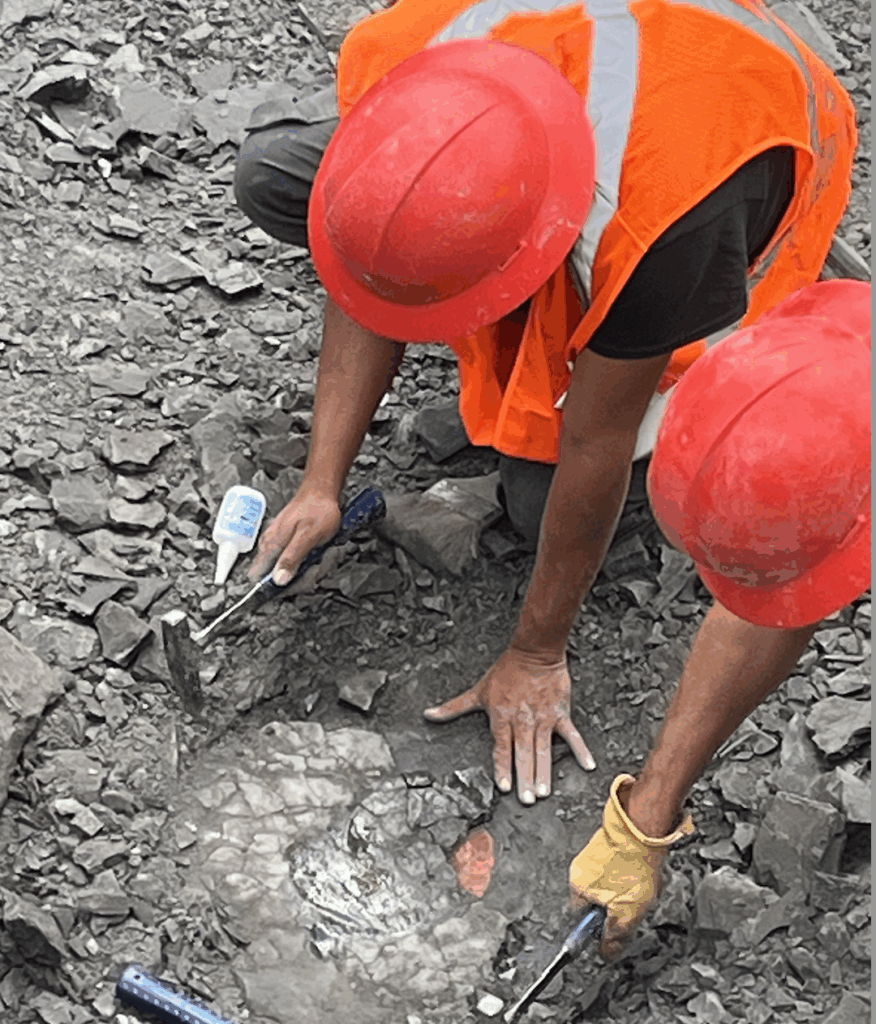
The Buffalo Rock is open pit, surface mined. Workers dig only an inch at a time to avoid breaking up an intact fossil. The aim is to get them out without cracks or fissures, and miners — 16 in total — don’t use headphones while digging, as they listen carefully for the sound of hitting glass, which signals an ammonite fossil has been found. Broken ammonites are cut and polished into ammolite gem stones, used in jewelry.
After every two acres mined, the company has to re-apply for the mineral rights, Day Chief says.
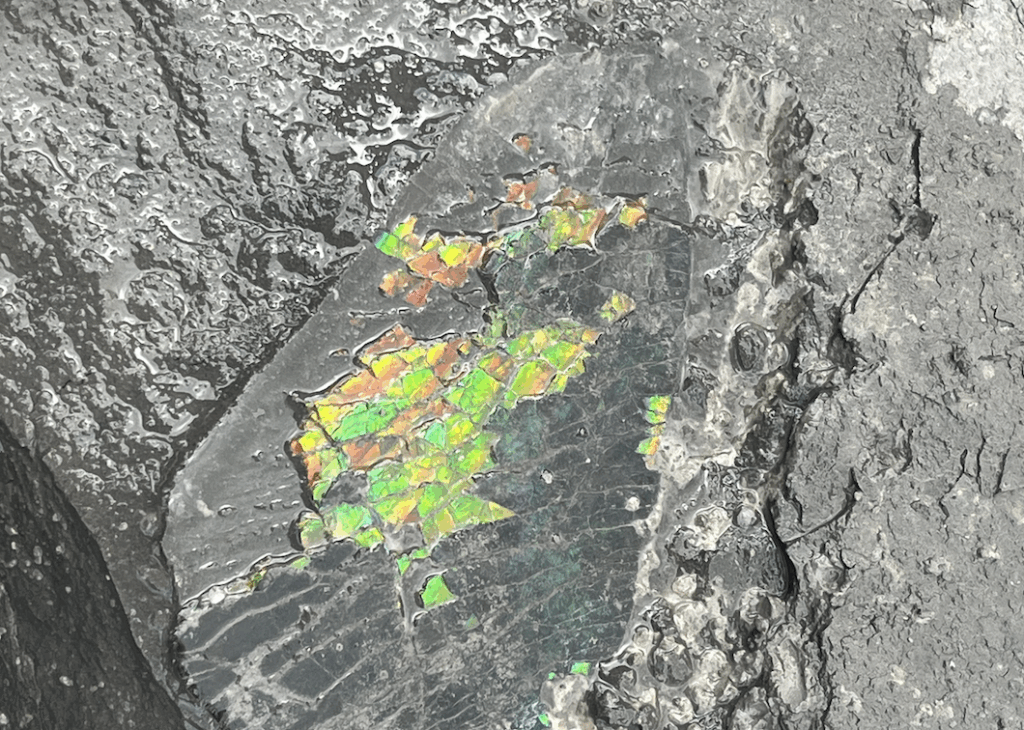
We arrive at Buffalo Rock, where Indigenous miners have discovered an intact fossil near the surface, and prod gently with small hammers to extract it in its entirety without breaking it up. The colours are revealed when a clear cleansing solution (ingredients undisclosed) is applied.
At the KORITE mine, about 10 minutes drive from Buffalo Rock, they panel mine two main zones. The first is the “K Zone” about 15 meters below the surface and extends 30 metres down.
Further down, roughly 20-65 meters deeper into the ground resides “Zone 4” or the “Blue Zone”. The Blue Zone is where the most high-quality ammolite gemstone material and fossils are found, and this is where KORITE sources much of its supply. In this zone, “sheet ammolite” comprises KORITE’s highest grade pieces that display many vibrant colour tones. Before the Buffalo Rock acquisition, KORITE was mined only about two months a year, but production is beginning to ramp up.
Some of the fossils are dug up, one miner explains, with teeth marks visible — the result of being chased and bitten by predatory dinosaur species. Some smaller dinosaur fossils have been dug up, and sent to local museums for display.
Back at camp, instead of a core shack there is a workshop, and instead of drill core there are tables strewn with fossils in various shapes and sizes.
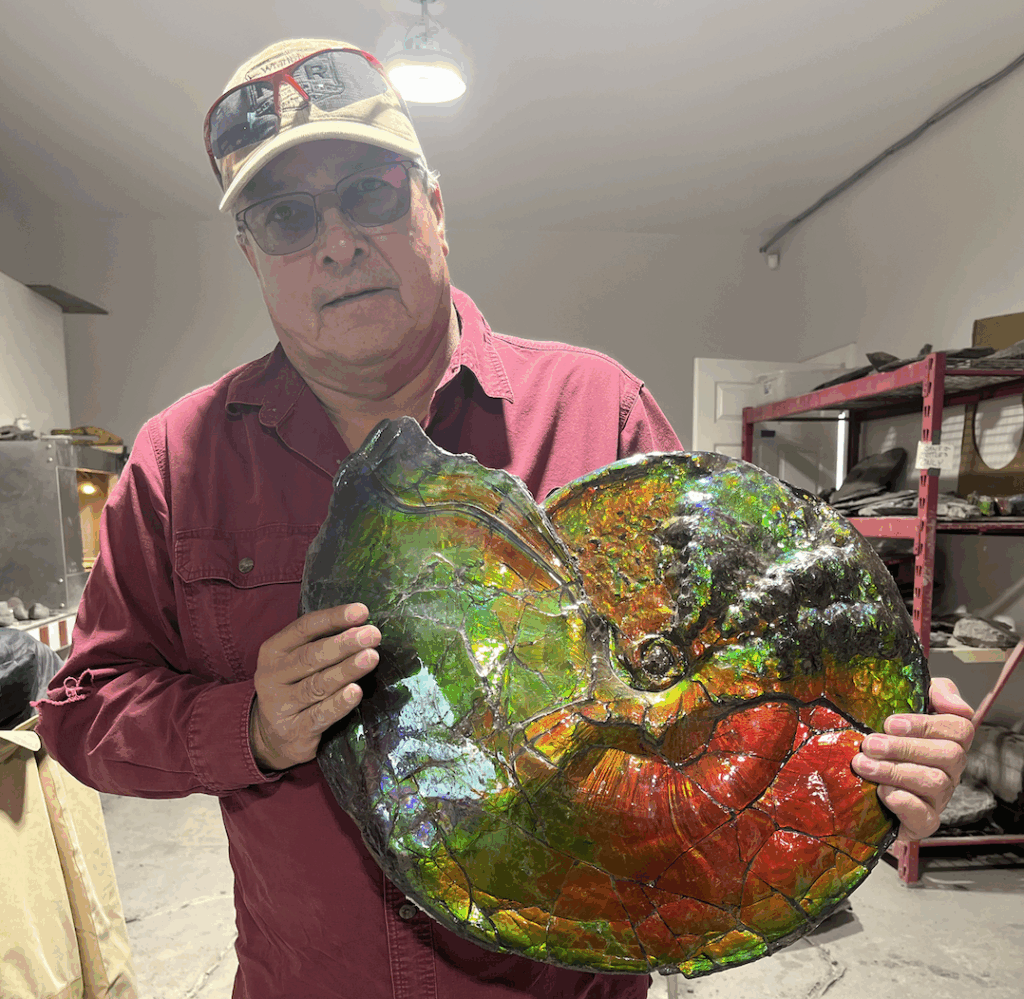
Day Chief and the team display the fruits of their labours, after using air pens and other hand tools to gently remove the surrounding rock, also known as matrix, from the nodule containing the fossil.
A large, intact rainbow-coloured fossil sits at the workbench, where they spend tireless hours with toolkits, working to preserve the ammonite fossils.
{{ commodity.name }}
{{ post.title }}
{{ post.date }}
Comments