SME warns 2026 may reset US mining’s global role
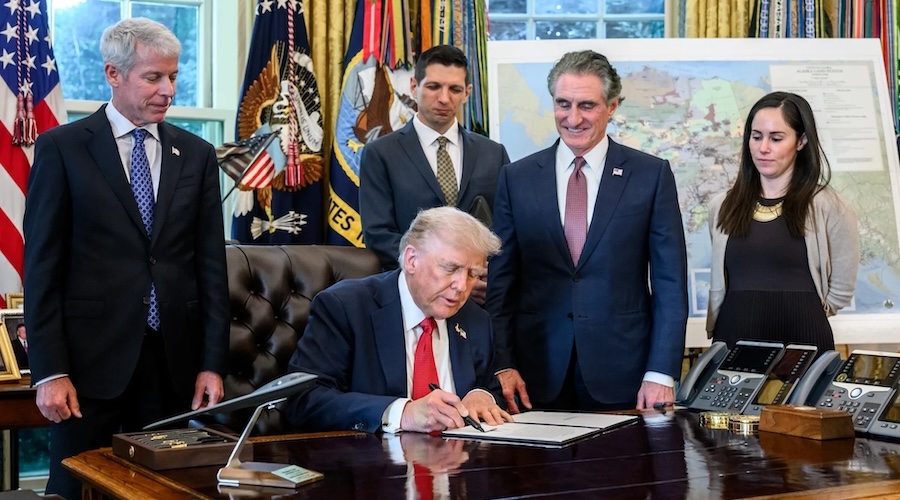

The US mining sector enters 2026 at a pivotal moment as geopolitical pressures and 2025 policy shifts begin to reshape permitting, investment and national security priorities.
While some expect a rapid rebound, Debra W. Struhsacker, consultant to the Society for Mining, Metallurgy & Exploration (SME), told MINING.COM that decades of restrictive policy may slow the pace of recovery.
More than 30 years of legislation and land-use limits, she says, have hollowed out the industry, making progress incremental rather than explosive. Momentum is building, but rebuilding foundations will take time.
The effects of President Trump’s executive actions this year are expected to become clearer in 2026. Struhsacker points to directives calling for increased domestic energy and mineral production and ordering agencies to remove barriers to mining, extraction and processing.
A series of executive orders, including EO 14213, 14220, 14241, 14261 and 14272, now guide federal departments to cut permitting delays, open land for exploration and expand domestic processing capacity. As these mandates work through the system, they are likely to shorten exploration timelines and improve investor confidence, particularly in critical minerals.
Permits and risks
Permitting reform will shape whether 2025’s momentum carries into 2026. Struhsacker sees the convergence of executive orders and the Supreme Court’s Seven County ruling, which significantly narrowed the scope of environmental reviews, as the most significant accelerant. Federal agencies have begun unwinding long-standing National Environmental Policy Act (NEPA) frameworks, developing department-specific guidance aligned with the ruling and adding projects to FAST-41 dashboards, moves that could speed approvals if they survive legal challenges.
Litigation remains the most immediate threat. Challenges to NEPA documents and agency approvals are still likely, Struhsacker says, making passage of the SPEED Act critical to limiting delays.
Financing poses another constraint. Many critical minerals projects still require federal backing to offset high costs and market uncertainty, particularly where private capital remains hesitant, the expert notes.
Security and Supply
Rare earths sit at the centre of the risk picture. Struhsacker describes US reliance on China for heavy and light rare earth elements as severe, noting that China is decades ahead after pursuing a deliberate, geopolitical strategy to dominate processing and supply chains.
Separating rare earth elements remains expensive and time consuming, while small domestic markets for many materials limit commercial returns. China’s history of price manipulation further discourages private investment and increases pressure for government intervention.
Public-private investment models introduced in 2025 are likely to expand this year, offering financing support and demand guarantees. Struhsacker asserts that the US can no longer treat critical minerals as normal commodities, as defence and economic security now drive policy. Additional federal investment, she says, is unavoidable.
Beyond capital and permits, Struhsacker flags a looming talent shortage as the most important trend to watch. Geopolitical competition is driving demand for geologists, mining engineers and metallurgists, yet the US has only 14 mining schools and graduates far fewer specialists than China.
She urges Congress to pass the Mining Schools Act of 2025 and to rebuild national mineral research capacity after the defunding of the Bureau of Mines, warning that the country remains far behind in processing expertise.
As 2026 unfolds, the US has begun to confront its mineral vulnerabilities, but whether it can translate policy intent into durable gains will depend on legislation, sustained investment and rebuilding the industry’s technical backbone.
{{ commodity.name }}
{{ post.title }}
{{ post.date }}
5 Comments
DOUGLAS A STILES
Just an editorial note – the hyperlink to the SPEED Act incorrectly references the wrong bill. While indeed titled the SPEED Act, the linked bill refers to infrastructure funding. The correct bill that should have been linked is HR 4776, which deals specifically with NEPA reform.
Cecilia Jamasmie
Appreciate the feedback. The right bill is now referenced.
Douglas Stiles
The hyperlink to the SPEED Act is the wrong bill; the correct version is HR 4776 not SB 1894. Same name, but very different purposes.
Cecilia Jamasmie
Thank you for pointing this out. It’s fixed.
Rick Denton
When are the small miner going to get a break from all the governments regulations.
They put us off for years because of government regulations.