Energy Fuels could rank among top rare earth producers in West, study shows
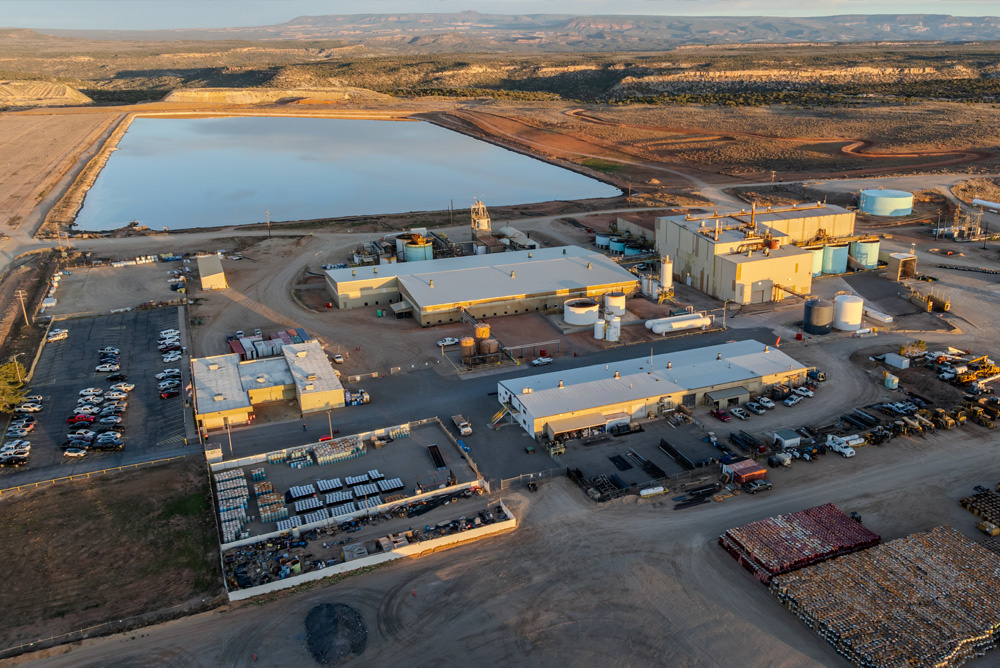
A new bankable feasibility study for Energy Fuels’ (TSX: EFR; NYSE: UUUU) White Mesa mill in Utah suggests the plant could become one of the biggest producers of separated rare earths outside China over a 40-year life.
The stage two circuit expansion at White Mesa could boost its processing of light and heavy rare earths about six-fold to around 6,000 tonnes per year of separated products, according to the study released Thursday. The expansion could also process 198,000 lb. per year of uranium mined at the company’s Pinyon Plain and La Sal mines in Arizona and Utah.
“Energy Fuels is on the cusp of solving America’s rare earth processing ‘bottleneck’,” Energy Fuels CEO Mark S. Chalmers said in a release. “Today’s BFS shows that Energy Fuels is in the process of restoring a US rare earth supply chain that is world-competitive.”
Rare earths, uranium processer
The study significantly raises the value of White Mesa for the United States’ push to develop rare earth supply chains outside the control of China, which dominates the mining, processing and separation of rare earth elements.
The mill, about 500 km southeast of Salt Lake City is the only operating conventional uranium facility in the US and the country’s only plant capable of processing light and heavy rare earths. The 17 rare earth elements are key components in electronics and electric vehicle batteries.
Even though rare earths are abundant worldwide, separating them into their individual elements is expensive and complex and few facilities outside China can do it at scale.
Energy Fuels shares gained 6% to C$30.85 apiece on Thursday morning in Toronto, valuing the company at C$7.3 billion.
$1.9+B value
At an 8% discount rate, the stage two circuit would have a post-tax net present value (NPV) of $1.9 billion and an after-tax internal rate of return of 33%, at initial capital costs of $410 million.
The NPV almost doubles to $3.7 billion if the circuit expansion is combined with the $1.8 billion NPV for Energy Fuels’ Vara Mada project in Madagascar, which was outlined in a feasibility study released last week.
Energy Fuels would source rare earths mined for White Mesa from third party sites, such as Astron’s (ASX: ATR) Donald project in Australia’s Victoria state and Chemours’ (NYSE: CC) projects in Florida and Georgia.
‘Game-changing’ supplier
The BFS results are a “gamechanger” because they show a pathway to supplying 45% of the US’ near-term rare earth needs and all its heavy rare earth needs by 2030, Chalmers said, citing a Benchmark Mineral Intelligence demand forecast.
“We are demonstrating that it is possible to achieve both large-scale rare earth production and superior economics here in the United States,” he said.
By processing output, White Mesa might be in league with Lynas Rare Earths (ASX: LYC), the top producer of rare earths outside China. Lynas produced 10,908 tonnes of rare earth oxides in 2024, for 5,655 tonnes of separated neodymium-praseodymium (NdPr) oxides, according to company figures. Lynas mines rare earths at its Mount Weld site in Western Australia and processes and separates the concentrate at a facility in Malaysia.
While MP Materials (NYSE: MP) produced 45,455 tonnes of rare earth oxide concentrates in 2024, it churned out only 1,294 tonnes of separated neodymium-praseodymium oxide that year. Its Mountain Pass project in California is the only rare earths mine in North America.
Those outputs are dwarfed by China, which produced 270,000 tonnes of rare earth oxides in 2024, according to USGS figures.
{{ commodity.name }}
{{ post.title }}
{{ post.date }}
Comments