Kinross greenlights three US builds for 3 million oz
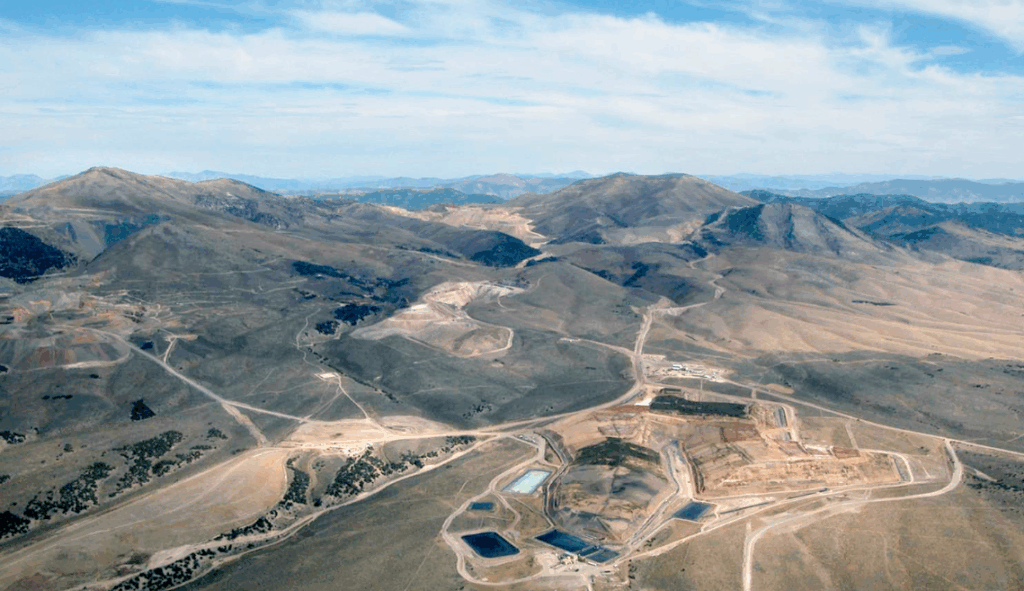
Kinross Gold (TSX: K; NYSE: KGC) has approved three US growth projects designed to add about 3 million oz. between 2028 and 2038.
The additions will keep total output around 2 million oz. a year through the decade, Kinross said Thursday. They are Round Mountain Phase X and Bald Mountain Redbird 2 in Nevada, and a restart of Kettle River–Curlew in Washington.
“Today, we are announcing plans to reinvest in our business to generate additional value from internal projects that are underpinned by a low-cost structure and demonstrate excellent economics at a range of gold prices,” CEO Paul Rollinson told analysts Thursday on a conference call. He called the package “the next phase” of Kinross’s grade-enhancement strategy, with “all projects demonstrating attractive all-in sustaining costs.”
At a $4,300 per oz. gold case, the trio are to generate a combined after-tax internal rate of return (IRR) of 55% and a net present value (NPV) of about $4.1 billion, with paybacks of less than two years. Average gold prices of $3,200 per oz. would cut combined NPV to about $2 billion and IRR to 32%.
Construction will be funded with internal cash resources, Kinross says. Chief financial officer Andrea Freeborough told analysts that roughly $425 million of 2026 capital is earmarked for the US projects within a total $1.5 billion budget.
“You should think about 2027 as being maybe a couple of hundred million higher than that and then most of the rest of it in 2028, and maybe a little bit of a tail in 2029,” Freeborough said.
Asked whether spending would spike above that level as other studies advance, Freeborough said investors should “think about $1.5 billion as sort of the new flat capex guidance for the next three years,” subject to inflation and the pace of longer-dated projects.
Geographical shift
The project approvals extend a portfolio shift that accelerated after Kinross exited Russia in 2022 on the back of US sanctions resulting from the war in Ukraine. Since then, the miner has emphasized assets in the Americas and Mauritania, completing the mill expansions to 24,000 tonnes per annum throughput at Tasiast and restarting Chile’s La Coipa, with Alaska’s Manh Choh sending high-grade ore to Fort Knox since 2024.
The new US mines are timed to coincide with a return to higher-grade mining at Tasiast in 2028, ahead of targeted first production at Great Bear in Ontario in 2029 and at Lobo-Marte in Chile in the early 2030s, Rollinson said.
Round Mountain
The company’s stage 10 for its Round Mountain mine marks a shift from the long-running open pit to bulk-tonnage underground mining of the low-sulphidation epithermal gold hosted along the ring-faulted margin of a collapsed caldera beneath the Phase W pit. Kinross has driven dual declines, advanced about 6 km of underground development and drilled roughly 35 km.
It amounts to a probable underground reserve of 11 million tonnes grading 3.2 grams per tonne gold for 1.2 million ounces of metal. First production, slated for 2028, would boost the mine’s annual output by about 140,000 ounces. This would extend Round Mountain’s life to 2038 for roughly 1.4 million oz. of additional output.
Initial capital is pegged at $400 million, with an all-in sustaining cost (AISC) of around $1,680 per ounce. Federal permits for 3,000 tonnes per day underground mining are in hand; a minor modification to lift that limit and state approvals are expected near-term.
To reduce execution risks, a contractor will handle critical development through 2028 while Kinross builds its underground team. “We’ve made that part of where we’ve taken our capex up a bit, to de-risk our initial ramp-up plans,” chief technical officer Will Dunford said, noting a week-on/week-off roster at Round Mountain to attract experienced miners.
The orebody remains open down-dip, with recent step-outs at widths and grades consistent with the plan, supporting potential mine-life extensions beyond 2038.
Curlew
In Washington state, Curlew will restart as a high-grade underground mine feeding the 1,800-tonnes per day Kettle River mill about 40 km northwest. Kettle River produced 2.8 million oz. before going on care and maintenance in 2017.
Kinross has defined about 1.2 million oz. of mineable inventory at an average life-of-mine grade near 5.8 grams gold per tonne. This includes 2 million oz. indicated at 6.4 grams gold per tonne and 4.2 million tonnes inferred at 6.3 grams gold.
Initial output is targeted for 2028, averaging about 100,000 oz. a year for the first five full years – and 85,000 oz. over the mine’s life – at an AISC of around $1,726 per ounce. Total output should reach about 940,000 ounces.
Upfront capital is estimated at $485 million, including a full mill refurbishment and conversion to dry-stack tailings.
Most permits for the restart are in place, and a state approval to increase the dry-stack height to accommodate the full mine plan is expected this year. Drilling at the North Stealth and Roadrunner zones is aimed at keeping higher-grade, wider stopes in the plan past 2034 and extending the mine.
Bald Mountain
At Bald Mountain, Redbird 2 comprises a second pushback at the namesake pit and five quick-payback satellite pits to leverage the existing fleet, leach pads and workforce.
Production is planned from 2028, delivering about 155,000 oz. per year between 2028 and 2031 and 640,000 oz. through 2032, at an AISC of about $1,466 per ounce.
Initial capital is estimated at $490 million, including pre-stripping, additional fleet and a sulphidization, acidification, recycling and thickening plant to improve leach economics on higher-copper ore.
The Redbird pit, three of the five satellites and two heap-leach expansions are already permitted to begin ramp-up this year. The remaining two satellites are expected win approval later in 2026.
Beyond Redbird, Kinross points to the permitted, 1-million-oz. Top pit as the next anchor that can carry operations into the 2030s across a district hosting more than 40 pits.
Execution risk
Questions on the conference call concentrated on execution and permitting. Dunford said only incremental approvals remain – the Round Mountain throughput increase, two small Bald Mountain satellites and the Curlew dry-stack lift. “We don’t see [them] as a risk,” he said, noting that the later-dated satellites are not needed until the second half of 2028.
As for capital returns, Kinross will stick with its balanced approach, Rollinson said.
“All things being equal, we’d like to continue looking at the buyback, looking at the dividend, strengthening the balance sheet and, of course, reinvesting in our business,” he said.
{{ commodity.name }}
{{ post.title }}
{{ post.date }}
Comments