Copper price tops $12,000 for first time on tariffs, supply woes

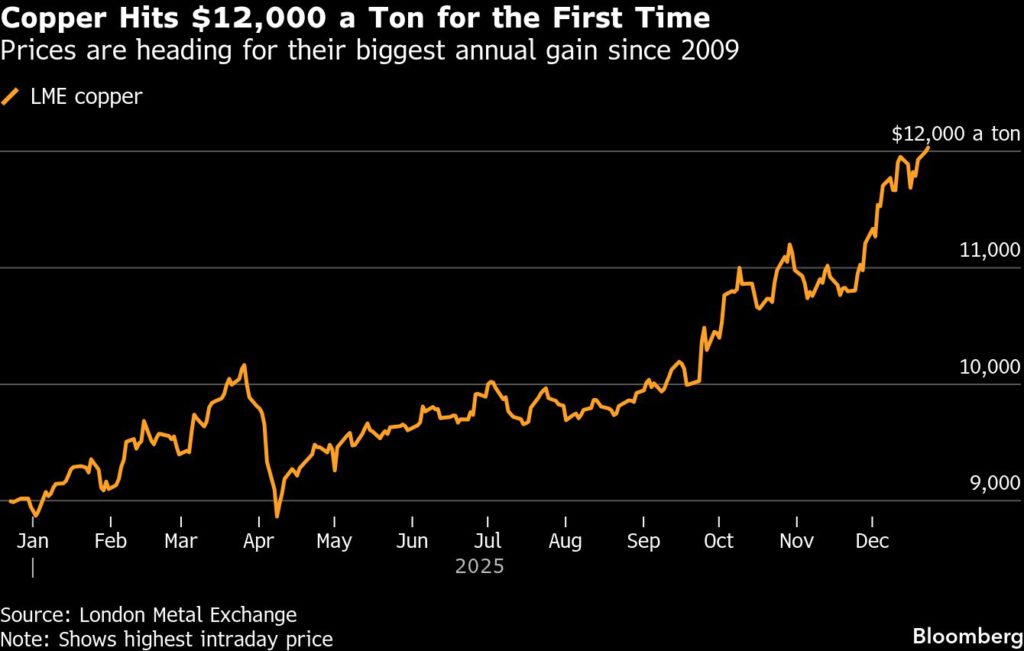
Copper prices hit a fresh all-time high above $12,000 a tonne on Tuesday capping a year that has seen mine outages and trade dislocations put the industrial metal on course for its biggest annual gain since 2009.
Prices rose as much as 2% to $12,159.50 a tonne on the London Metal Exchange, extending a rally that has lifted prices by almost 40% this year. The possibility that Trump will place tariffs on the metal has been a central factor driving prices higher, with a surge in US imports through the year thrusting manufacturers elsewhere into bidding war for supply.
The rally has persisted even as demand weakens in China, which accounts for about half of global copper consumption. Copper is often treated as a proxy for industrial health, yet slowing Chinese usage has failed to cool prices as traders bet that front-running tariffs will keep US-bound shipments elevated.
Structural squeeze
Disruptions at mines across the Americas, Africa and Asia have choked output just as governments expand spending on electrification, renewable power and grid upgrades, all of which rely heavily on copper. Investors have also priced in rising demand from data centres and artificial intelligence (AI) infrastructure.
Brendan Smith, CEO of SiTration, said the current rally reflects a mix of near-term disruptions layered onto a longer-term supply challenge. While the market may not yet be in a full-blown deficit, he said it is not surprising to see heightened enthusiasm given recent outages at major mines, shifting tariff risks and accelerating demand tied to AI data centres.
Smith noted that limited local processing capacity in major mining regions such as North America, South America and Australia has increased reliance on foreign refining, exposing the market to geopolitical risk.
Policy shifts have driven sharp swings. Analysts warn that any Trump-era tariffs on copper or copper-intensive goods could further disrupt flows and increase volatility between LME and CME prices.
Manufacturers have turned to aluminium where possible, while elevated values have pulled more scrap into the market. These factors can slow rallies if demand softens, though substitution is limited in many applications.
Building new supply remains difficult. “Nearly everything the global economy wants to invest in is copper-intensive, including the energy transition and AI,” Benchmark Minerals copper analyst Albert Mackenzie told MINING.COM earlier this month.
Check live copper prices
Long-term game
Longer term, analysts see structural strain. BloombergNEF’s Transition Metals Outlook 2025 forecasts that copper demand tied to the energy transition could triple by 2045, with the market slipping into deficit as early as 2026. Disruptions in Chile, Indonesia and Peru, slow permitting and a thin project pipeline deepen the risk, with deficits potentially reaching 19 million tonnes by 2050 without major investment in new mines and recycling.
Kwasi Ampofo, head of metals and mining at BloombergNEF, said the predicted copper market imbalance reflects rising demand colliding with slow project delivery.
“Copper, platinum and palladium have experienced very slow capacity addition at a time where demand is growing,” he told MINING.COM, calling them the commodities under the greatest near-term pressure.
SiTration’s Smith argued that processing, rather than mining, represents the sharper geopolitical fault line as China dominates refining, producing more than 45% of the world’s refined copper. He noted that smelters and SXEW plants require billions of dollars in upfront investment, long development timelines and specialized technical expertise, making it difficult for new capacity to emerge quickly outside existing hubs.
(With files from Bloomberg)
More News
Contract worker dies at Rio Tinto mine in Guinea
Last August, a contract worker died in an incident at the same mine.
February 15, 2026 | 09:20 am
{{ commodity.name }}
{{ post.title }}
{{ post.date }}

Comments