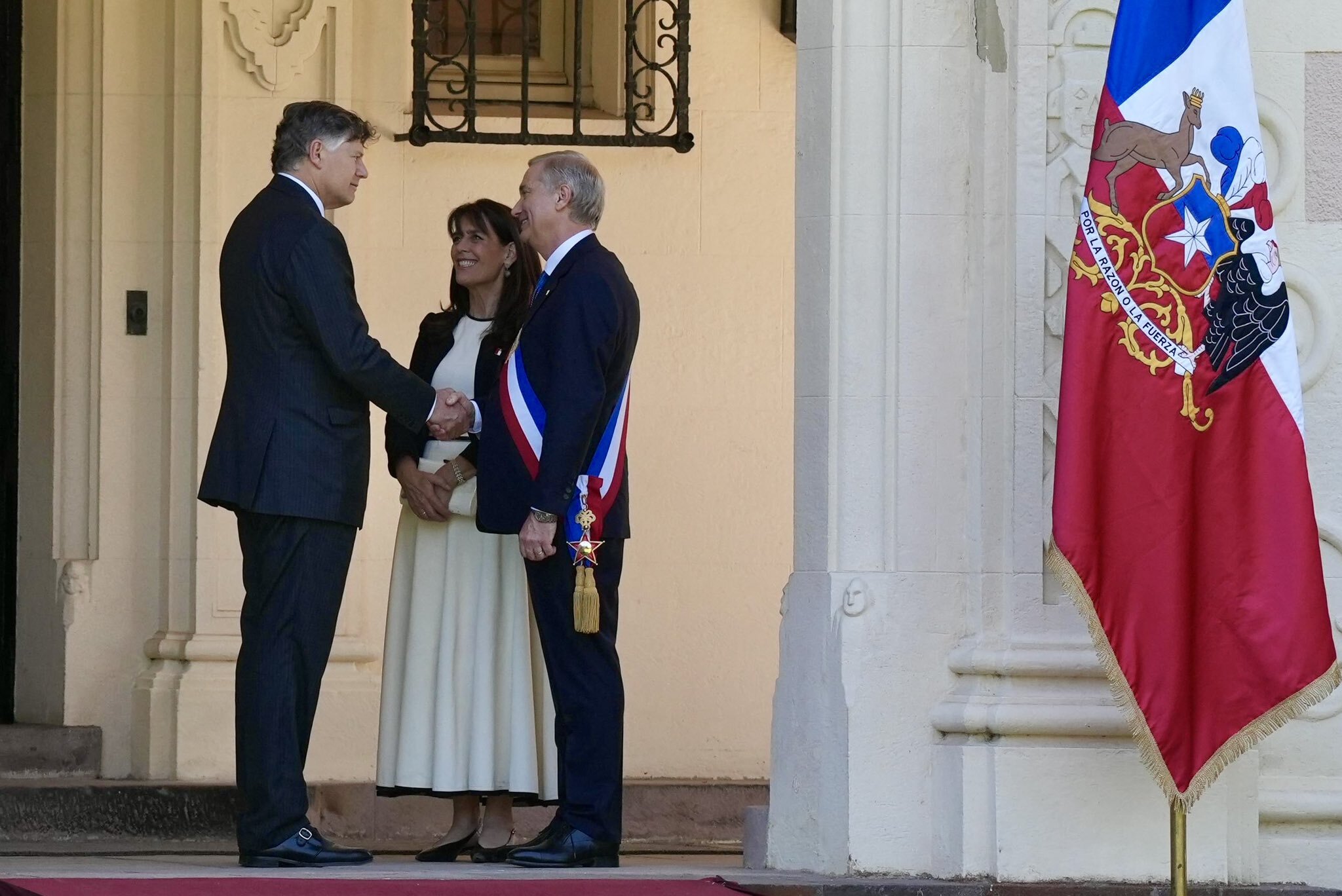
Chile and US eye collaboration on critical minerals
Chile is the world's largest copper producer and second-largest lithium producer.

Highlights
| 602m @ 0.32% CuEq incl. 272m @ 0.44% CuEq incl. 40m @ 0.50% CuEq | |
| 495m @ 0.31% CuEq incl. 284m @ 0.42% CuEq | |
| 184m @ 0.51% CuEq (12 - 196m) incl. 16m @ 1.09% CuEq16m @ 0.46% CuEq (268 - 284m)30m @ 0.51% CuEq (300 - 330m) | |
| 64m @ 0.42% CuEq (154 - 218m) incl. 6m @ 0.74% CuEq | |
| 66m @ 0.40% CuEq (28 - 94m) | |
| 30m @ 0.52% CuEq (162 - 192m)38m @ 0.63% CuEq (264 - to 302m) | |
| 18m @ 0.34% CuEq (24 - 42m) | |
| 8m @ 0.60% CuEq (30 - 38m)10m @ 0.42% CuEq (84 - 94m)18m @ 0.42% CuEq (402 - 420m) | |
VANCOUVER, British Columbia, Feb. 23, 2026 (GLOBE NEWSWIRE) -- Koryx Copper Inc. (“Koryx” or the "Company") (TSX:KRY.V) (NSX:KYX) (OTCQB:KRYXF) is pleased to announce assay results from 13 drill holes (4,960m) received as part of the Phase 2 and 3 infill and expansion drill program for its 2026 exploration and project development strategy on the wholly-owned Haib Copper Project (“Haib” or the “Project”) in southern Namibia.
Haib is an advanced, large-scale open-pit sulphide Cu/Mo/Au porphyry project that is envisaged to produce at an average of 88,000tpa of Cu in concentrate over a 24-year mine life via a simple, scalable, open pit crushing/milling/flotation process. The Company's Preliminary Economic Assessment (“PEA”) dated 4 September 2025 demonstrated the project to be technically and economically feasible with attractive economics and a simple, scalable, long-life and low-cost development strategy undergoing rapid advancement.
Heye Daun, Koryx Copper’s President and CEO commented: “These latest assay results once-again demonstrate and confirm the size, grade and robust copper mineralization of the Haib deposit with some excellent, wide and very consistent intercepts across multiple areas of the envisaged open pit. The encouraging intersection widths and grades in the in-fill as well as step-out holes further strengthens the resource base. These results demonstrate the ongoing success of our drill program as we progress the technical work towards the highly anticipated PFS to be published in late 2026.”
Figure 1: Plan view indicating recent drill hole locations. Results indicated in black are shown on the long section below
Figure 2. Long section showing thirteen drillhole intersections relative to the model for Cu mineralization
Discussion of Drill Results
Thirteen drillholes are reported across the main mineralised zone at Haib, comprising three holes in Target 1, three in Target 2, five in Target 3 and two in Target 4. Four of these holes are classified as in-fill drillholes, designed to reduce sample spacing within known mineralisation, while the remaining nine are peripheral step-out holes intended to test the lateral extent of Cu mineralisation.
Results from the in-fill holes are better than anticipated, with both intersection widths and Cu grades exceeding expectations. The two holes drilled in the northern part of Target 3 and the two in the southeastern part of Target 2 tested conceptual grade extensions; although Cu grades were low, the implications for the mineral resource are considered negligible. The remaining step-out holes returned results ranging from slightly positive to highly encouraging, particularly in the eastern part of Target 1 and the southeastern sector of Target 3.
Table of Significant Intersections
| Hole# | Zone | From (m) | To (m) | Width (m)1 | Cu (%) | Mo (ppm) | Au (g/t) | CuEq%2 |
| HM108 | Entire Hole | 0 | 201.68 | 201.68 | 0.17 | 13 | 0.026 | 0.19 |
| Main | 24.00 | 42.00 | 18.00 | 0.30 | 10 | 0.051 | 0.34 | |
| HM109 | Entire Hole | 0 | 470.52 | 470.52 | 0.16 | 88 | 0.034 | 0.22 |
| Main | 30.00 | 38.00 | 8.00 | 0.33 | 626 | 0.057 | 0.60 | |
| Main | 42.00 | 46.00 | 4.00 | 0.42 | 52 | 0.032 | 0.46 | |
| Main | 84.00 | 94.00 | 10.00 | 0.40 | 23 | 0.011 | 0.42 | |
| Main | 324.00 | 328.00 | 4.00 | 0.54 | 14 | 0.127 | 0.64 | |
| Main | 402.00 | 420.00 | 18.00 | 0.34 | 124 | 0.047 | 0.42 | |
| HM110 | Entire Hole | 0 | 208.19 | 208.19 | 0.09 | 11 | 0.008 | 0.09 |
| HM111 | Entire Hole | 2.05 | 222.87 | 220.82 | 0.18 | 33 | 0.013 | 0.20 |
| Main | 122.00 | 130.00 | 8.00 | 0.38 | 36 | 0.020 | 0.41 | |
| Main | 154.00 | 218.00 | 64.00 | 0.37 | 79 | 0.021 | 0.42 | |
| Including | 162.00 | 168.00 | 6.00 | 0.65 | 69 | 0.033 | 0.70 | |
| Including | 208.00 | 214.00 | 6.00 | 0.70 | 35 | 0.037 | 0.74 | |
| HM112 | Entire Hole | 0 | 602.24 | 602.24 | 0.26 | 117 | 0.025 | 0.32 |
| Main | 12.00 | 102.00 | 90.00 | 0.30 | 38 | 0.023 | 0.33 | |
| Including | 16.00 | 22.00 | 6.00 | 0.55 | 47 | 0.026 | 0.58 | |
| Including | 92.00 | 102.00 | 10.00 | 0.45 | 169 | 0.033 | 0.54 | |
| Main | 194.00 | 200.00 | 6.00 | 0.48 | 76 | 0.030 | 0.53 | |
| Main | 232.00 | 504.00 | 272.00 | 0.35 | 175 | 0.029 | 0.44 | |
| Including | 266.00 | 282.00 | 16.00 | 0.54 | 173 | 0.033 | 0.63 | |
| Including | 324.00 | 330.00 | 6.00 | 0.54 | 91 | 0.024 | 0.59 | |
| Including | 360.00 | 400.00 | 40.00 | 0.45 | 78 | 0.025 | 0.50 | |
| Including | 438.00 | 442.00 | 4.00 | 0.57 | 101 | 0.040 | 0.63 | |
| Including | 466.00 | 474.00 | 8.00 | 0.50 | 13 | 0.133 | 0.60 | |
| HM113 | Entire Hole | 0 | 635.6 | 635.6 | 0.13 | 38 | 0.015 | 0.16 |
| Main | 64.00 | 70.00 | 6.00 | 0.33 | 61 | 0.023 | 0.37 | |
| Main | 76.00 | 80.00 | 4.00 | 0.32 | 39 | 0.022 | 0.35 | |
| Main | 92.00 | 98.00 | 6.00 | 0.33 | 25 | 0.021 | 0.36 | |
| Main | 344.00 | 346.00 | 2.00 | 0.60 | 5 | 0.033 | 0.62 | |
| Main | 370.00 | 374.00 | 4.00 | 0.38 | 6 | 0.020 | 0.39 | |
| Main | 376.00 | 380.00 | 4.00 | 0.32 | 12 | 0.022 | 0.34 | |
| Main | 404.00 | 410.00 | 6.00 | 0.31 | 13 | 0.020 | 0.33 | |
| Main | 442.00 | 448.00 | 6.00 | 0.32 | 9 | 0.025 | 0.34 | |
| Main | 484.00 | 490.00 | 6.00 | 0.35 | 3 | 0.020 | 0.37 | |
| Main | 526.00 | 530.00 | 4.00 | 0.51 | 48 | 0.028 | 0.55 | |
| HM114 | Entire Hole | 0 | 317.04 | 317.04 | 0.21 | 37 | 0.044 | 0.26 |
| Main | 28.00 | 94.00 | 66.00 | 0.34 | 42 | 0.052 | 0.40 | |
| Including | 30.00 | 34.00 | 4.00 | 0.77 | 89 | 0.079 | 0.86 | |
| Main | 140.00 | 150.00 | 10.00 | 0.30 | 74 | 0.079 | 0.39 | |
| Main | 196.00 | 202.00 | 6.00 | 0.42 | 36 | 0.059 | 0.47 | |
| Main | 218.00 | 230.00 | 12.00 | 0.30 | 120 | 0.039 | 0.37 | |
| HM115 | Entire Hole | 0 | 449.15 | 449.15 | 0.22 | 40 | 0.031 | 0.26 |
| Main | 28.00 | 32.00 | 4.00 | 0.48 | 34 | 0.048 | 0.53 | |
| Main | 44.00 | 48.00 | 4.00 | 0.33 | 49 | 0.031 | 0.37 | |
| Main | 54.00 | 60.00 | 6.00 | 0.42 | 28 | 0.045 | 0.46 | |
| Main | 162.00 | 192.00 | 30.00 | 0.44 | 42 | 0.081 | 0.52 | |
| Including | 170.00 | 172.00 | 2.00 | 2.28 | 79 | 0.419 | 2.61 | |
| Main | 264.00 | 302.00 | 38.00 | 0.55 | 124 | 0.048 | 0.63 | |
| Including | 264.00 | 268.00 | 4.00 | 1.44 | 239 | 0.070 | 1.57 | |
| Including | 282.00 | 286.00 | 4.00 | 1.24 | 73 | 0.047 | 1.31 | |
| Including | 296.00 | 302.00 | 6.00 | 0.92 | 255 | 0.056 | 1.06 | |
| Main | 346.00 | 356.00 | 10.00 | 0.50 | 26 | 0.031 | 0.53 | |
| Including | 352.00 | 356.00 | 4.00 | 0.76 | 23 | 0.039 | 0.80 | |
| Main | 404.00 | 412.00 | 8.00 | 0.91 | 59 | 0.044 | 0.96 | |
| Including | 406.00 | 408.00 | 2.00 | 2.34 | 139 | 0.068 | 2.44 | |
| HM116 | Entire Hole | 0 | 222.6 | 222.6 | 0.04 | 6 | 0.013 | 0.05 |
| HM117 | Entire Hole | 0 | 428.29 | 428.29 | 0.31 | 43 | 0.034 | 0.35 |
| Main | 12.00 | 196.00 | 184.00 | 0.46 | 45 | 0.047 | 0.51 | |
| Including | 12.00 | 28.00 | 16.00 | 1.02 | 46 | 0.070 | 1.09 | |
| Including | 36.00 | 40.00 | 4.00 | 0.51 | 46 | 0.050 | 0.56 | |
| Including | 48.00 | 50.00 | 2.00 | 1.24 | 16 | 0.053 | 1.28 | |
| Including | 54.00 | 58.00 | 4.00 | 0.96 | 52 | 0.054 | 1.02 | |
| Including | 90.00 | 96.00 | 6.00 | 0.57 | 38 | 0.061 | 0.63 | |
| Including | 102.00 | 106.00 | 4.00 | 0.81 | 100 | 0.071 | 0.89 | |
| Including | 142.00 | 144.00 | 2.00 | 4.14 | 21 | 0.184 | 4.28 | |
| Including | 150.00 | 156.00 | 6.00 | 0.70 | 20 | 0.038 | 0.73 | |
| Main | 268.00 | 284.00 | 16.00 | 0.42 | 36 | 0.031 | 0.46 | |
| Including | 280.00 | 282.00 | 2.00 | 0.97 | 79 | 0.044 | 1.03 | |
| Main | 300.00 | 330.00 | 30.00 | 0.45 | 83 | 0.043 | 0.51 | |
| Including | 312.00 | 320.00 | 8.00 | 0.79 | 99 | 0.076 | 0.88 | |
| HM118 | Entire Hole | 0 | 183.63 | 183.63 | 0.15 | 9 | 0.030 | 0.17 |
| HM120 | Entire Hole | 0 | 530.38 | 530.38 | 0.15 | 70 | 0.020 | 0.19 |
| Main | 348.00 | 352.00 | 4.00 | 0.47 | 25 | 0.043 | 0.51 | |
| HM121 | Entire Hole | 0 | 494.59 | 494.59 | 0.27 | 42 | 0.022 | 0.31 |
| Main | 92.00 | 102.00 | 10.00 | 0.31 | 9 | 0.031 | 0.34 | |
| Main | 132.00 | 136.00 | 4.00 | 0.50 | 10 | 0.038 | 0.53 | |
| Main | 192.00 | 476.00 | 284.00 | 0.38 | 63 | 0.028 | 0.42 | |
| Including | 224.00 | 234.00 | 10.00 | 1.08 | 79 | 0.121 | 1.19 | |
| Including | 238.00 | 242.00 | 4.00 | 1.19 | 13 | 0.049 | 1.23 | |
| Including | 244.00 | 254.00 | 10.00 | 0.64 | 31 | 0.033 | 0.68 | |
| Including | 266.00 | 290.00 | 24.00 | 0.51 | 54 | 0.034 | 0.55 | |
| Including | 410.00 | 420.00 | 10.00 | 0.46 | 10 | 0.020 | 0.48 |
Target 1 Results
HM114 was drilled in the southeastern part of Target 1 to reduce sample spacing in this area. Results are broadly consistent with expectations, with the known Cu mineralised zones successfully intersected; however, the upper high-grade zone from 28m downhole proved to be approximately 25m wider than anticipated. Of additional interest is an 8 m wide interval encountered at 88m downhole, averaging >0.1g/t Au, together with a further three samples between 140m and 312m returning grades exceeding 0.1g/t Au. Tungsten (W) is also present, with sporadic samples exceeding 100ppm and a peak value of 3,700 ppm recorded in a single sample.
HM115 is located 50m south of HM114 and returned results consistent with the current mineralisation model for Target 1, characterised by shallow-dipping zones. Two mineralised intervals intersected below 340m downhole (10m at 0.5% Cu and 8m at 0.91% Cu) exceed expectations in both thickness and grade. Gold grades are also elevated, with three samples between 110m and 172m downhole returning values of approximately 0.4 g/t Au.
HM117 is located 50m west of the two preceding boreholes and was drilled to reduce sample spacing in this area. Results are in line with expectations, with the upper 150m of the hole intersecting eight mineralised zones ranging from 2m to 16m in thickness and averaging between 0.5% and 4.1% Cu, the latter representing the highest Cu grade encountered to date at Haib. Deeper intersections of 16m at 0.42% Cu and 30m at 0.45% Cu represent significantly better-than-anticipated mineralisation at depth. Gold values remain elevated, with a 28 m wide zone from surface averaging just under 0.1 g/t Au.
Target 2 Results
HM108 was collared in the eastern part of Target 2 to test Cu mineralisation indicated by historical drilling. Copper grades are broadly in line with expectations; however, the higher-grade intersections around 120m downhole, suggested by historical data, proved to be both thinner and lower grade than predicted. Molybdenum is essentially absent, while gold is present in a 10m wide interval from 18m downhole, averaging just under 0.1 g/t Au.
HM118 was drilled on the eastern periphery of Target 2 to test the potential for resource extension in this area. The hole returned uniformly low Cu, Mo and Au grades, indicating that mineralisation at Haib does not extend into this location.
HM120 is located in the southern part of Target 2 and was drilled to define the boundary of higher-grade Cu mineralisation in this area. Although substantial portions of the hole returned Cu grades exceeding 0.2%, intersections grading above 0.3% Cu are limited. Molybdenum is present at elevated levels, with at least five discrete mineralised zones identified, the widest averaging 158ppm Mo over 88m. Gold is absent; however, tungsten values exceeding 100ppm are relatively common, including intersections of 2,470ppm W over 2m and 1,360ppm W over 2m.
Target 3 Results
HM110 and HM116 were drilled 87m apart on the same section in the eastern part of Target 3. Historical hole HM064, located approximately 140m south of HM110, intersected significant mineralisation, and these two holes were designed to test the up-dip extension of this mineralisation towards surface.
Both HM110 and HM116 returned no significant Cu or associated mineralisation, indicating that they lie outside the main mineralised envelope at Haib. A large-scale, interpreted sub-vertical shear zone has been mapped between HM110 and HM064. At Haib, shear zones are commonly associated with depletion of Cu, and it is therefore interpreted that the mineralisation intersected in HM064 terminates against or near this structure.
HM121 and HM111 were drilled north of, and on the same section as, previously reported holes HM090 and HM006 in the southeastern part of Target 3. HM090 and HM006 returned the widest near-surface high-grade Cu intersections (>1% Cu) encountered at Haib, and the new holes were designed to test the northern extension of this mineralisation.
Structural complexity is evident in this area, characterised by an east–west striking, broad, sub-vertical zone of intense alteration mapped between HM090 and HM121 and associated with depletion of Cu. This is reflected in the upper 88m of HM121, which averages only 0.06% Cu, with molybdenum absent. Beyond this depth and outside the alteration zone, Cu grades increase rapidly, culminating in a 284m interval of mineralisation averaging just under 0.4% Cu.
HM111, located 80 m north of HM121, returned comparable results. The upper 120 m of the hole averages 0.07% Cu, followed by a higher-grade interval of 64 m averaging 0.38% Cu. The hole was terminated while still in mineralisation and should be extended to fully define the depth extent of this zone. Spatial comparison of the high-grade intersections in HM006/HM090 and HM121/HM111 suggests that the zone of intense alteration is associated with a normal fault exhibiting up to approximately 150 m of vertical displacement.
HM112 was collared on the boundary between the Target 3 and Target 4 mineralised domains and drilled northwards to intersect the main Target 3 mineralisation at depth. Results indicate a broad zone from surface grading >0.3% Cu; however, Cu grades decrease to below 0.2% for the subsequent ~130m before defining a 17 m interval averaging 0.35% Cu. This includes higher-grade sub-intervals such as 16m at 0.54% Cu and 40m at 0.45% Cu.
Molybdenum is present at significant levels throughout this 172 m interval and extends into the footwall, averaging 196ppm Mo over 292m, with multiple samples exceeding 1,000ppm and a peak value of 5,200 ppm. Tungsten is also present, with a 32m interval averaging 450ppm W, including 4m at 1,640 ppm. Gold values are elevated locally, with a 2m sample returning 0.42 g/t Au.
Target 4 Results
HM109 was drilled well south of Target 4, progressing northwards to intersect previously identified Cu zones at depth. A shallow Cu zone exceeding 0.3% was confirmed, consistent with earlier drilling results. Deeper extensions of Cu mineralization are present but occur as thinner intervals with lower grades. Molybdenum (Mo) is notably elevated, averaging 279ppm from surface over 76m, including a high-grade interval of 8 m at 1,007 ppm. While the average Cu grade of this first 76m is 0.22%, these Mo grades raise the CuEq to 0.35% over this interval. Starting at a downhole depth of 26m, Au mineralization averages 0.15g/t over 10 m, with one sample returning 0.52g/t. Additional Au assays above 0.2g/t were also encountered at greater depths.
HM113, located 75m east of HM109, was drilled for the same objectives. Results are broadly comparable to HM109, though Cu grades are more continuous, averaging between 0.25–0.30%. Ten mineralized zones, ranging from 2m to 6m in width, returned grades of 0.30–0.35% Cu. These results indicate a reduction in grade with depth within the shallower Cu zones of Target 4. Molybdenum (Mo) is also present at elevated levels, with a 92 m interval from 24m downhole averaging 144 ppm.
Updated Drill Program
The drill program has been planned to achieve a comprehensive conversion of all mineral resources from the Inferred to the Indicated category resource in order for all of the material to qualify for the PFS study update in the second half of 2026. This entire drill program comprises 55,000m to be completed by the end of July 2026 to allow time for the assaying and updated resource modelling in 2026 Q3.
Quality Control
All drill core was logged, photographed, and cut in half with a diamond saw. Half of the core was bagged and sent to ALS Laboratories Ltd. in Johannesburg, South Africa for analysis (SANAS Accredited Testing Laboratory, No. T0387) and ActLabs in Canada, while the other half was quartered with one quarter archived and stored on site for verification and reference purposes while the other quarter will be used for metallurgical test work. 33 elements are analysed by Induced Coupled Plasma (ICP) utilizing a 4-acid digestion and gold is assayed for using a 30g fire assay method. Duplicate samples, blanks, and certified standards are included with every batch and are actively used to ensure proper quality assurance and quality control (“QA/QC”) The QA/QC frequency is 1 in 20 for each of blanks, duplicates and standards.
Qualified Person
Mr. Dean Richards Pr.Sci.Nat., MGSSA – BSc. (Hons) Geology is the Qualified Person for the Haib Copper Project and has reviewed and approved the scientific and technical information in this news release and is a registered Professional Natural Scientist with the South African Council for Natural Scientific Professions (Pr. Sci. Nat. No. 400190/08). Mr. Richards is independent of the Company and its mineral properties and is a Qualified Person for the purposes of National Instrument 43-101.
About Koryx Copper Inc.
Koryx Copper Inc. is a Canadian copper development Company focused on advancing the 100% owned Haib Copper Project in Namibia whilst also building a portfolio of copper exploration licenses in Zambia. Haib is a large, advanced (PEA-stage) copper/molybdenum porphyry deposit in southern Namibia with a long history of exploration and project development by multiple operators. More than 80,000m of drilling has been conducted at Haib since the 1970’s with significant exploration programs led by companies including Falconbridge (1964), Rio Tinto (1975) and Teck (2014). Extensive metallurgical testing and various technical studies have also been completed at Haib to date.
Additional studies are underway aiming to demonstrate Haib as a future long-life, low-cost, low-risk open pit, sulphide flotation copper project with the potential for additional copper production from heap leaching. Haib has a current mineral resource of 511Mt @ 0.33% Cu and 51 ppm Mo for 1,668kt of contained copper and 25.9kt contained Mo in the Indicated category and 308.9Mt @ 0.31% Cu and 40 ppm Mo for 949Mt of contained copper and 12.4kt contained Mo in the Inferred category (0.15% Cu cut-off).
Mineralization at Haib is typical of a porphyry copper deposit and it is one of only a few examples of a Paleoproterozoic porphyry copper deposit in the world and one of only two in southern Africa (both in Namibia). Due to its age, the deposit has been subjected to multiple metamorphic and deformation events but still retains many of the classic mineralization and alteration features typical of these deposits. The mineralization is dominantly chalcopyrite with minor bornite and chalcocite present and only minor secondary copper minerals at surface due to the arid environment.
Further details of the Haib Copper Project are available in the corresponding technical report titled, “Preliminary Economic Assessment of the Haib Copper Project, Namibia, National Instrument 43-101 Technical Report” dated effective September 4, 2025 (the "Technical Report"). The Technical Report and other information is available on the Company's website at www.koryxcopper.com and under the Company's profile on SEDAR+ at www.sedarplus.ca.
Additional information is also available by contacting the Company:
Julia Becker Corporate Communications [email protected]+1-604-785-0850
Neither the TSX Venture Exchange nor its Regulation Services Provider (as that term is defined in the policies of the TSX Venture Exchange) accepts responsibility for the adequacy or accuracy of this release.
Cautionary Statement Regarding Forward-Looking Information
This press release contains "forward-looking information" within the meaning of applicable Canadian securities legislation. Forward-looking information includes, without limitation, statements regarding the use of proceeds from the Company's recently completed financings and the future or prospects of the Company. Generally, forward-looking information can be identified by the use of forward-looking terminology such as "plans", "expects" or "does not expect ", "is expected ", "budget", "scheduled", "estimates", "forecasts", "intends", "anticipates" or "does not anticipate", or "believes", or variations of such words and phrases or state that certain actions, events or results "may", "could", "would", "might" or "will be taken", "occur" or "be achieved". Forward-looking statements are necessarily based upon a number of assumptions that, while considered reasonable by management, are inherently subject to business, market, and economic risks, uncertainties, and contingencies that may cause actual results, performance, or achievements to be materially different from those expressed or implied by forward-looking statements. Although the Company has attempted to identify important factors that could cause actual results to differ materially from those contained in forward-looking information, other factors may cause results not to be as anticipated, estimated, or intended. There can be no assurance that such information will prove to be accurate, as actual results and future events could differ materially from those anticipated in such statements. Accordingly, readers should not place undue reliance on forward-looking information. Other factors which could materially affect such forward-looking information are described in the risk factors in the Company's most recent annual management discussion and analysis. The Company does not undertake to update any forward-looking information, except in accordance with applicable securities laws.
Photos accompanying this announcement are available at:
https://www.globenewswire.com/NewsRoom/AttachmentNg/801b97a6-3592-49aa-b5eb-59624c14a13b
https://www.globenewswire.com/NewsRoom/AttachmentNg/8505bfce-44ce-4d73-aae4-6f306af66655




The new Mining Power Rankings are live. Vote for the sector’s leaders in each of the Large-, Small-, and Micro-Cap leagues.