Why Mining Companies Should Consider Alternative Tailings Discharge
Why Mining Companies Should Consider Alternative Tailings Discharge
Central tailings discharge can be especially advantageous at closure
Mining companies have opportunities to reduce long-term risk and increase the resiliency of their tailing storage facilities (TSFs) by evaluating and implementing new tailing management strategies, such as central tailings discharge (CTD).
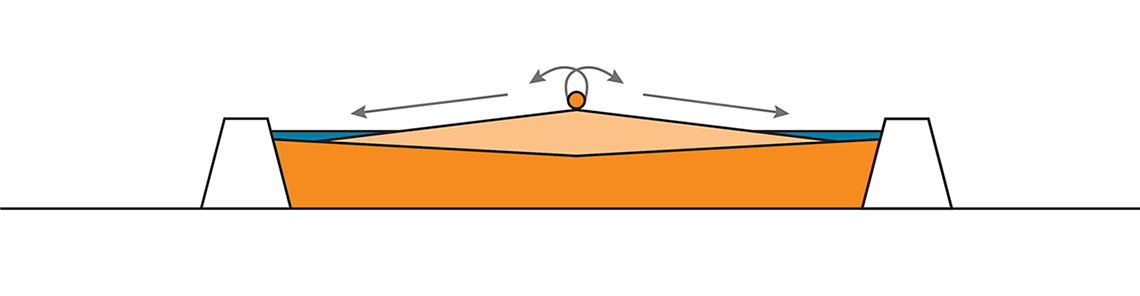
Most conventional perimeter-discharge TSFs lack water efficiency and their dish-shaped geometry has significant disadvantages for closure, especially if the closure requires shedding precipitation runoff. CTD creates a conical geometry that offers three key advantages for TSF closure: improved water management, less land disturbance and expedited TSF closure.

Improved water management
CTD methods require thickened tailings. Thickening the tailings reduces the amount of water in the tailings impoundment and allows for more mine water to be reclaimed. Recovering water in a thickener is more efficient than sending the water to an impoundment where it is lost through evaporation, infiltration and within the tailings voids.
Reducing water in the TSF also reduces overall cost of tailings storage because there is less water to manage and monitor. In addition, less water poses fewer downstream risks in the event of an impoundment failure. Water conservation that leads to reduced fresh water requirements is a positive environmental and social feature for any project or mine.
The CTD geometry improves the ability to manage the effects of precipitation and prevents infiltration at closure. If the TSF is designed to shed water, the domed shape of tailings allows for designing water shedding covers or store and release covers (or a combination of the two) that take advantage of the conical post-closure landform.
Less land disturbance and earthmoving
CTDs typically require smaller containment structures during the operational period of the TSF. Thickened tailings have the potential for higher beach slopes and higher shear and cyclic resistance than conventional tailings – this creates the opportunity for smaller, less robust embankments.
More importantly, because the tailings can be used for fill material, the need for borrow materials – which potentially cause additional land disturbance in the form of a borrow pit – is also reduced. Lower containment structures and use of active tailings deposition as backfill reduce the capital expenditures, construction costs and required closure funds. Less land disturbance generally provides an opportunity for faster permitting due to reduced environmental impacts.
Faster TSF closure
With early planning, the use of CTD for closure can bring the closure process forward by using active tailings deposition, avoiding the need for borrow materials and a permitted borrow pit. The mine owner also benefits because the closure work is initiated during the active mining process, when revenue is still being generated.
An earlier, lower cost approach to closure has financial benefits too. It can reduce bonds needed to allow post-mining land to be returned to its intended post-mining state. If CTD is implemented early and progressively during operations, the need to defer closure costs and the liability at closure are reduced.
Converting to CTD for closure
There can be challenges in switching from conventional deposition to CTD for closure – primarily because a new approach to water management will be required. Thickened tailings displace the centralized pond and water will migrate to areas near the perimeter embankments requiring most operations to excavate sumps in the tailings beaches near the embankments, add ditches to move the water to those sumps, as well as pumps and pipes to move the water to an external reclaim water pond.
When to Consider CTD
Factors that might motivate a mine to evaluate the switch to CTD for closure include:
- High cost of water
- Constraints on land use
- Accelerated TSF closure time
- Closure concept is to shed precipitation runoff
- Significant re-grading and earthmoving needed to close the conventional TSF
The closure planning team should include a tailings management professional, and should consider conventional and alternative disposal methods, and TSF closure strategies that take an integrated approach to develop effective, long-term solutions.
By beginning the TSF closure planning process early, mining companies can evaluate and benefit from a move to CTD. Yet it is important to note that switching to CTD is a commitment! Converting from CTD to another method or back to conventional TSF would be very difficult.

About the Author
Bryan Ulrich, Vice President of Geotechnical Engineering of the Mine Site Infrastructure group at Stantec, is a leader in geotechnical design for the mining industry. He’s experienced in leading design teams and performing independent reviews of mine waste and heap leach facilities. With over 30 years of experience, he has participated in all aspects of the design of tailings and heap leach facilities worldwide.

{{ commodity.name }}
{{ post.title }}
{{ post.date }}



Comments