Redstar Going for Gold at one of the Highest Grade
The market loves high grade. Drill results like 202 g/t gold and 82 g/t silver over 2 metres attract a lot of attention – unless the news comes out in the depths of a bear market. Then no one notices.
Enter Redstar Gold. In 2015 Redstar drill tested the Shumagin target at its Unga project in Alaska. The results were very good, outlining a high-grade gold-silver structure starting at surface tested so far to 250 meters below surface and stretching along an interpreted 2000 meter strike length. The eight-hole program returned this list of stellar results:
- 202 g/t gold and 82 g/t silver over 1.9 metres
- 11.8 g/t gold and 72.7 g/t silver over 7.3 metres
- 14.97 g/t gold over 29.6 metres
- 33.26 g/t gold over 3.2 metres
- 24.02 g/t gold over 5.49 metres (deepest hole at ~250m below surface)
Let’s flashback to 2011 and earlier to results before Redstar consolidated the entire 240 square kilometers:
- 192.60 g/t gold and 5403.4 g/t silver over 0.6 metres
- 365.35 g/t gold and 190.60 g/t silver over 1.22 metres
- 738.00 g/t gold and 408.00 g/t silver over 0.55 meters
The market did not care, noting the land package was not consolidated, and the market struggled through the last year of a long bear market, metals investors could not get excited, even about very high-grade gold.
The market may have ignored Redstar’s results, but the company carried on. Now, a year later and with gold alive again, Redstar is cashed up with ~$7.5 million in its treasury and just finished a follow-up drill campaign, which ended November 4th, 2016. Every one of the seven holes hit the target, returning the breccias and veins from the Shumagin structure, that when previously drilled in other historical holes returned excellent grade. So……Assays are pending.
If last year’s results are any guide, the numbers could make a splash in a gold market that is now open for business.
And it gets better. Last year’s effort continued to show that the 2 km long Shumagin Gold Zone carries high grade gold. This year’s drilling, if successful, would stretch the known zone hundreds of metres along strike and to depth. Grade and size – together they make a deposit meaningful. An example of the potential increase in strike length is that hole #1 of the recent drill program was drilled 400 meters west of the deepest hole and nearly 900 feet below surface. It hit the structure!
And this meaningful deposit would be very close to tidewater, on ground that Redstar has now consolidated and controls 100%, and within a company with $7.5 million in the bank and more than half of its float controlled by some of the top gold funds in the industry. These gold funds have already completed their due diligence, and another key fact…. Management controls ~17%…that shows commitment!
The Unga project is on the Aleutian Islands, just south of the Alaska Peninsula and about 600 km southwest of Anchorage. The location sounds extreme but the climate is temperate and the nearby town of Sand Point has a deep-water port that functions year round, as well as a paved mile long airstrip with daily flights to Anchorage.
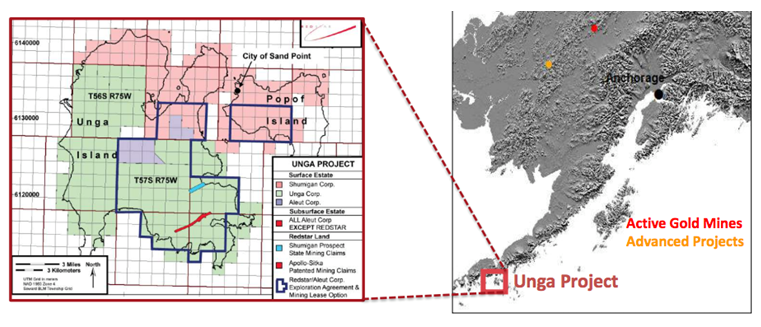
It’s a big property, covering 240 sq. km, and hosting dozens of showings. Known as one of the largest intermediate sulfidation epithermal vein fields in the Americas and thus known as a “district-scale” gold play. World leading expert Dr. Jeff Hedequist, visited the site in the summer of 2016, and completed a technical report comparing the Unga Gold Project to other world-class epithermal projects. Who better to give the project the thumbs up, than the leading expert. The report lies on the home page of Redstar Gold’s website (www.redstargold.com).
The numerous other gold zones range from high-grade gold-silver veins and breccias to low-grade disseminated gold, but the common theme is they all relate to an intermediate sulphidation epithermal mineralization. Such deposits either stem from magmatic sources or from geothermal fluid circulation. Unga’s location puts it in the former category: the Pacific Rim hosts a long list of magmatic source (also known as Island Arc) low to intermediate sulphidation epithermal deposits.
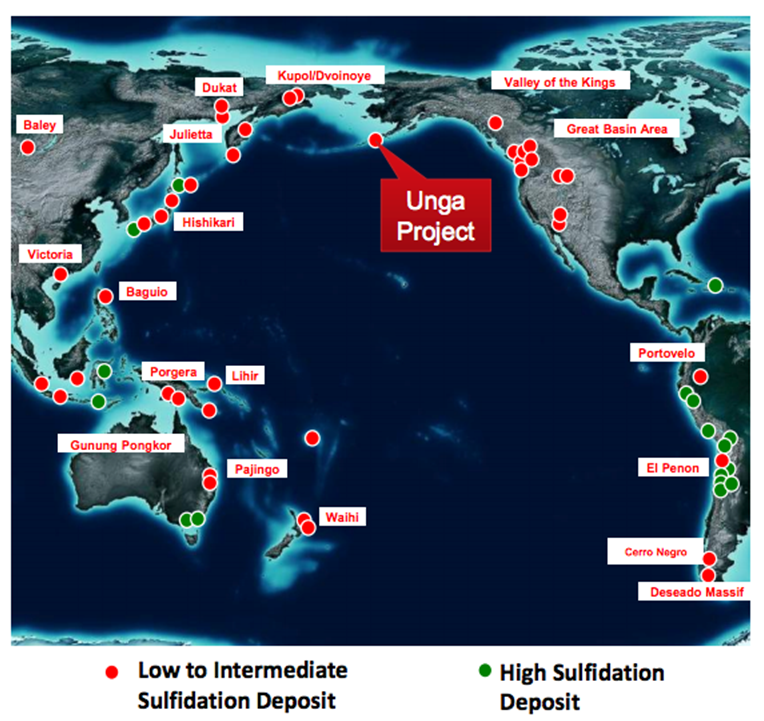
Low to Intermediate sulphidation epithermal gold on the Pacific Rim is a good target to chase. Success stories include Cerro Negro, the Argentinean deposit that Goldcorp bought for $3 billion; El Penon, the Chilean project that Yamana swept up for $3.6 billion; and Kupol, the Russian deposit the Kinross laid out $3.1 billion to have.
Unga has in fact already produced gold: the project includes Alaska’s first ever underground gold mine, which churned out 150,000 oz. gold from ore averaging 10 g/t.
That was at the Apollo-Sitka Zone, which is in the middle of the Apollo-Sitka southern trend, which runs parallel to the northern Shumagin trend. Both are about 10 km long and each offers interesting targets.
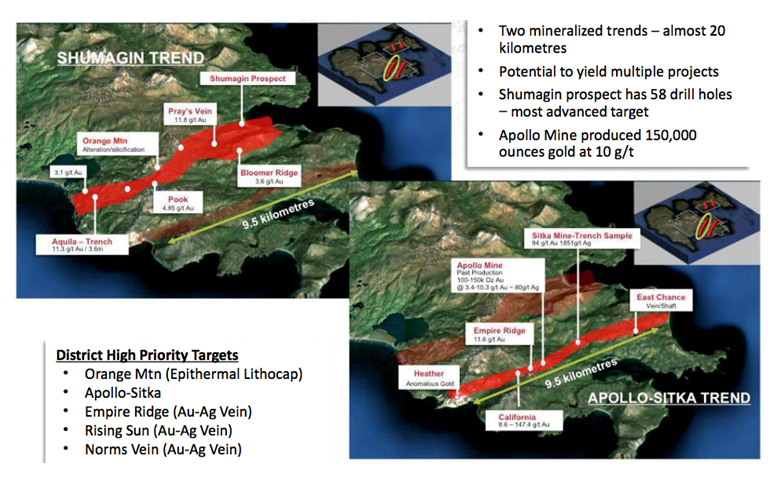
The Apollo mine tapped into the oxidized portions of a structure hosting brecciated andesite and sheeted veins – in other words, classic structurally constrained epithermal mineralization. The stope averaged 6 metres in width and mining stopped when the easy-to-process oxide ore from the easy-to-track outcropping structure ran out.
Of course, the structure continued, sometimes under cover and in other places poking out. For example, Empire Ridge is a target west along trend from Apollo offering an interesting zone running 750 metres consisting of silicified volcanic rocks haloed by intense argillic alteration and swathed by a strong gold-and-pathfinder-in-soil anomaly. Great evidence of potential mineralization, but Empire Ridge has never been drill tested. Grab samples from the surface of Empire Ridge were up to 400 g/t gold.
Each of the other dozen targets has its own prospectivity, like the impressive alteration zone and anomalous mercury in silicified basalts at Orange Mountain.
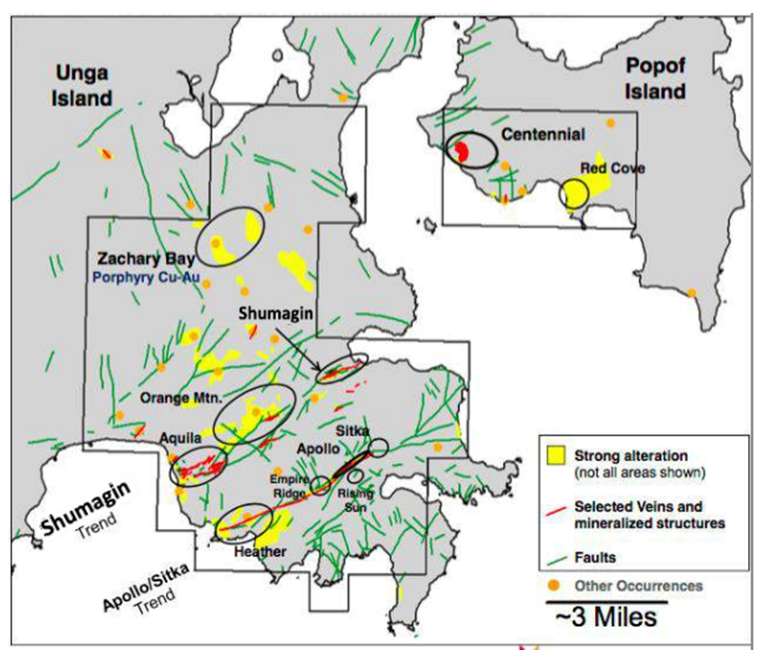
But those targets are all secondary, for the moment, to Shumagin.
Shumagin is the target that produced those stellar results for Redstar last year. The northeast-trending structure dips steeply to the southeast and averages 7 metres thick. At surface it runs along the side of a ridge, outcropping in a few spots.
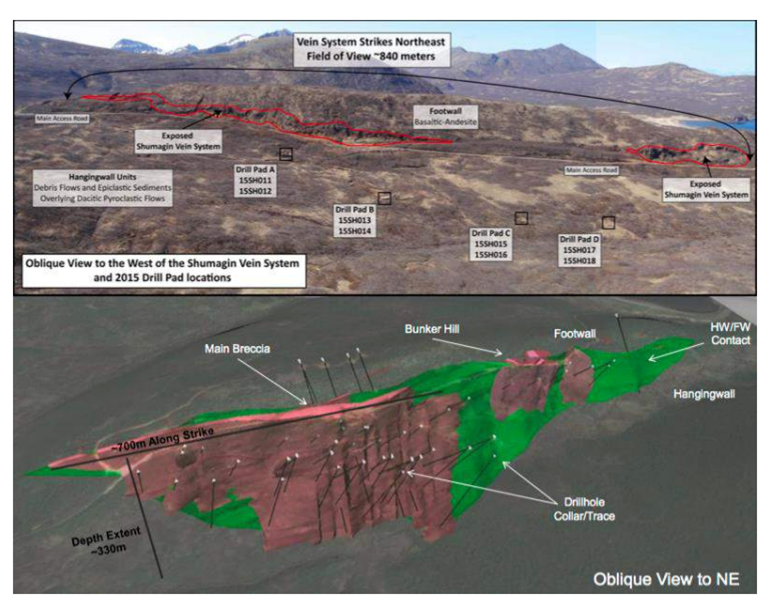
ON a very small portion of the Shumagin Gold Zone, a “non- 43-101 compliant resource” of 250,000 tonnes of material grading 27.4 g/t gold and 127 g/t silver was completed by SRK Consulting, 2000. This is historical in nature but provides an interesting view in what may exist and could get bigger and confirmed with future drilling.
The graphic above shows drilling to date. You’ll notice there are more than the eight holes Redstar completed last year. There were two prior drill efforts: Redstar punched 6 holes in 2011 as part of a joint venture (before the market started to collapse). A total of 65 holes have now been completed in the Shumagin Gold Zone, dating back to the early 1980s.
Redstar’s program last year had two parts. The infill holes confirmed those old results, boosted confidence in the continuity of mineralization, and helped the team better understand local geologic controls.
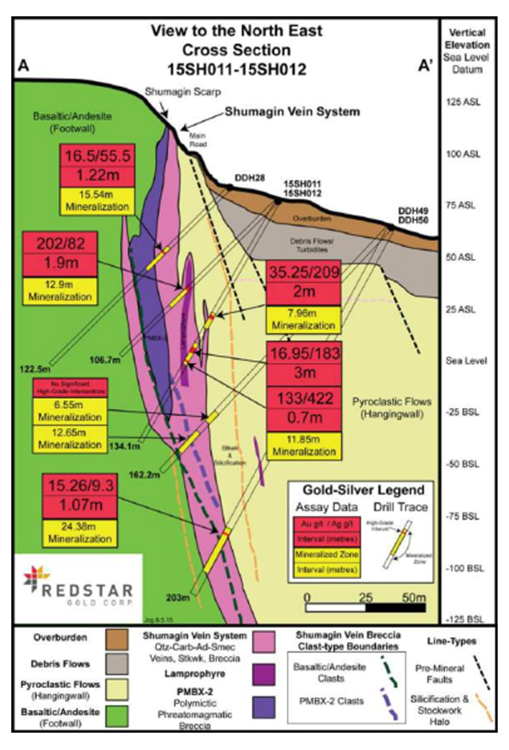
The step-out holes extended the zone. The effort stretched the known strike at Shumagin to 1000 metres, extended its depth extent to 330 metres, and confirmed an average width of 7 metres. Mineralogy work confirmed the mineralization has a low sulphide content, which bodes well for mining.
In other words, the 2015 program was a success. But the market wasn’t in any shape to care.
Today the situation is very different.
Redstar just finished another drill program, punching another seven holes into Shumagin. The effort had two goals: extend the zone along strike to the east and farther down dip.
More News
Contract worker dies at Rio Tinto mine in Guinea
Last August, a contract worker died in an incident at the same mine.
February 15, 2026 | 09:20 am
{{ commodity.name }}
{{ post.title }}
{{ post.date }}



Comments