Draft mining regulations expected late spring, mid-summer 2016
By Mark Sabourin
Sometime between late spring and mid-summer 2016, the British Columbia (B.C.) public will get its first look at proposed amendments to the Health, Safety and Reclamation Code for Mines in British Columbia (the Mining Code) setting new standards for tailings dams. The amendments will respond to recommendations, 26 in total, from independent reviews of the 2014 Mount Polley tailings dam failure.
Though no lives were lost, the Mount Polley disaster is often referred to as the worst mining disaster in Canadian history.
Click here for a free 45-day subscription to EcoLog
There are two certainties in mining: that there will be water and that there will be tailings. The former is needed for mining operations, and the latter is a necessary by-product of the process. How those two certainties will be managed is at the centre of a debate that may shape the future direction of mining in B.C.
On one side of the debate, critics of current mining practices are calling for a regulatory requirement that would have all new mines manage only “dry stack” tailings — tailings with a water content of no more than 35%. On the other side is the mining industry, which concedes the need for stricter tailings management standards, but argues that mine operators should be free to select the best from a range of available options.
Muddying the waters are the January 2015 “Report on Mount Polley Tailings Storage Facility Breach” by the Independent Expert Engineering Investigation and Review Panel, and the words of Minister of Energy and Mines Bill Bennett himself.
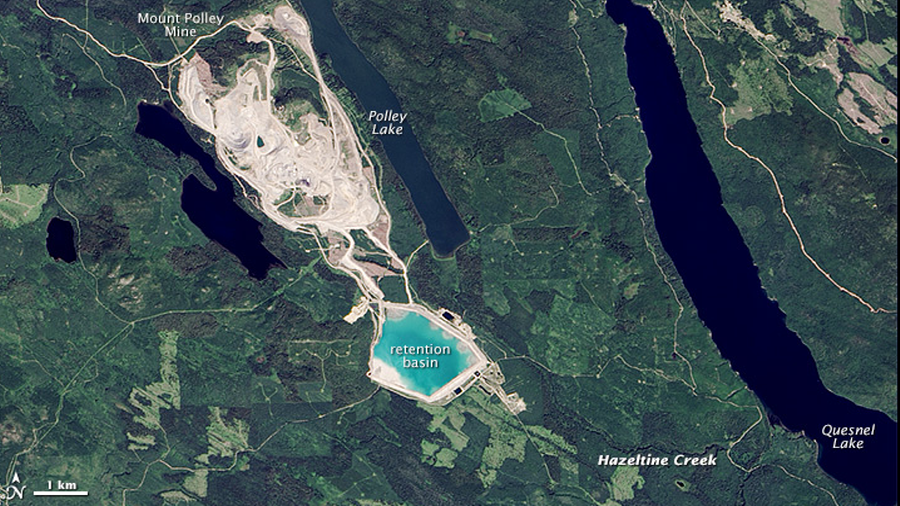
Mount Polley Mine site in British Columbia on July 24, 2014 prior to the dam breach on August 4, 2014. Image from Wikipedia/Nasa.
The review panel’s report came down firmly in favour of best available technology (BAT) for tailings impoundments. It identified dry stack tailings as a clear example of BAT, but never specifically recommended dry stack as the only safe option for mining in B.C. Minister Bennett’s contribution to the confusion stems from his commitment to implement all of the review panel’s recommendations, and his acknowledgment that there are circumstances where approaches other than dry stack tailings may be appropriate.
Miners love water, Ugo Lapointe, Canadian Program Coordinator with MiningWatch Canada, told EHScompliance.ca newsletter. Mining facilities need water to operate, and tailings mixed with water can be inexpensively pumped to tailings impoundments for storage.
Wet tailings sites serve a dual purpose, he says: waste storage and water reservoir. And therein lies the problem, he says, because water is probably the worst thing to have in terms of safety and risk factors. Water brought down Mount Polley.
According to the Ministry of Energy and Mines announcement, the Red Chris tailings impoundment was subject to three separate independent reviews and proponents successfully demonstrated to the Chief Inspector of Mines that the dam would perform as designed.
Second, the provincial environmental assessment process for mines was amended in 2015 to require proponents to consider several alternatives for tailings management and to justify the choice they make.
“Proponents usually look at all of these different technologies to begin with and then they decide the option that is going to be most appropriate for the facility and the most viable economically as well,” says Briño.
“Now, they must also justify their decision. I think it’s going to make a difference,” she says.
About EcoLog
 EcoLog Environmental Resources Group is Canada’s leading publisher of print and electronic environmental, oh&s and workers’ compensation news, legislation and compliance solutions. Subscribers include EHS managers, engineers, executives and lawyers in all industry sectors and government.
For over 30 years, EcoLog has been providing environmental, oh&s and workers’ compensation information to thousands of Canadian and international businesses in manufacturing, mining, forestry, transportation, and oil and gas. You can count on EcoLog’s dedicated and award-winning editorial staff to provide you with the most accurate, comprehensive and up-to-date environmental and oh&s information available anywhere.
Free 45-Day Subscription to EcoLog Click Here Or Call Specialty Technical Publishers Toll free: 1-800-251-0381 Phone: 1 604-983-3434
Email: [email protected]
Visit: www.stpub.com
More News

Gold price extends gain amid US-Iran standoff
Spot gold rose as much as 1.2% to above $5,250 an ounce.
February 27, 2026 | 09:48 am
{{ commodity.name }}
{{ post.title }}
{{ post.date }}



Comments