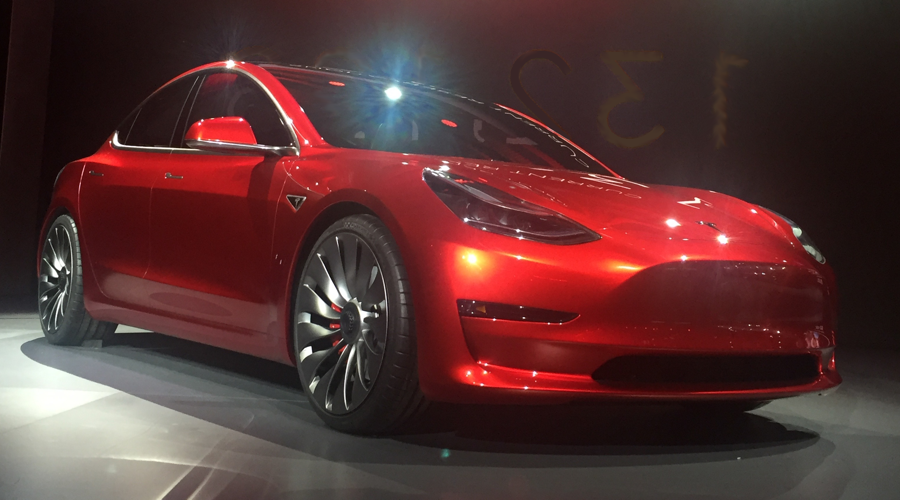
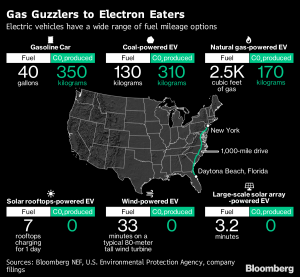
New Yorkers looking to escape the winter chill by driving to Daytona Beach, Florida, would use about 40 gallons of gasoline to traverse the 1,000 miles in a Chevrolet Impala.
Switch that gas guzzler out for an electron-eating EV and the equation changes. A Tesla Model S traveling the same distance would need power generated by about 2,500 cubic feet of natural gas, 286 pounds of coal or 33 minutes of blades spinning on a giant offshore wind turbine to make the same journey.
As electric vehicles slowly become a bigger part of the global automobile fleet, questions about mileage and fuel efficiency are going to become more apposite. While there are multiple variables that can affect electric vehicle energy consumption, a Bloomberg NEF analysis illustrated some ballpark estimates to give drivers a better picture of what’s happening underneath the hood.
Modern coal plants only convert about 35 percent of the fuel’s energy into electricity, and about 10 percent of that electricity could be lost as it travels along power lines
Coal
Taking that same 1,000-mile road trip in an electric vehicle that needs 33 kilowatt-hours of energy to travel 100 miles, like a Tesla Model S, would require about 286 pounds (130 kilograms) of coal to be burned at the local power plant. Modern coal plants only convert about 35 percent of the fuel’s energy into electricity, and about 10 percent of that electricity could be lost as it travels along power lines.
Even with all those losses, the electric vehicle road trip is still better for the climate than driving a gasoline-powered car. Burning that much coal would release about 310 kilograms of carbon dioxide into the atmosphere, compared with 350 kilograms by the 40 gallons of gasoline. Even though coal tends to emit more pollutants than oil for the amount of energy it generates, the efficiency of the electric vehicle, which recharges its battery with every brake, more than makes up the difference.
Comments