New BHP CEO to tackle deals, China exposure and capital discipline
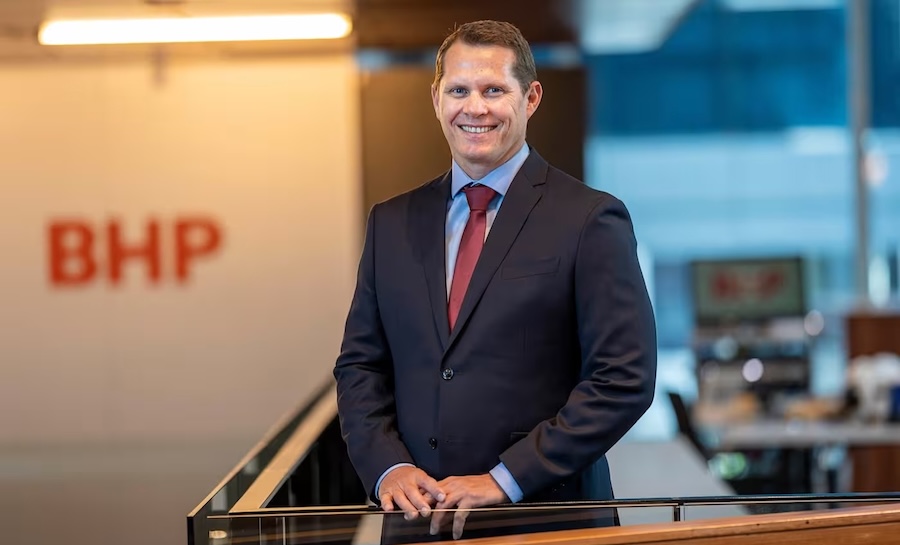
BHP’s (ASX, LON: BHP) promotion of insider Brandon Craig to chief executive officer cements the world’s largest miner’s pivot toward copper as it turns the page on Mike Henry’s run.
Craig, a 25-year company veteran, will assume the top job on July 1 after leading BHP’s Americas division, where he oversaw its expanding copper and potash portfolio.
While market rumours tied Henry’s departure the company’s failed $49 billion bid for Anglo American (LON: AAL), the leadership transition had been in motion well before the Anglo setback. The end of his time at BHP also aligns with the roughly six-year tenures of predecessors Andrew Mackenzie and Marius Kloppers.
On a personal level, Henry is understood to have been preparing to step down for some time as he is in a relationship with Canadian National (CN) Railway chief executive Tracy Robinson. They met during negotiations over transporting potash 1,700 km from the Jansen project in Saskatchewan to ports on Canada’s west coast.
Henry leaves behind a reshaped BHP, having exited oil and gas, reduced coal exposure and sanctioned major growth projects including the Jansen potash mine in Canada, which has faced several costs blowouts and delays.
His tenure also marked a return to large-scale dealmaking, culminating in the rejected Anglo American bid that shook the sector and spurred consolidation attempts by rivals including Rio Tinto (ASX, LON: RIO) and Glencore (LON: GLEN).
BHP also strengthened its balance sheet and operational performance under Henry’s leadership. It returned about $80 billion to shareholders, while positioning itself for long-term growth through large-scale investments in copper and the Jansen project. Under Henry’s leadership, BHP earmarked roughly $20 billion in copper and potash projects.
Craig’s rise has been deliberate. Early in Henry’s tenure, he was tasked with running BHP’s iron ore business through the pandemic, improving efficiency at its most profitable unit, before moving to oversee the Americas. That shift brought copper and potash — now central to BHP’s future — under his control and positioned him as a natural successor.
The incoming CEO now inherits a company balancing ambitious spending plans with investor expectations for returns, setting up early scrutiny over capital discipline after a period defined by bold — and not always successful — dealmaking.
Copper beats iron ore
Copper has overtaken iron ore as BHP’s top earnings driver, accounting for 51% of first-half profit. The company produces about 2 million tonnes a year across Chile, Peru and South Australia and is positioning itself as the world’s largest copper developer.
BHP aims to lift copper equivalent production to 2.5 million tonnes a year by the 2035 financial year, with about 1.4 million tonnes a year coming from its Escondida and Pampa Norte assets in Chile.
Craig has helped drive that shift, including advancing the Vicuña project in the Andes with Lundin Mining (TSX: LUN) and pushing the long-delayed Resolution project in Arizona with Rio Tinto (ASX, LON: RIO), which has gained momentum under US President Donald Trump’s second term. Expanding operations in remote South Australia also remains a priority.
Execution will be everything. Copper sits at the heart of AI data centres and renewable energy buildouts, and BHP is betting heavily that demand will hold.
Deals: discipline over scale
BHP insists it remains disciplined on M&A, even after two failed attempts to acquire Anglo American. Those bids helped spark a broader consolidation push across the sector, with rivals also exploring large-scale tie-ups.
Craig struck a cautious tone, saying any deal “would have to be incredibly compelling” relative to existing opportunities. He also ruled out breaking up BHP’s structure, arguing that steady cash flow from iron ore and coal underpins investment in copper and potash.
China remains a critical variable. The country has been the profit engine for Australian miners, but slowing construction and industrial growth are weighing on demand. BHP is also navigating sensitive talks with China Mineral Resources Group, the state-backed iron ore buyer, amid reports that some of its ore grades face restrictions.
Craig will visit key markets, including China, with Henry in the coming weeks. Strengthening customer relationships there is “really important,” he said.
Americas rise, Australia lags
Craig pointed to the Americas as the centre of gravity for future mining investment, citing supportive policies in Chile, Argentina, the US and Canada. Australia did not make the list.
He has been openly critical of domestic energy, labour and tax settings, arguing they risk pushing capital elsewhere. He singled out higher coal royalties in Queensland as an example of shifting goalposts and warned the country must remain competitive.
“There is a shift in the gravity of the business,” Craig said. “Australia has to compete.”
More News
{{ commodity.name }}
{{ post.title }}
{{ post.date }}
Comments