Argentina approves Milei glacier mining reform amid protests
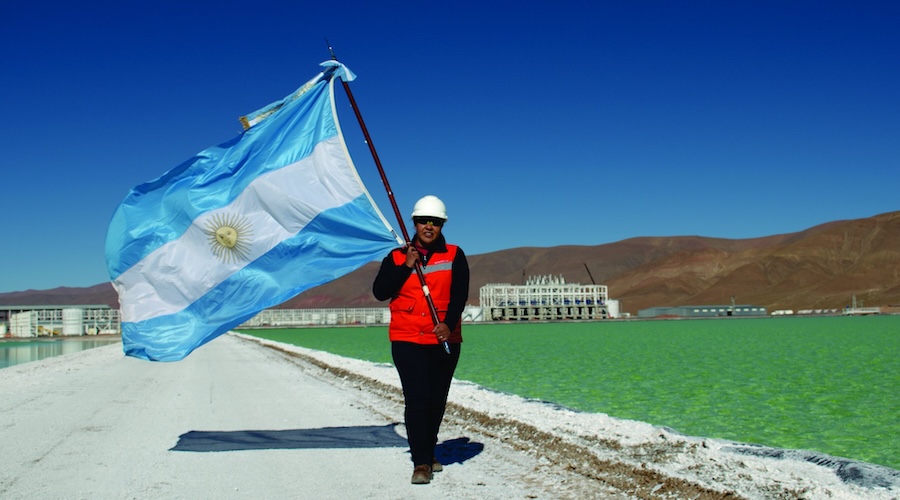
Argentina’s Congress approved on Thursday a government-backed bill pushed by the country’s right-wing President Javier Milei that opens sensitive high-altitude regions to mining, triggering warnings over water security and environmental risks.
Lawmakers in the lower house passed the reform 137–111, with three abstentions, clearing a final hurdle after Senate approval in February and setting the stage for the law to take effect once published in the official gazette.
The reform amends the 2010 Glacier Law by allowing provinces to define their own protection standards for glaciers and periglacial environments, a shift that critics say weakens safeguards for critical freshwater reserves.
“It strengthens Argentina’s appeal at a time when governments and buyers are racing to secure lithium and copper from jurisdictions that can move from reserves to production,” Mariano Machado, Americas analyst at Verisk Maplecroft, told MINING.COM.
Economy Minister Luis Caputo said in X the measure could generate $165 billion in exports by 2035 and create thousands of jobs, adding that “some provinces will be changed forever.” The central bank has separately estimated Argentina could triple mining exports by 2030 based on industry forecasts.
“With global copper demand expected to rise sharply and supply lagging, improved access to large deposits raises Argentina’s relevance in investment decisions,” Machado said.
Growing backlash
Opposition lawmakers and environmental groups say the reform weakens national safeguards for critical freshwater reserves, with critics arguing that devolving authority to provinces risks inconsistent protections across fragile ecosystems.
“Decentralizing glacier oversight could initially support investor confidence, particularly in mining-friendly regions with established pro-investment policies, but over time it may introduce regulatory fragmentation if political priorities shift,” Antonia Godoy, policy and regulatory affairs analyst at Plusmining, a Santiago, Chile-based consulting firm, said.
Machado said the shift could accelerate approvals in pro-mining regions but may also erode legal certainty for investors if standards diverge across jurisdictions.
Thousands of demonstrators gathered outside Congress on Wednesday, with sporadic clashes reported, as protesters carried banners reading “Water is more precious than gold!” and “A glacier destroyed cannot be restored!”
Opposition figures also accused authorities of limiting public input, saying just 0.3% of more than 100,000 applicants were allowed to speak against the proposal during hearings.
“Attempts by foreign organizations to interfere failed, and environmentalists determined to block the progress of the Argentine Republic were defeated once again,” Milei said, while also arguing critics would “rather see us starve than have anything touched.”
Water risk
Scientists and legal experts warn the changes could jeopardize water supplies for a large share of the population, with Enrique Viale, president of the Argentinean Association of Environmental Lawyers, saying the reform threatens resources relied on by 70% of Argentinians.
“Allowing mining in periglacial areas carries real environmental risk, as these zones play a key role in water regulation in arid Andean regions,” Machado said.
Godoy agrees. She said that mining in periglacial areas presents “real” environmental and technical challenges. “This is particularly true around water systems and freeze–thaw dynamics, though many impacts can be managed with strong standards and monitoring.”
Juan Ignacio Guzmán, head of mineral consulting firm GEM, has a different view. He said Argentina’s reform went in “the right direction”, as the new law combines economic development with technical and environmental considerations.
“Argentina is opening areas near glaciers, but not the glaciers themselves; therefore, it does not affect water reserves,” Guzmán said.
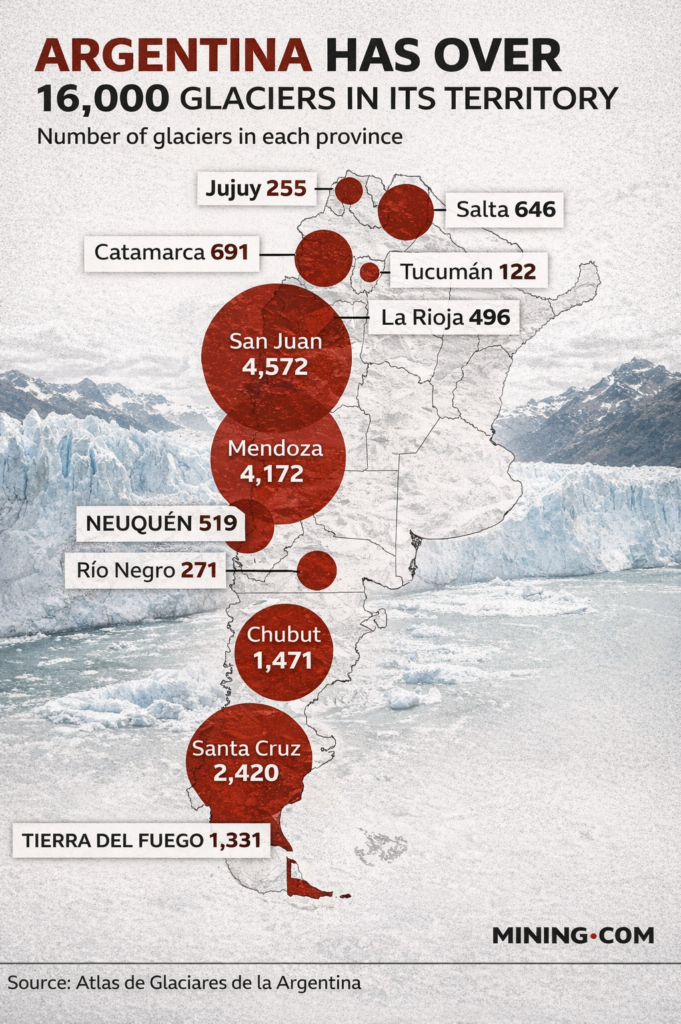
Since 2010, mining and industrial activity have been barred in glacier zones, which span nearly 17,000 ice bodies across 8,484 sq. km in the Andes and act as vital freshwater reserves.
“The economic upside is significant, with potential to unlock major copper, lithium and gold assets, but social licence remains a critical constraint,” Machado said.
Under the previous framework, a national scientific body determined protected areas, while the new law grants provinces authority to define which glaciers and periglacial zones can be developed, raising concerns about political and economic pressures shaping those decisions.
The University of Buenos Aires had earlier called for unified, science-based criteria, warning against fragmenting protections across jurisdictions.
Investment push
Provincial leaders in mining-heavy regions such as Mendoza, San Juan, Catamarca and Salta have backed the reform, arguing it clarifies rules and improves conditions for investment in critical minerals tied to the energy transition.
Milei’s government has rolled out tax, currency and legal incentives aimed at attracting global miners, including Glencore (LON: GLEN), BHP (ASX: BHP), Rio Tinto (ASX: RIO), Lundin Mining (TSX: LUN) and McEwen Mining (TSX, NYSE: MUX).
“The reform pushes Argentina closer to becoming a credible supplier in Western critical mineral supply chains, where political alignment and investable rules now matter as much as geology,” Machado said. “However, investors will be watching whether these rules hold up in courts and communities, as legal challenges and social opposition could keep risks — and financing costs — elevated.”
Rob McEwen, chairman of McEwen Mining, told MINING.COM that recent policy changes such as this reform have transformed Argentina’s investment climate.
“Since President Milei was elected in December 2023, he has introduced policies and legislation that are designed to encourage investment into his country, to reduce inflation,” McEwen said, pointing to tax cuts and the removal of exchange controls. “Argentina has changed.”
2026 is shaping to be a key year for Latin America, with resources at the centre of a growing global power struggle, as governments and investors focus on who controls critical minerals and the supply chains behind them. If the region matters to you, don’t miss MINING.COM’s Latin America series tracking the geopolitical forces reshaping it and why markets are increasingly driven by global alliances as much as local politics.
Countries in the series so far:
More News
{{ commodity.name }}
{{ post.title }}
{{ post.date }}
Comments