JV Article: Discoveries, ore sorting could lift Spanish Mountain
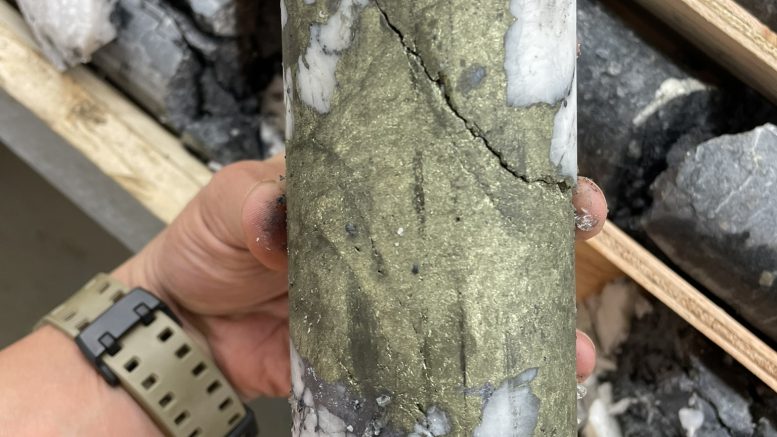
Spanish Mountain Gold (TSXV: SPA; US‑OTC: SPAUF) is betting recent in pit, near surface high-grade discoveries of 1 gram gold per tonne and higher, coupled with ore sorting can raise mill head grades, scale output and front‑load cash flow at its namesake project in British Columbia’s Cariboo district.
The company has launched particle and bulk sorting programs while a 9-10,000-metre drill campaign, with over 60% of drilling completed and pending assays, seeks to better define higher‑grade areas inside a proposed main pit shell. Spanish Mountain has already released the targeted higher-grade results cut in the new Orca Fault discovery area with the programs first four holes in press releases on Nov. 3 and 17.
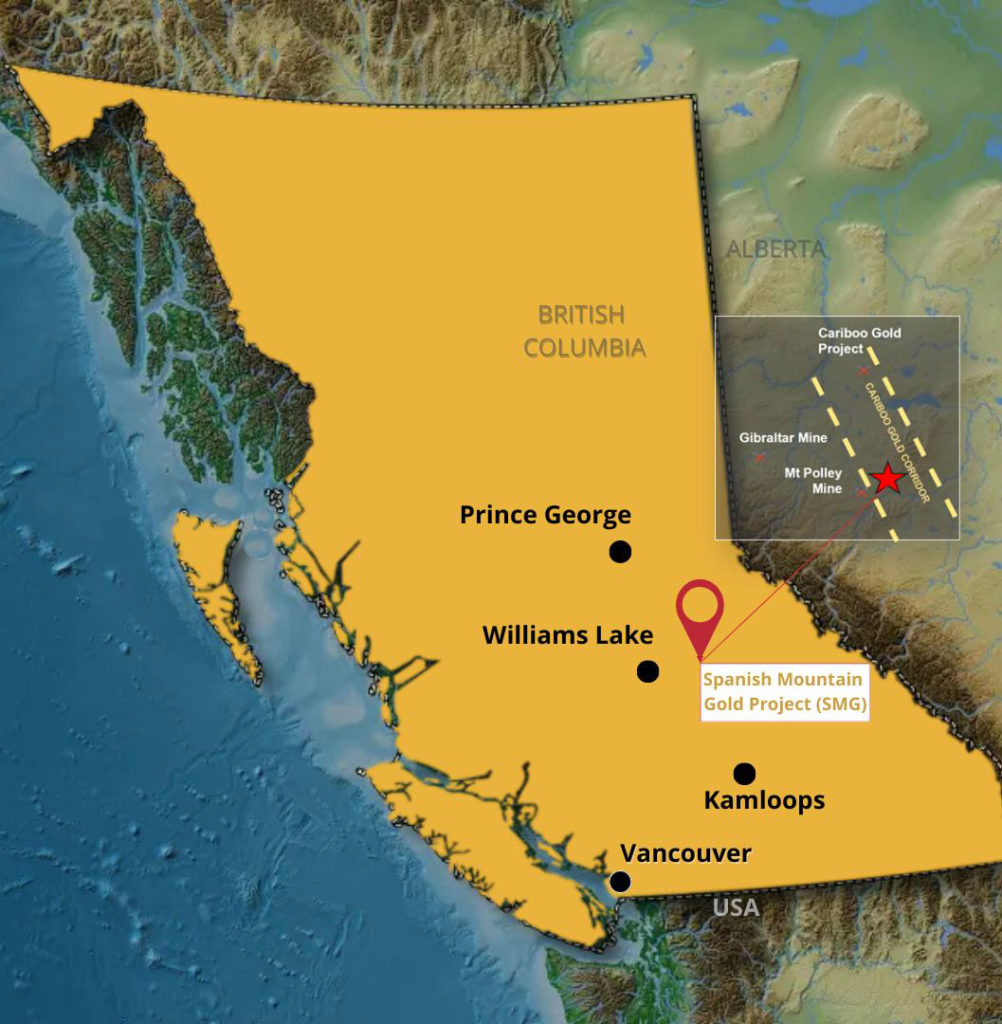
Eleven more holes in this area have been drilled pending assays. The site sits about 555 km north of Vancouver, near the community of Likely, with year‑round access. It’s in the same district where Osisko Development (TSXV: ODV; NYSE: ODV) is advancing the $890-million capex Cariboo gold project to construction and Artemis Gold (TSXV: ARTG) recently achieved commercial production at its Blackwater mine.
“We are extremely encouraged with the progress of our two-pronged strategy to improve head grade to the proposed mill,” President and CEO Peter Mah said.
“Firstly, our recent drill programs have demonstrated huge potential to discover new, continuous in-pit high grade,” Mah said. “Secondly, preconcentrating mineralization essentially moves more gold through the process plant, which together, these two initiatives could dramatically uplift processed grades, gold production and overall project economics.”
Project advantages
For investors increasingly focused on early cash generation and smaller footprints, sorting that strips out waste ahead of the mill could prove pivotal – particularly if infill drilling continues to link up higher‑grade structures in the near‑surface mine plan.
If the Orca Fault area infill drilling keeps mapping contiguous higher‑grade corridors inside the pit, the combined effect could improve the first decade of operations, according to Mah, where value is most sensitive. The pending trove of drill assays and the results from ore sorting are to show whether the company can improve the project’s math as it works towards making a development decision by 2027.
Head grade
Spanish Mountain is running two complementary test work streams. ABH Engineering is leading a particle‑scale program following past amenability work that indicated the deposit responds to X‑ray transmission sorting – tested to lift mill feed grades and gold produced.
In parallel, OrePortal is conducting a bulk sorting desktop study that examines ore heterogeneity and sensor options such as XRF and prompt gamma neutron activation analysis for shovel or belt applications at the front end.
“The logic is simple,” Mah said, “reject dilution and low‑grade material early, send a richer feed to the plant and tail fewer tonnes.”
Overall, the work will estimate capital and operating costs and model the impact on project value relative to the current study, the executive said. Both streams target next‑stage engineering decisions as the company advances towards a feasibility study. It is currently in the request for proposal competitive bidding process and expected to be awarded in the first quarter of next year.
Infrastructure supports the approach. A proposed 230‑kV/~60‑MW grid interconnection is in the second stage of BC Hydro’s system‑impact process. Sorting that trims haulage, reduces energy and tailings volumes would stack on these advantages.
Connecting the dots
The first two drill holes delivered broad, near‑surface intervals: 112 metres grading 0.77 gram gold per tonne starting at 84 metres in hole 25‑DH‑1292, including 35.8 metres of 1.18 grams. Drill hole 25‑DH‑1293 returned 102 metres grading 0.64 gram from 94 metres, including 20.25 metres at 1.28 grams per tonne.
The results confirmed continuity beyond 25 metres between closely spaced holes and reinforced a preferred drilling orientation (about 120° azimuth) to properly intersect vein sets, Mah said.
Split tubes
The wider land package still teases upside. That includes a 0.75‑metre interval at 719.26 grams gold per tonne in the K-Zone which was contained in a broader mineralized interval of 139 metres at 4.18 grams gold per tonne within 200 metres of surface and previously classified as waste.
This hole, the new Phoenix deposit and most of the 2025 drilling have not been included in the current resource estimate and economic study. It’s a reminder of the system’s ability to locally concentrate metal even within previously proposed mining limits. It supports growth and scalable production, begging the question of how high can the bar be raised, according to Mah.
PEA baseline
Spanish Mountain’s July preliminary economic assessment – prepared by a consortium led by Ausenco – re‑envisions the project at larger scale than the 2021 pre‑feasibility, extending mine life to 24.5 years and raising throughput to 26,000 tonnes per day.
It projects 3 million oz. of payable gold over the mine life, with 203,000 oz. averaged in the first five years, 122,000 oz. annually over the life, and a waste‑to‑resource strip ratio of 2:1. The all-in sustaining cost is estimated at US$1,338 per oz. and US$1,024 in the first five years. Recoveries average 89%.
The PEA envisions an open‑pit mine processing 26,000 tonnes per day with a base‑case after‑tax net present value (at a 5% discount rate) of $1 billion (US$710,000), an internal rate of return (IRR) of 18% and initial capital of $1.25 billion, using a gold price of US$2,450 an ounce.
At a spot gold price of US$3,900 an oz., the NPV and IRR improve to $3.2 billion and 41% with a payback of 1.7 years. This excludes the potential upsides of higher grades, ore sorting and Phoenix mentioned earlier. The flowsheet is conventional – grinding, gravity, flotation and carbon‑in‑leach – and features a move to filtered dry‑stack tailings and integrated water management.
The environmental design is a notable pivot, according to Mah. The plan adopts filtered dry‑stack tailings and a small, lined cell for any potentially acid‑generating fraction. It will also reuse all of process water with capture, treatment and discharge to provincial standards – aimed at reducing mine‑impacted runoff and avoiding discharges near nearby parkland.
The Main deposit hosts 292.1 million measured and indicated tonnes grading 0.44 gram gold per tonne for 4.16 million oz. of contained metal. The inaugural Phoenix estimate adds 25.4 million inferred tonnes grading 0.44 gram for 357,000 oz. However, Phoenix isn’t in the current economics, setting up a clear avenue for future inclusion as drill confidence improves and ore sorting is tested.
“Importantly, besides adding high grade mineralization, the study identified pre‑concentration among one of the most promising levers to enhance value at the next stage,” Mah stressed.
Catalysts
Management’s near‑term plan is to complete the ongoing drilling, finish the sorting workstreams and refresh the PEA to include sorting and higher‑grade domains before starting a feasibility study.
Mah points to “PEA upside” scenarios – specifically sensor‑based sorting to uplift mill head grade and possible inclusion of the Orca Fault area and Phoenix once resource confidence is higher – alongside a program of engineering and power‑line work. The company says it is advancing toward feasibility studies with a build decision targeted for 2027.
Engagement with First Nations and communities – which shaped the tailings and water plan – continues alongside baseline work, Mah said.
“We have the ounces, the jurisdiction and the infrastructure,” the CEO said. “Now it’s about proving we can build a mine the Cariboo can be proud of.”
The preceding Joint Venture Article is PROMOTED CONTENT sponsored by Spanish Mountain Gold and produced in co-operation with The Northern Miner. Visit: https://spanishmountaingold.com for more information.



Comments