PATH TO NET ZERO: Miners pursue decarbonization despite regulatory rollbacks
Top miners are advancing their decarbonization goals despite heightened geopolitical volatility.
US President Donald Trump has actively opposed efforts to reduce CO2 emissions, and his government has sought to eliminate emissions-cutting measures from US policy. But while the US is one of the largest buyers of metals, it is not a major producer. Miners that face pressure from the EU, Australia, Canada and other governments to get off fossil fuels have pushed ahead with measures to reduce their carbon footprints.
"When we are talking to the big mining houses, we get a sense that they are still very much full-on on these [emissions goals] and that there are new projects coming up adopting renewable energies, etc.," Perrine Toledano, director of research and policy at the Columbia Center on Sustainable Investment, told Platts, part of S&P Global Commodity Insights, in an interview.
As they enter the fourth quarter of a tumultuous 2025, 26 of the world's 30 largest mining companies by market capitalization have maintained net-zero or carbon neutrality goals, with 2050 as the most common target year. The other four did not have previously established net-zero goals.

Cutting emissions
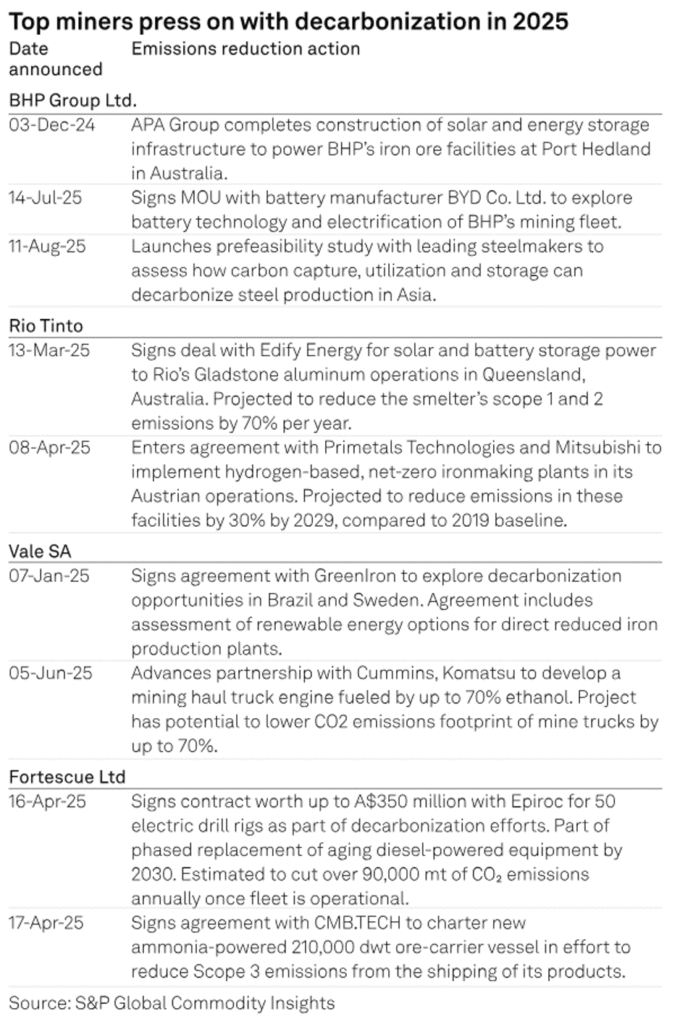
Leading miners have made strides in decarbonization efforts this year.
BHP Group Ltd., the world's top miner by market capitalization, signed an agreement in July with leading battery manufacturer BYD Co. Ltd. to explore battery technology opportunities and the electrification of BHP's mining fleet. The partnership includes a comprehensive investigation into electrification opportunities for heavy mining equipment and locomotives, as well as commercial and light electric vehicles.
The world's second-largest mining company, Rio Tinto Group, signed a deal in March with Edify Energy Pty. Ltd. for solar and battery storage power for Rio Tinto's Gladstone aluminum operations in Queensland, Australia. Rio Tinto estimates the project will reduce its Boyne aluminum smelter's Scope 1 and 2 emissions by 70%.
Agnico Eagle Mines Ltd., one of the world's largest gold producers, also made significant decarbonization advancements in 2025, Mohammed Ali, vice president of sustainability and regulatory affairs at Agnico Eagle, told Platts in an email.
Ali cited a wind energy project at Agnico Eagle's operations in Canada's Nunavut territory; clean power purchase agreements at sites in Kittilä, Finland, and Pinos Altos, Mexico; and solar energy installations in Quebec and at Pinos Altos.
A passing storm
Many in the mining sector regard the current political volatility and upheaval of conventional international trade relationships as a transient shock. Trump has sharply reversed course from his predecessor: the US Environmental Protection Agency is considering ending the endangerment finding for carbon dioxide, Republicans in Congress stripped incentives for electric vehicles, and Trump himself has railed against wind and solar energy. But miners press on.
"There's still a strong case to reduce emissions," Pierre Gratton, president and CEO of trade group Mining Association of Canada, told Platts. "Our companies recognize that there's a pendulum, and what might be happening now probably won't be the case in five years. They're not going to just change their focus or commitments simply based on changes in governments elsewhere."
While the US has significantly reduced its focus on climate and emissions goals, other markets are standing firm on their green ambitions. Canada and Australia — both major metal producers and mining jurisdictions — have climate reduction policies, and the EU, another major buyer, has given lower-carbon metals priority in trade.
"Our view on this is, okay, this is a storm now, but it will pass," Florian Anderhuber, deputy director general of trade group Euromines, told Platts. "Even though there were some rollbacks from others, the big picture hasn't changed. Net zero by 2050, that's still around."
Anderhuber highlighted significant decarbonization progress in the mining sector this year, including the startup of operations in May at Boliden AB's Ravliden zinc mine in Sweden, which uses an electric trolley line to bring ore to the surface and is nearly fossil-free.
"There is no real indication that the willingness to invest in climate-neutral production is going down," Anderhuber added.
While political and trade dynamics may make the road to net zero bumpier for some regions, emissions reduction will likely remain a sector focus.
"Geopolitical pressures can raise costs and volatility and speed of change, but do not typically alter the overall direction for decarbonization," John Diasselliss, principal US mining and metals leader at Deloitte, told Platts.
Business case for electrification
Miners see strong business cases for emissions reduction and efficiency measures. Eight out of the world's top 10 miners by market capitalization are aiming for fully electrified fleets, according to their latest sustainability reports.
"When we are talking to mines, they are in remote places, so getting fossil fuel there on a truck is often threatened by all kinds of logistical and safety issues," Toledano said. "They have realized all the benefits that renewable energies bring. They don't even need to be dependent on the grid; they can build it on their own land."
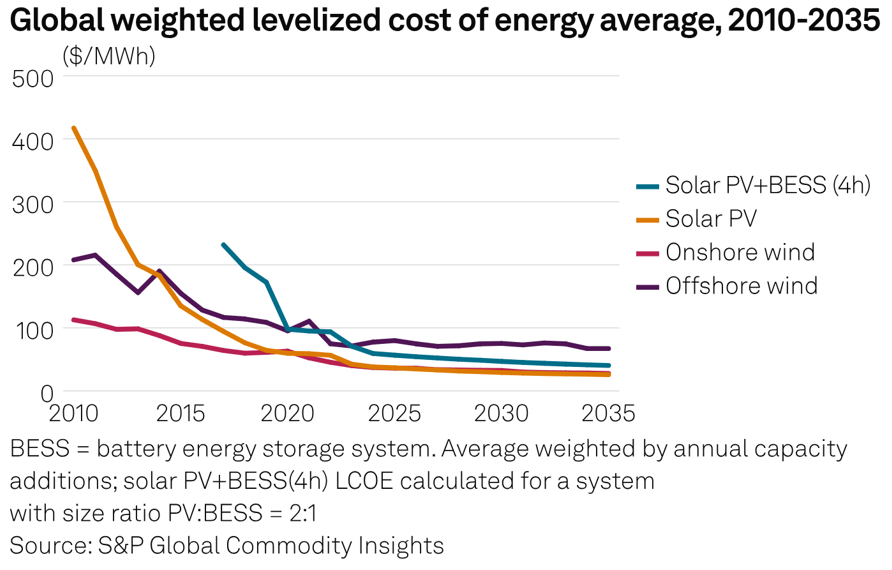
Toledano added that, as the clean energy sector develops, the cost of adopting green technologies is dropping.
The cost of renewable generation, such as solar and wind sources, has fallen 50%-80% over the past decade, according to a Commodity Insights report released Sept. 11. Solar photovoltaic and onshore wind were the cheapest power generation technologies globally in 2024, based on their global weighted average levelized cost of energy metric, and are expected to remain so through 2035.
"It's a combination of public subsidies, technology development and China giving a big impulse," Toledano said. "There is a big impulse coming on green technologies. When we started, batteries were very small. Now, mines can adopt batteries that have way more capacity. Batteries, renewables or a combination work way better than they used to."
Advancements in electric vehicle technology have also created attractive economic opportunities for the mining sector.
"Electrification is yielding very high efficiency gains," Anderhuber said. "When you look at the speed of electrified trucks, they are twice as fast as their diesel-powered counterparts. So you can create a business case."
Challenges ahead
Miners have rolled out decarbonization announcements in 2025, but these were likely underway before this year's geopolitical volatility took hold.
"Their investment plans started before the political swing," Toledano said. "We will need to wait a bit more to see if a real increase in [emissions reduction] penetration continues in the next couple years, because the political swing is really this year. It's hard to tell."
Hurdles remain in implementing operational decarbonization, especially in electrifying mine-site vehicles.
"Renewables can get the global mining sector to 50% emissions reductions, but then the hard work of eliminating diesel starts," Mary Stewart, partner at ERM, a global consulting firm focused on sustainability, told Platts.
"It is easier to electrify underground fleets both because of the availability of technology (it is proven to work) and because electrifying underground vehicles improves underground air quality. Diesel in haul trucks is a greater challenge — technology is not proven yet on whether fleet electrification is going to be in pit crushing and conveying, trolley-assist technology or giant batteries."
In its annual report released in August, BHP said it was delaying the displacement of its diesel fleet until after 2030 due to delays in EV technology.
"The pace of development of some decarbonization technology has slowed, particularly in relation to diesel displacement," BHP said in the report. "We expect our previously anticipated spend on operational decarbonization to now be in the 2030s, aligned with the delayed timeline for critical technologies to become commercially available."
Rio Tinto highlighted fleet electrification challenges in May, saying it is focusing its investments on "maturing this technology."
© 2024 by S&P Global Inc. All rights reserved. S&P Global, the S&P Global logo, S&P Global Commodity Insights, and Platts are trademarks of S&P Global Inc. Permission for any commercial use of these trademarks must be obtained in writing from S&P Global Inc. You may view or otherwise use the information, prices, indices, assessments and other related information, graphs, tables and images (“Data”) in this publication only for your personal use or, if you or your company has a license for the Data from S&P Global Commodity Insights and you are an authorized user, for your company’s internal business use only. You may not publish, reproduce, extract, distribute, retransmit, resell, create any derivative work from and/or otherwise provide access to the Data or any portion thereof to any person (either within or outside your company, including as part of or via any internal electronic system or intranet), firm or entity, including any subsidiary, parent, or other entity that is affiliated with your company, without S&P Global Commodity Insights’ prior written consent or as otherwise authorized under license from S&P Global Commodity Insights. Any use or distribution of the Data beyond the express uses authorized in this paragraph above is subject to the payment of additional fees to S&P Global Commodity Insights. S&P Global Commodity Insights, its affiliates and all of their third-party licensors disclaim any and all warranties, express or implied, including, but not limited to, any warranties of merchantability or fitness for a particular purpose or use as to the Data, or the results obtained by its use or as to the performance thereof. Data in this publication includes independent and verifiable data collected from actual market participants. Any user of the Data should not rely on any information and/or assessment contained therein in making any investment, trading, risk management or other decision. S&P Global Commodity Insights, its affiliates and their third-party licensors do not guarantee the adequacy, accuracy, timeliness and/or completeness of the Data or any component thereof or any communications (whether written, oral, electronic or in other format), and shall not be subject to any damages or liability, including but not limited to any indirect, special, incidental, punitive or consequential damages (including but not limited to, loss of profits, trading losses and loss of goodwill). ICE index data and NYMEX futures data used herein are provided under S&P Global Commodity Insights’ commercial licensing agreements with ICE and with NYMEX. You acknowledge that the ICE index data and NYMEX futures data herein are confidential and are proprietary trade secrets and data of ICE and NYMEX or its licensors/suppliers, and you shall use best efforts to prevent the unauthorized publication, disclosure or copying of the ICE index data and/or NYMEX futures data. Permission is granted for those registered with the Copyright Clearance Center (CCC) to copy material herein for internal reference or personal use only, provided that appropriate payment is made to the CCC, 222 Rosewood Drive, Danvers, MA 01923, phone +1-978-750-8400. Reproduction in any other form, or for any other purpose, is forbidden without the express prior permission of S&P Global Inc. For article reprints contact: The YGS Group, phone +1-717-505-9701 x105 (800-501-9571 from the U.S.). For all other queries or requests pursuant to this notice, please contact S&P Global Inc. via email at [email protected].

Comments