Unlocking Zimbabwe’s Lithium Potential with Sensor-Based Sorting
Bikita and the Future of African Lithium
As the world accelerates toward electrification, few minerals are as strategically important as lithium. Demand for lithium-ion batteries is projected to soar in the coming decade, driving intense interest in new supply sources across Africa. Zimbabwe, home to some of the oldest hard-rock lithium mines on the continent, is emerging as a vital player in this supply chain.
At the heart of this transformation is Bikita Mine, a long-established pegmatite deposit in Masvingo Province. With proven reserves and a history of lithium production, Bikita is now embracing cutting-edge technology to ensure it can meet the scale, quality, and sustainability demands of the global battery sector.
The Challenge of Complex Ore
Like many lithium pegmatites, Bikita hosts a mixture of valuable spodumene and lepidolite alongside significant amounts of quartz, feldspar, and dark waste rock. While these ores are rich in potential, they also present metallurgical challenges: variable feed grades, dilution from barren material, and high downstream processing costs.
Traditional beneficiation relies on crushing, grinding, and flotation…processes that consume significant amounts of energy, water, and reagents. The more waste that enters the plant, the higher the operating cost and the lower the overall efficiency. The challenge for Bikita was clear: how to upgrade ore at the front end of the flowsheet and reduce unnecessary processing of barren rock.
Testing the Potential of Sensor-Based Sorting
In 2024, Bikita partnered with HPY Technology to evaluate the role of sensor-based ore sorting in their operations. Representative samples from the mine were sent to HPY’s laboratory where they were tested using the company’s advanced optical and X-ray based sorting systems.
The trials focused on the -25+7 mm size fraction, representing the bulk of plant feed. Using HPY’s imaging systems, mineralized ore and barren gangue were classified into distinct categories: white and purple spodumene-bearing rocks, lepidolite-rich ore, and dark hornfels waste.
The results were striking. Depending on the sorting scenario applied:
- Head grade: The feed material averaged around 1.6–1.7% Li₂O.
- Waste rejection: By identifying and removing dark hornfels and mica-rich ore, waste rejection reached up to 36%.
- Concentrate grade: The upgraded product achieved Li₂O grades as high as 2.2–2.3%, with cesium grades also showing marked improvement.
- Recovery: Lithium recoveries remained robust, ranging from 90% to over 98% depending on the configuration.
- Tailings: Li₂O in tailings dropped to as low as 0.2–0.7%, confirming effective waste separation.
These results confirmed not only the feasibility of sensor-based sorting at Bikita but also the potential for significant operational gains.
From Testwork to Deployment
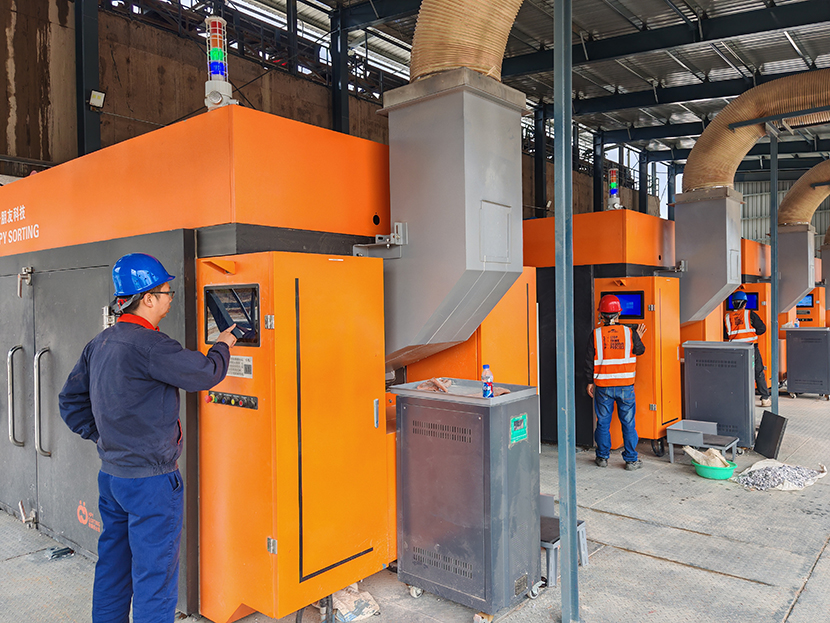
Encouraged by the laboratory success, Bikita has now installed six HPY Insight Series ore sorters on site. These industrial-scale units are designed to handle high throughputs with the precision required for complex pegmatite ores.
The Insight Series utilizes VIS-HD camera technology, which captures high-resolution images of every particle on the belt. By training algorithms to recognize the unique visual signatures of spodumene compared to barren material, the system can make split-second decisions to separate ore from waste.
The result is a highly selective, non-invasive sorting process that requires no chemicals or water. Instead of processing every tonne of material mined, Bikita can now upgrade its feed before it enters the plant — increasing the value of each tonne while reducing strain on downstream circuits.
Driving Efficiency and Sustainability
The benefits of sensor-based sorting at Bikita are multifold:
- Higher profit margins: By feeding a higher-grade product to the concentrator, overall lithium recovery increases, and more concentrate can be sold into the booming battery market.
- Reduced operating costs: Rejecting barren rock upfront cuts down on crushing, grinding, and flotation requirements, saving power, water, and reagents.
- Extended resource life: More efficient use of the ore body ensures that marginal zones can be economically mined, maximizing resource utilization.
- Lower environmental footprint: Less waste in the plant means reduced tailings volumes and a smaller overall environmental impact.
In short, the technology aligns with both the economic and sustainability goals that define the modern mining industry.
Positioning Zimbabwe in the Global Supply Chain
Bikita is not just another lithium mine — it is a cornerstone of Zimbabwe’s mining history. With operations dating back more than a century, Bikita has built a reputation as one of Africa’s most important hard-rock lithium producers. Yet, like many mature operations, the mine was facing the natural limits of its life cycle. Reserves were being depleted, and the economics of processing increasingly lower-grade material posed challenges for long-term viability.
The adoption of HPY’s sensor-based sorting technology has transformed this outlook. By rejecting waste at the front end and selectively upgrading ore, Bikita can now extend its resource base and economically recover zones that were once considered uneconomic. In effect, sorting has given the mine a cleaner, more efficient pathway to add years of production without the need for costly plant expansions.
This innovation also aligns with Bikita’s broader ESG commitments. The company, recognized in 2024 as a “Responsible Mining and Clean Energy Champion,” has steadily improved its sustainability performance, cutting its ESG risk score from 48% to 40% in just one year. By reducing energy and water consumption while minimizing tailings volumes, sensor-based sorting directly supports these goals, reinforcing Bikita’s position as both a technological leader and a responsible steward of Zimbabwe’s mineral wealth.
At the same time, Bikita’s leadership role in the Lithium Producers Association underscores its strategic importance for Zimbabwe’s future. By marrying a century-long legacy with modern innovation, Bikita is helping ensure that Zimbabwe is not only a reliable source of lithium for global markets but also a standard-setter for responsible, future-ready mining across Africa.
HPY Technology: Partnering in Transformation
For HPY Technology, the project at Bikita represents more than a single deployment, it is a showcase of how sensor-based sorting can transform the economics of lithium mining. With a growing portfolio of installations across commodities and continents, HPY is proving that ore sorting is no longer an experimental add-on but a central tool for future-ready mines.
The six Insight Series sorters at Bikita mark one of the largest lithium-focused deployments in Africa. They stand as proof of concept for other pegmatite producers in the region: upgrading ore at the belt can deliver immediate improvements in grade, cost, and sustainability.
Smarter Mining for a Sustainable Future
The global energy transition depends on a secure and sustainable supply of lithium. By combining Zimbabwe’s resource base with HPY’s advanced sensor-based sorting technology, Bikita Mine is showing how innovation can unlock hidden value, reduce costs, and create a cleaner pathway to the critical minerals of the future.
As the industry looks ahead, projects like Bikita highlight an essential truth: smarter mining is not just about producing more, it’s about producing better.
{{ commodity.name }}
{{ post.title }}
{{ post.date }}

Comments