Billionaire turns Pentagon into Trump’s defense investment wing
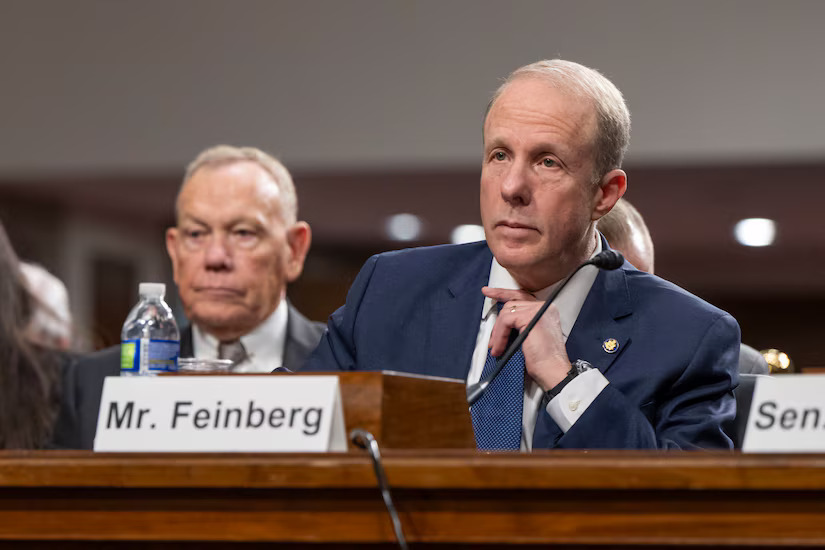
Just four months into his tenure at the Pentagon, private equity billionaire Steve Feinberg has landed his first big deal: a $400 million bet on the US’s only miner of rare earth elements, a key commodity in the rivalry with China.
The equity investment in MP Materials Corp. – the first in modern Pentagon history – was a priority for the Cerberus Capital Management co-founder, who took over as deputy secretary of defense in March, according to people familiar with the efforts. The deal, which comes alongside $1 billion in financing from JP Morgan Chase & Co. and Goldman Sachs Group Inc., is to be the first of several aimed at leveraging Pentagon support and Wall Street cash to jump-start efforts to break China’s lock on global supplies of rare earth minerals, the people said.
Feinberg, who has made few public comments since taking office, declined to respond to written questions for this article. In his confirmation hearing, he vowed to make unleashing US critical-minerals production a priority and highlighted the need to accelerate use of the Defense Production Act – a law dating back to the Korean War that was used for the MP deal.
US dependence on Chinese supplies of rare earth minerals – used for everything from cars to missiles to data centers – emerged as a key vulnerability for the administration when Beijing cut off supplies this spring in retaliation for President Donald Trump’s tariffs, driving the White House to the negotiating table.
Pentagon officials immediately began canvassing the industry for ways to ramp up production of permanent magnets, an especially critical product made from neodymium-praseodymium oxide.
Feinberg pushed the MP deal despite objections within the Pentagon about using DPA authority, which typically involves loans, to take a 15% equity stake that would make the Pentagon MP’s largest shareholder, according to people familiar with the matter. The company highlighted the “unconventional use” of the law, along with the fact the Pentagon will need to secure more funding from Congress for the deal, among the risk factors it disclosed to investors.
US administrations have for years sought to develop domestic supplies of the minerals to counter China’s grip on 85% of global processed supplies. But the domestic industry has struggled for decades with high costs and brutal competition from Beijing.
“DoD selected a unique approach to this agreement to account for the difficulties in establishing and sustaining production of critical rare earth magnets in a market environment in which China controls much of the supply chain,” a Pentagon spokesperson said.
The MP deal includes a 10-year agreement to establish a price floor that’s nearly double current market prices to ensure profitability, as well as a Pentagon commitment to make sure all the so-called permanent magnets the Las Vegas-based company will produce at a new factory find either defense or commercial customers.
The deal, followed days later by a $500 million pact with Apple, catapulted MP’s stock to a record. Hopes of similar agreements boosted share prices across the small US rare earth sector.
Feinberg is eager to build national champions across key sectors to boost US competitiveness, according to people familiar with his thinking. He’s personally making decisions on which companies will get Pentagon funding through the DPA, which allows the government to support strategic projects. He co-signed the MP deal with his boss, Defense Secretary Pete Hegseth.
“Taking a partial stake is something I have not seen,” said William Greenwalt, a former deputy undersecretary of defense for industrial policy. “It is much easier for DoD to own the factory or means of production and bring a contractor in to perform the work.”
Feinberg made his name in private equity and has deep experience dealing with defense contractors. He’s also known on Wall Street for keeping a tight circle of staff, a characteristic that’s carried over to his Defense Department post, according to people familiar with the situation. Secrecy around the MP deal was especially tight.
“Even though there’s significant government equity, they’re also moving a lot of capital,” said Gracelin Baskaran, director of the critical minerals security program at the Center for Strategic and International Studies. “That’s what you want out of federal dollars — you want federal dollars to mobilize a lot of private capital.”
The bet on MP is a potentially risky one. The last company that owned the deposit MP is now developing went bankrupt. Most of the expertise in refining the materials and turning them into magnets is in China.
“There’s a lot of good faith in this, but for the taxpayer I’m concerned,” said David Abraham, a critical minerals specialist at Boise State University. “We’ve chosen a company that’s never made magnets to rely on to make all the magnets.”
(By Joe Deaux)

{{ commodity.name }}
{{ post.title }}
{{ post.date }}
Comments