China investors swap gold for stocks as ETFs see record outflow

Investors in China look to be pivoting from gold-backed exchange-traded funds into local equities, putting outflows on course for a record this month as shares push higher and bullion prices stall.
The four, major onshore gold-backed ETFs — Huaan Yifu, Bosera, E Fund and Guotai — have seen combined net outflows of about 3.2 billion yuan ($450 million) in July, according to data compiled by Bloomberg. At the same time, the CSI 300 Index has climbed 5.5%, its strongest showing since last September.
“Some investors are taking profits from gold and rotating into equities to chase stronger momentum,” said Steve Zhou, an analyst at Huaan Fund Management Co., which issues China’s biggest gold-backed ETF. Retail investors have been the main drivers of the outflows, he said.
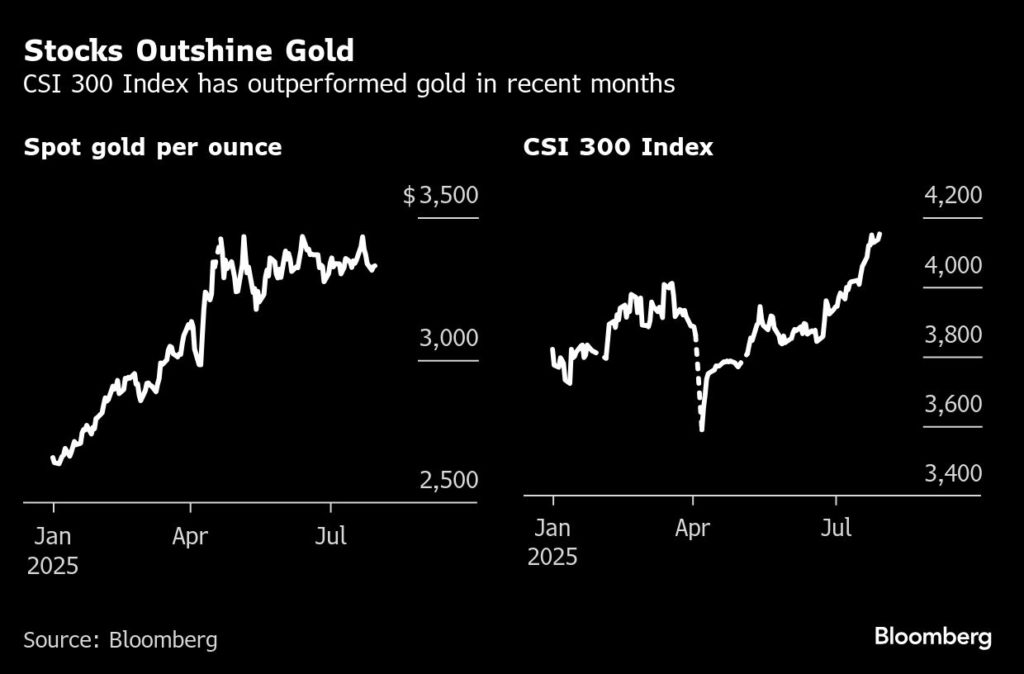
China is the largest physical bullion market, and while the nation’s ETFs are small compared with global counterparts, they are one of the easier ways for local investors to get exposure to the metal, and are a key barometer of sentiment. Access to investing in gold directly is limited since banks stopped the opening of bullion-trading accounts for individuals five years ago.
Gold has been one of the strongest performing major commodities so far this year, rallying by about a quarter on stronger haven demand, a weakening US dollar, and buying by central banks. Still, the bulk of that advance was concentrated in the first four months of 2025, with prices setting a record in April. Since then, they have largely tracked sideways, even as banks including Goldman Sachs Group Inc. have flagged potential for further gains.
At the same time, stock markets in China have responded positively to a high-profile push by the authorities to curb cut-throat price wars and what’s seen as excessive competition and overcapacity across the vast industrial sector. The drive to combat so-called involution is expected over time to improve profitability and corporate earnings, making equities more attractive.
To be sure, there’s no sure-fire way to determine that funds garnered from exits from gold-backed ETFs have been redirected into local equities. Aggregate inflows into equity ETFs in Shanghai and Shenzhen have been negative in recent weeks, although they would not capture stock-specific investments.
Chinese commodity stocks stand out as one group that’s risen. After lagging the broader market for three years, the sector has emerged as a top performer this year, aided by the supply-side reform, as well as the recent launch of a $167 billion hydropower project in Tibet.
“My view is that equities are likely to stay strong in the near term, but gold probably won’t weaken much,” said Kenny Ng, a strategist at China Everbright Securities International. Eventually, China gold ETFs “may stay relatively steady, without any sharp inflows or outflows,” said Ng.
(By Yihui Xie)

{{ commodity.name }}
{{ post.title }}
{{ post.date }}
Comments