China is taking on mining giants to reorder a $190 billion market
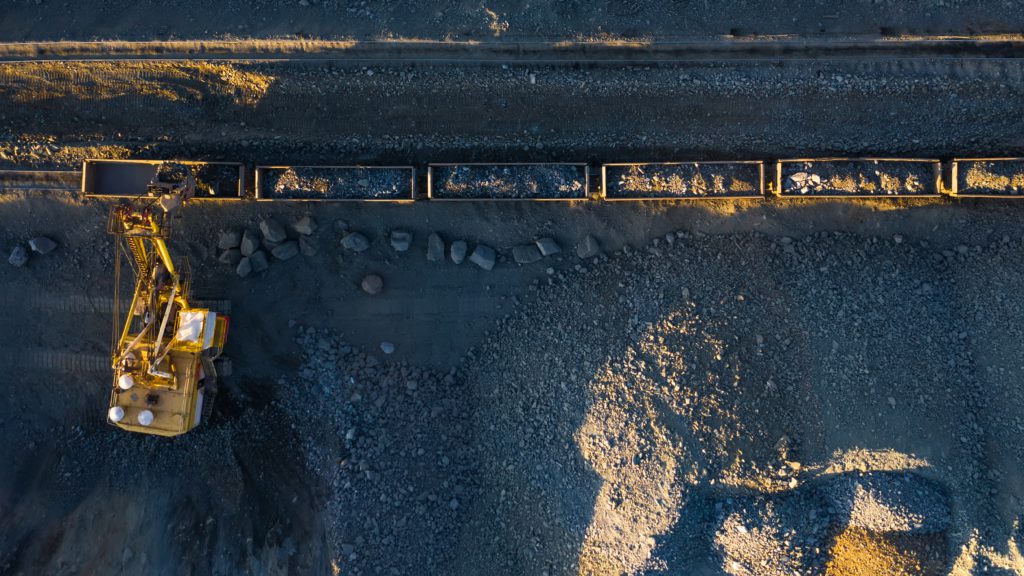
China has sought for decades to turn its clout as the world’s largest commodities consumer into pricing power. With iron ore — the most traded raw material after oil, and the backbone of global economic expansion — it is closer than ever to success.
The engine behind the current campaign is China Mineral Resources Group Co., an opaque company directly under the country’s central government which has been locked in a confrontation with mining giant BHP Group Ltd. for months. This is already the most significant commercial clash in nearly two decades between the country and one of its top suppliers, and has sent shockwaves through the industry.
Those heated negotiations are now reaching a critical juncture. A new chief executive is set to take the helm at BHP, with every incentive to resolve a deepening crisis. For China, meanwhile, a month-long war in the Middle East has only underscored the importance of CMRG’s mission, as the conflict deals another blow to US financial dominance and reinforces the urgency of holding more sway in key commodity markets.
“CMRG is not just an economic instrument,” said Marina Zhang of the University of Technology Sydney’s Australia-China Relations Institute, who works on supply chains and global power dynamics. “It is a geopolitical blueprint.”
This account of CMRG’s rise is based on interviews with more than 20 industry executives, financiers, traders and others involved working with the institution, all of whom asked not to be named given the sensitivity of the discussions. They reveal the depth of CMRG’s relationships within China’s economic power structure as well as nascent plans to expand its reach beyond iron ore.
CMRG and BHP declined to comment.
With a vast steel industry that consumes more than 70% of seaborne iron ore, China has consistently pushed for greater influence. Yet even after it overtook Japan as the leading importer in the early 2000s and ultimately forced a dramatic change in pricing — the industry moved toward shorter-term index-linked contracts, more reflective of market levels — that ambition remained unfulfilled.
To fix that, CMRG was set up in July 2022, after years of preparation, by the Communist Party’s central committee and the State Council, with industry veteran Yao Lin at the helm and a direct line to President Xi Jinping’s economic czar. The world’s biggest miners acknowledged the new arrival with some confusion, but said the trade would continue as normal. After all, most had been negotiating with Chinese buyers for decades, enjoying blockbuster margins.
This was true — until it wasn’t.
In September, CMRG set its sights on BHP. This was the first step in a new and more aggressive direction, with a confidence reflecting its backing by authorities in Beijing and a willingness to take on its largest suppliers — beginning with iron ore.
As China prepared for its early October holidays, executives at several of China’s largest steel producers recall receiving telephone calls out of the blue. The order coming over the line was simple and to the point: Stop using Jimblebar. A type of iron ore shipped from Western Australia by BHP was now out of bounds. The directive, targeting a product that is crucial for some steelmakers to balance cost and performance, left them stunned, they said.
The target was no accident. CMRG had spent months negotiating long-term supply contracts with BHP, and those talks had stalled. Back in 2010, BHP had led the pricing shift that ultimately reduced the scope for bilateral bargaining, and had the clout to set the tone once again. By choosing Jimblebar, a medium-grade product sold almost exclusively to the world’s top-consuming market, China could also deal a targeted blow.
BHP initially gave no public response to what it later described as sometimes challenging commercial negotiations. Privately, however, its team in Singapore acknowledged from the start that there was more at stake, as did the miner’s rivals. Here was the first step in a concerted effort to change the way that China does business with giant foreign producers, one that injected an uncomfortable measure of uncertainty into a mining industry built on predictability and vast scale.
Not since the arrest of former Rio Tinto Plc executive Stern Hu in 2009 — a corruption case that highlighted a breakdown in relations between China’s mills and big miners — had ties been as fraught. Hu pleaded guilty to accepting bribes and was jailed in 2010. At the time China denied it was using the judicial process as an economic policy tool.
The fight
Escalation was swift. After BHP did not respond as CMRG had hoped to the Jimblebar move, the buyer took another step and within days urged major mills and traders not to take on new dollar-denominated seaborne cargoes from the miner. (It did allow volumes that had already arrived in China to remain tradeable.)
And the ratcheting-up continued. In November, a second BHP product, Jingbao fines, a minor product similar to Jimblebar, was added to the banned list, specifically to subvert blending efforts. CMRG then asked authorities overseeing port terminals to raise storage costs in order to curb hoarding by foreign miners and traders.
It had become a full-blown standoff.
Then, CMRG indicated it would put even more BHP products on the same restricted list, according to people directly involved in the conversations, citing telephone calls. That began to test limits. Mills reacted, rushing to move iron ore from stockpiles to their plants, shifting popular grades like Newman fines and lumps and Mining Area C fines out of ports in northern and eastern China — enough to prompt CMRG to indicate last month it would ease Jimblebar constraints temporarily.
International investors, many of whom had largely dismissed CMRG until the crisis broke, were now pressing BHP, along with its major iron ore rivals, Rio Tinto and Vale SA, seeking explanations and a better understanding of the potential implications. Australia — whose relationship with China is still thawing after a years-long diplomatic freeze that ended in 2022 — stepped in to note concern at the end of last year, with Prime Minister Anthony Albanese expressing a desire to see the crisis resolved swiftly.
Speaking during the group’s earnings call in February, BHP chief executive officer Mike Henry said commercial negotiations were tough but the overall relationship remained “on track.” Rio Tinto told its investors it continued to engage. Iron ore producer Fortescue Ltd. has said that CMRG is trying to get more from its relationships, and adding it was responding, including with Chinese equipment purchases.
The iron ore market is deep and complex enough to withstand a crisis, not least because in this instance not every channel was cut off. BHP’s cargoes sold through private tenders at discounts are finding bold Chinese buyers willing to defy the directive — CMRG still needs to rely on compliance. Blending has also proved a very effective means of evading some checks.
Still, CMRG’s tactics — particularly its use of indirect methods, like cargo inspections at ports carried out by other government agencies — have kept up pressure, people involved in the trade said. They have also underscored CMRG’s remarkable ability to operate outside China’s conventional bureaucratic channels. While formally a centrally administered state-owned enterprise with trading ambitions, in practice the group works like a State Council coordinator and can press ministries to step in around matters it considers strategically important.
And the methods and contradictions are also creating trouble with mills in what remains an industry rooted in China’s regions, not Beijing. For them, CMRG is an effort to demonstrate that existing conglomerates and industry groups, like the China Iron and Steel Association, known as CISA, have not done enough. It’s an effort to take greater control. Several state-owned traders have also shown that it is possible for some to work around CMRG’s directives, risking disfavor for profit, the people said.
First steps
The ideas behind CMRG had been circulating in policy circles well before the group formally existed. In late 2020, the Chinese government laid out a plan to promote joint procurement of iron ore and explore the establishment of a more “open, fair and transparent” pricing system — the first step toward a unified negotiating front. Then during the following year’s annual congress meetings, He Wenbo, ex-chairman of the predecessor of China Baowu Steel Group Corp. and CISA’s head, publicly called for the creation of groups to develop iron ore production overseas. (Baowu would become a major stakeholder in the giant Simandou project in Guinea.)
Other industries that are dependent on imports have taken the coordinated buying approach. There is a copper-purchasing alliance known as the China Smelter Purchasing Team, or CSPT, and there have been discussions among China’s state-owned refining giants about forming consortia to jointly procure crude oil.
Yet for iron ore, Beijing went one step further — a standalone, centrally administered state-owned enterprise operating independently of individual industry players, and a direct line to the very top of the political establishment.
Even today, few in the industry are clear on how exactly what began as a purchasing consortium — initially just one part of a package aimed at strengthening China’s position in iron ore — evolved into a behemoth. Today it has a registered capital of 20 billion yuan (roughly $2.9 billion), challenges international miners and is reshaping the way the commodity is bought and priced.
Crucially, it is also beginning to show interest in other metals, particularly copper, according to several officials, who suggested the group’s name already points to this wider remit. In December, a CMRG researcher gave a presentation on the global copper market at a forum in Shanghai. No formal move has been decided, they added.
“They have the lion’s share of representation of steel mills,” Dino Otranto, CEO of Fortescue Metals, said in January, pointing to multiple meetings with the group and an effort to shore up the Australian miner’s leadership in China. “They are the China Mineral Resources Group, so we see them currently as just the procurer of iron ore, but they are actually a lot bigger than that — they are an investment vehicle.”
There are plenty of reasons for skepticism, even in iron ore. After all, Beijing has tried to exert more control before, with only fleeting results, and the market has only become more complex since.
“The genie is out of the bottle. The market has become more financialized,” said Pascale Massot, a political scientist at the University of Ottawa, who has written on CMRG and China’s negotiations. “If CMRG had been created with the same amount of gravitas in 2006, we would be in a different place today, but this world has been allowed to evolve for 15 years. That creates a whole lot of stakeholders that have a say in this actual system.”
Proponents, though, argue this time is different, thanks to political support and a far more centralized political structure across the country. In this context, it matters that oversight of the group sits at the top of the bureaucratic firmament. CMRG occupies an unusually elevated position, thanks to Yao’s links to Beijing’s top leadership.
That status has allowed the group access to a wider range of levers, from prompting environmental and tax inspections of mills that do not align with its coordination efforts to higher port fees. All have been used in the spat with BHP — though not without raising questions about overreach.
CMRG has already displaced traditional trading houses as one of the top spot traders in China, with dozens of cargoes on the water in any given month, treating inventories across over a dozen ports like a strategic reserve. That physical presence matters. CMRG doesn’t just talk about price — it can shape flows, deciding when ore is bought, how it moves, and how quickly it clears Chinese ports.
Price maker
For all the lingering questions around its structure and mechanics, CMRG has been open about the problems it sees with the seaborne iron ore market, worth roughly $190 billion at current prices. Analysts from its research arm have presented at domestic and international conferences, emphasizing the need for the world’s largest consumer to have a say. In the context of a market shaped by daily spot trades, with contracts overwhelmingly priced in US dollars, China’s fragmented domestic steel sector struggled to replicate the past power of Japanese peers, many of whom were shareholders as well as buyers.
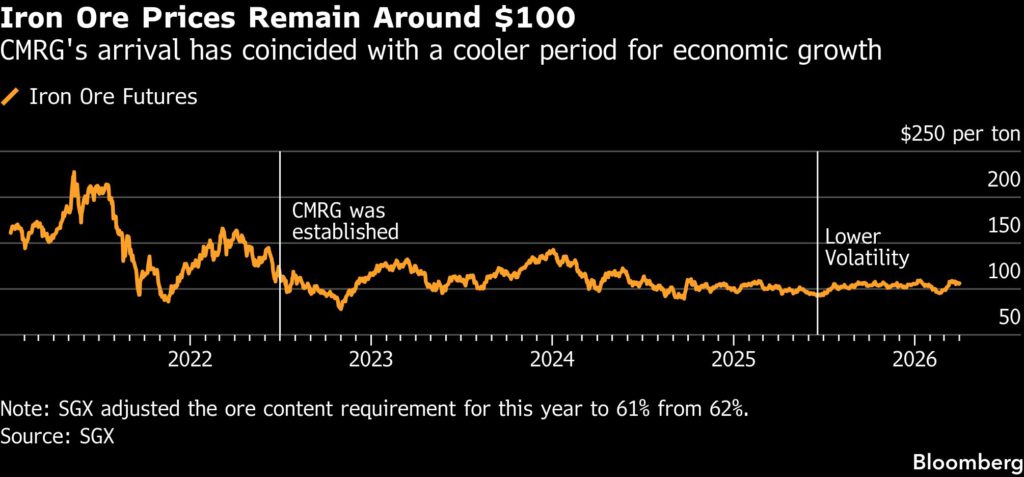
At one such event in October, attended by Bloomberg, CMRG described current global pricing mechanisms as irrational, arguing that benchmarks rely too heavily on thin spot trades and overseas futures markets — instead, Chinese alternatives should be used as a closer reflection of supply and demand.
China’s steel association has urged steelmakers to adopt a newly launched domestic port-side spot index as a core reference in long-term negotiations, explicitly shifting pricing away from international gauges.
Rio Tinto and Fortescue have already agreed to drop the Platts index for early 2026 shipments, switching to an alternative as a compromise, under pressure from CMRG, according to people familiar with the situation. The largest owner of Rio Tinto’s London shares is the Aluminum Corporation of China Ltd. Fortescue, meanwhile, has a major Chinese shareholder — a subsidiary of Hunan Valin Iron and Steel Co. — and is heavily exposed to Chinese lenders. Both miners also extended long-term supply contracts with the state buyer by six months into 2026.
Rio Tinto and Fortescue declined to comment.
BHP is a different beast.
The world’s largest miner was central to the creation of the current pricing system. Back in 2010, under then-CEO Marius Kloppers, BHP led the shift toward index-linked spot pricing, reshaping the market.
And the stakes are high for BHP, as it tries to turn its path toward growth commodities but needs the generous margins of its iron ore business. The miner has announced Americas boss Brandon Craig — who before his current role was asset president for the iron ore business in Western Australia — will take over from Henry in July. He may well be eager to reset, even without a full overhaul of the negotiating team.
Craig is set to travel to Beijing imminently as he prepares for the role, for fresh conversations.
“Australian iron ore, and BHP’s volumes in particular, remain structurally embedded in China’s steel supply chain in terms of scale, quality consistency and logistics reliability,” said David Cachot, an iron ore research director at Wood Mackenzie Ltd, adding BHP would also struggle to find a market large enough to absorb iron ore at the necessary scale.
“Neither side holds a credible exit,” said Cachot. “China cannot replace BHP’s iron ore, and BHP cannot replace China.”
With an eye on the supply disruption wrought by Russia and now US strikes in the Persian Gulf, though, it is clear that CMRG will certainly try.
“China wants to make sure it will continue to develop and improve its terms of trade against major suppliers,” said Weihuan Zhou, a professor at UNSW Sydney who studies the country’s integration into the international economic order. “China can’t just continue to be disadvantaged.”
(By Alfred Cang and Katharine Gemmell)
{{ commodity.name }}
{{ post.title }}
{{ post.date }}
Comments