China pulls silver from global markets to meet surging demand
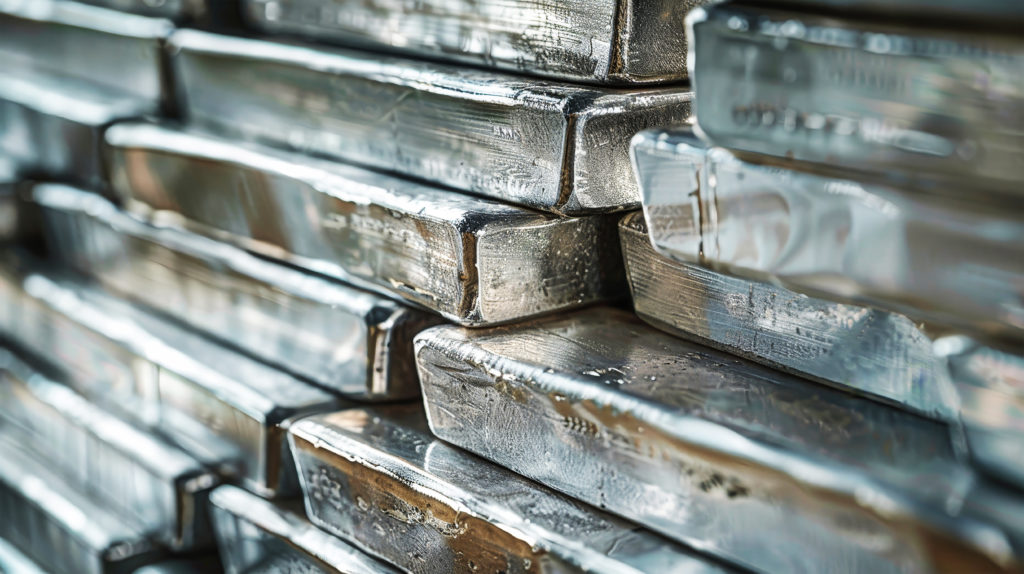
China’s ravenous appetite for silver lifted overseas purchases to an eight-year high at the start of 2026, as importers fed a surge in industrial and investment demand.
The world’s biggest buyer pulled in over 790 tons in the first two months, including nearly 470 tons in February, the highest ever for that month, according to Chinese customs data on Friday. Strong demand has pushed local prices well above international benchmarks, whittling down already-low exchange stockpiles and hoovering up metal from abroad.
Silver prices have never had such a volatile start to a year, soaring about 70% on a wave of speculative buying from China and elsewhere, before abruptly giving up their gains at the end of January. The strong import figures suggest physical consumption in China has been sustained despite shifts in trading flows.
Demand has come from both retail investors piling into silver bars, an alternative to increasingly pricey gold, and solar manufacturers front-loading production ahead of the removal of export tax rebates on April 1. The solar industry consumes about a fifth of annual supply, and is overwhelmingly located in China.
Demand for physical bars is very strong, and solar cell manufacturers “are going gangbusters,” said Rhona O’Connell, head of market analysis for EMEA and Asia at StoneX Group Inc. “At the same time, inventories in Chinese exchanges have been falling lower and lower, which has its own psychological effect.”
Much of the metal has flowed through Hong Kong, a gateway for precious metals headed to the mainland, as traders sought to profit from an attractive arbitrage opportunity. In the first two months, prices in the territory for the large silver bars traded by banks have attracted a premium of as much as $8 an ounce, when they usually trade at a discount to the benchmark in London, said Stanley Cheung, managing director of AC Precious Metals Refinery Ltd.
China’s lofty imports have yet to disrupt the London market, thanks to a record inflow of silver into the global trading hub following an historic squeeze last year. Less silver held in exchange-traded funds around the world, which have dropped this year by more than 1,900 tons, has also freed up more metal.
“The London market is behaving very well despite this strong demand for silver in China,” said Daniel Ghali, senior commodity strategist at TD Securities Inc. “For the first time in more than a year, the market can face this scale of demand without resulting in significant price dislocations or disruptions.”
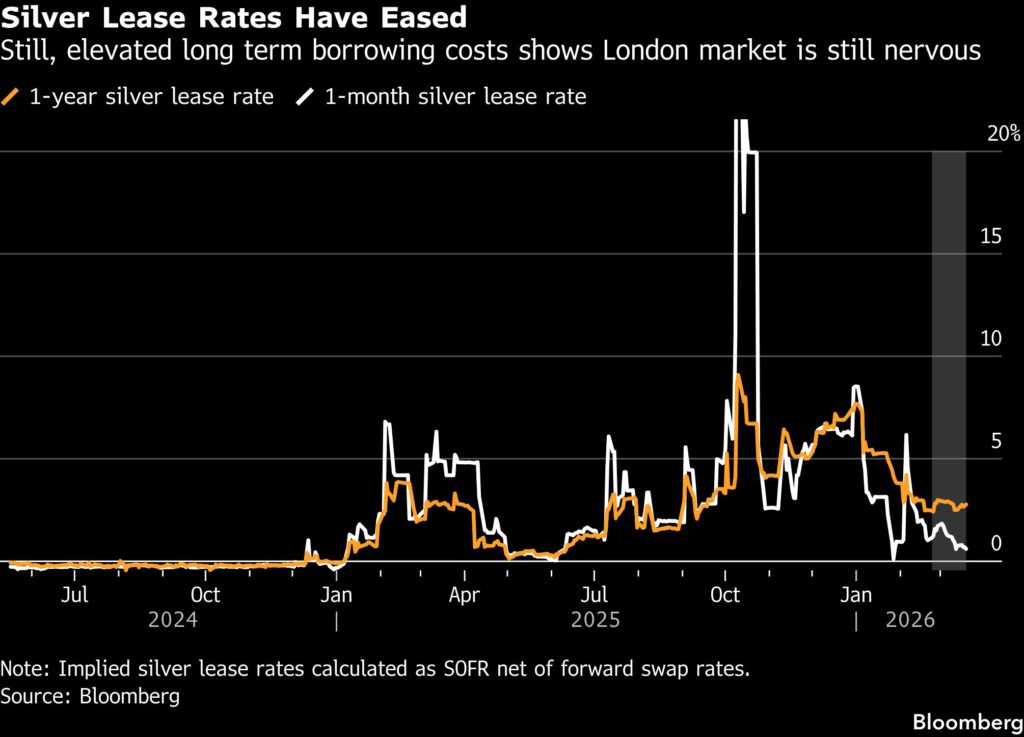
Looser supply in London has allowed the cost of borrowing silver to ease, although longer-dated leases are still more expensive, due to the volatility in prices and as a precaution against another squeeze.
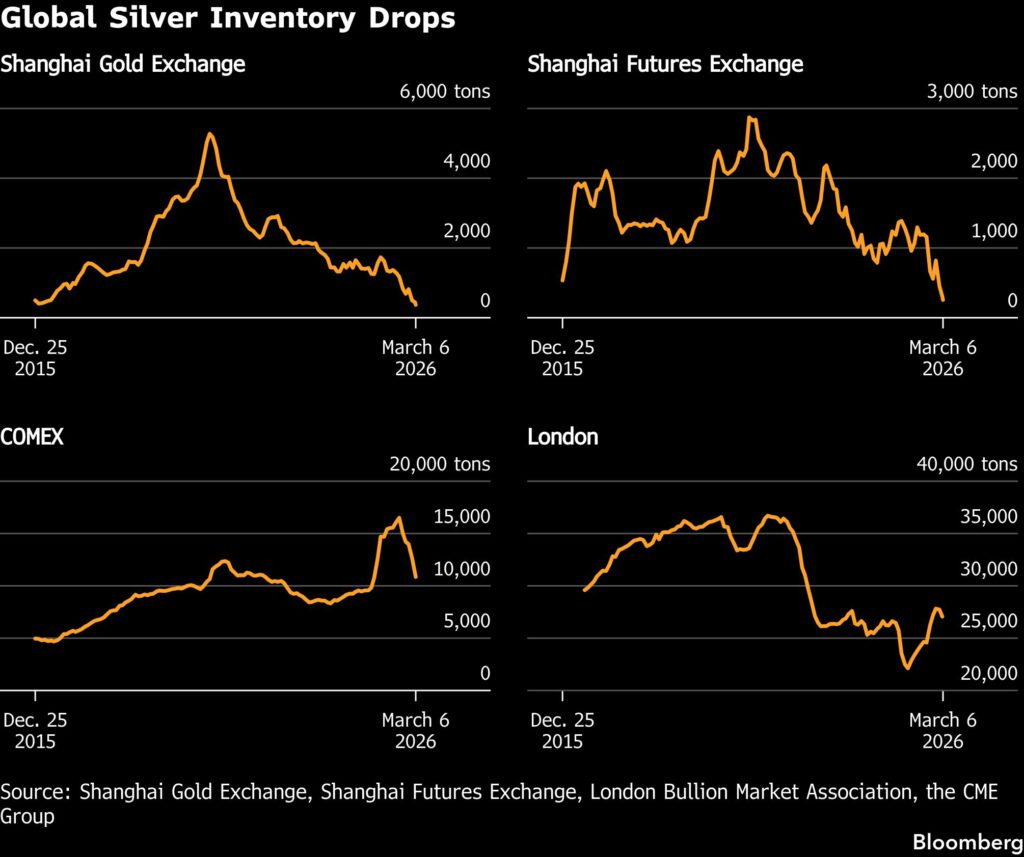
Visible inventories tracked by major exchanges from New York to Shanghai are either falling or sitting well below their long-term averages, suggesting metal remains scarce in the broader system. And the market has reason to be worried.
“China is one of the world’s most significant markets for both industrial consumption and silver investment,” said Simone Knobloch, chief operating officer of major Swiss refinery Valcambi SA. “The feedback we receive from the market indicates strong interest in physical products.”
The developing appetite for silver as a cheaper replacement for gold has made investment bars — ranging from 20 grams to one kilogram — common in the Shuibei market in Shenzhen, the center of China’s retail bullion trade.
“Silver has been a hit among retail investors and sellers,” said Song Jiangzhen, a researcher at Guangdong Southern Gold Market Academy.
He said there’s been a change in the mindset of consumers, who increasingly view gold as inaccessible. The white metal is currently trading at about $70 an ounce, while gold has fluctuated around $5,000 an ounce this year after a barnstorming rally.
Bullion dealers welcome the shift, said Song. Cheaper bars mean less pressure on financing. Many dealers have increased their silver stockpiles, tripling total inventory in Shuibei to around 300 tons in recent months, according to his estimate.
For now, though, markets are breathing a little easier. The Chinese premium on silver has softened and solar demand has slowed as the rebate deadline nears, said Yuan Zheng, an analyst at the Shanghai-based trading arm of Henan Jinli Gold and Lead Group Co. “We’ve moved into a situation of more supply than demand in the near term.”
That’s showing up in Shenzhen, where the silver bars on display are finding fewer takers. But it’s unlikely to be the end of the story.
“All it takes is just another surge in prices,” said Song. “Retail investors tend to follow rising trends rather than buy dips.”
(By Yihui Xie and Jack Ryan)
{{ commodity.name }}
{{ post.title }}
{{ post.date }}



Comments