Australia flags risk to iron ore price from China state buyer
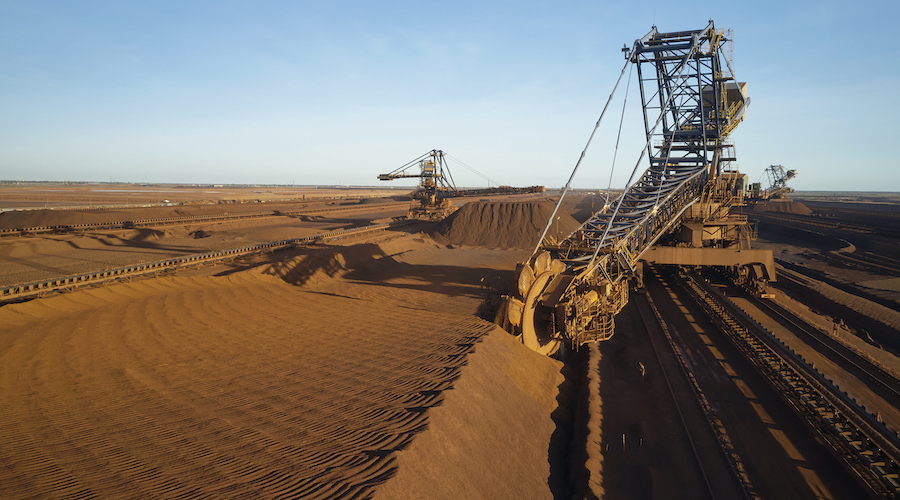
An Australian government report on Friday said efforts by China’s state-backed iron ore buyer to cut costs for Chinese steel mills may push down prices in the medium term, in a rare acknowledgment that such activity could affect earnings.
Australia is the largest exporter of iron ore, which it counts as its single biggest export-earner and a significant contributor to government revenue. China buys roughly three-quarters of the entire seaborne trade.
The Department of Industry, Science and Resources in its Resources and Energy Quarterly report said state-backed China Mineral Resources Group (CMRG) has increased activity in the iron ore market this year, including in a high-profile dispute with BHP.
“The CMRG has sought to drive changes in pricing mechanisms among miners, with the aim of reducing costs for Chinese steel mills. That may drive the benchmark price down in medium term,” the department said.
The comment is among the government’s clearest acknowledgements of the potential impact of CMRG, which was established in 2022 to consolidate steel mills’ buying power and increase leverage in negotiations with suppliers including BHP, Rio Tinto and Fortescue.
CMRG has asked some domestic steel mills not to take delivery of certain portside iron ore products from Fortescue, Reuters reported on Wednesday. Fortescue declined to comment.
CMRG did not respond to an emailed request for comment.
The government has been watching negotiations between miners and CMRG amid concern that changes to price arrangements or lower benchmark prices could affect profit and tax receipts. Resources minister Madeleine King said this year the government was keeping “an active watch” on developments because of iron ore’s importance to the economy and federal budget.
The issue of iron ore pricing was a note of caution in an otherwise upbeat report, which sharply upgraded the outlook for commodity export earnings.
The government raised its forecast for the value of exports in the fiscal year that began on July 1 by 11% versus its outlook in December, to A$416 billion ($286 billion), after conflict in the Middle East boosted gold and energy prices.
It did not publish a quarterly report in March due to market volatility.
The government also raised its forecast prices for several commodities this fiscal year compared with the previous report.
It now expects iron ore at $91 a metric ton rather than $85, and gold at $4,792 an ounce versus $4,049.
Iron ore was last trading at $98.5 and spot gold was last at $4,063.
The government also said it expects LNG prices to exceed $16 per million British thermal units rather than $11.3, before declining to around $11 by 2028.
Asia spot was last priced $15.35.
($1 = 1.4507 Australian dollars)
(By Melanie Burton, Helen Clark and Emily Chow; Editing by Christopher Cushing)
More News

Congo plans first stock market as AI mineral boom draws interest
July 02, 2026 | 06:49 am
Agnico Eagle suspends Quebec pit mining, flags production hit
July 02, 2026 | 06:29 am
{{ commodity.name }}
{{ post.title }}
{{ post.date }}
Comments