China’s steel mills squeezed as demand shows signs of softening

Iron ore’s rally is clashing with sluggish Chinese steel demand, leaving mills squeezed even as the nation’s construction season traditionally picks up at this time of year.
The ratio of China’s steel rebar futures in Shanghai to Dalian iron ore contracts dropped to the lowest level since 2020 this week, according to Bloomberg data, which implies mill margins are narrow. The ratio is a widely watched gauge of the steel market.
“Weak demand for finished steel products has kept steel prices subdued, yet the incentive for mills to sustain production is strong with modest profit margins,” Foshan Financial Holdings Futures Co Ltd. said in a note. “Iron ore prices are projected to outperform finished steel products.”
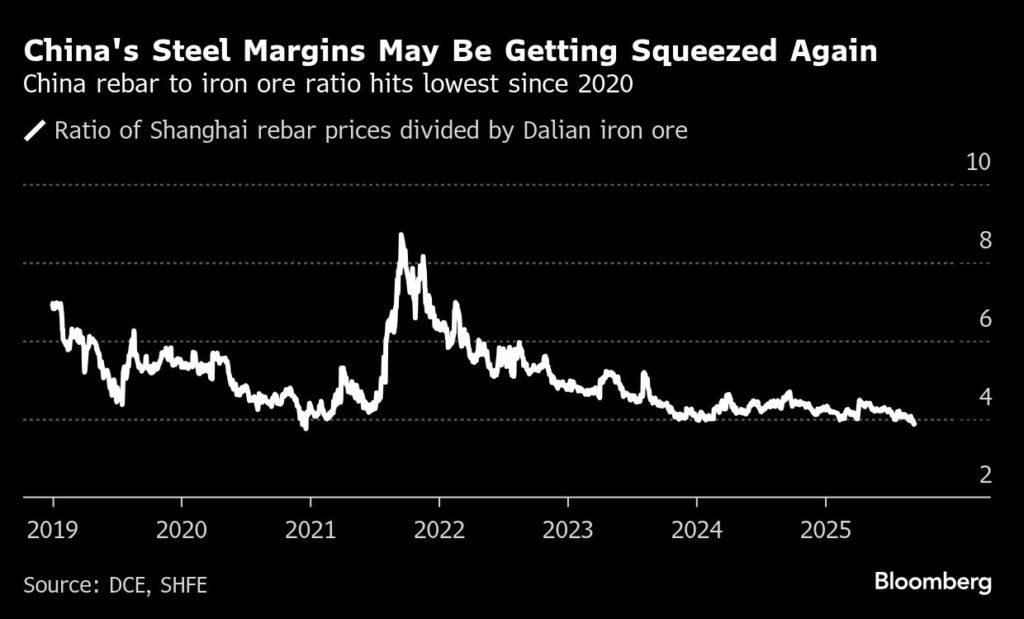
The ratio weakness underscores how China’s steel sector remains tied to its struggling property market and slowing construction activity, both of which are major consumers of rebar. Steel mill margins did better than expected earlier this year as cheaper raw materials helped push down costs.
“It’s difficult for mills to push down the raw material prices,” said Han Jing, an analyst at SDIC Futures Co. “The mills’ profitability is now expected to fluctuate at a lower level.” If demand doesn’t pick up later, the elevated hot metal productions may come down and eventually pressure iron ore prices, she added.
Dalian iron ore futures reached the highest since July this week as supply worries from the Simandou mine in Guinea and the upcoming restocking season in China boosted market sentiment. Singapore iron ore futures followed suit, reaching highs last seen in February.
Singapore iron ore futures declined 1.6% to $105.10 a ton as of 12:45 p.m. local time, while yuan-priced futures on the Dalian exchange also weakened. Rebar contracts in Shanghai were down for the fourth day, heading toward the lowest since July.
(By Jessica Zhou and Katharine Gemmell)
{{ commodity.name }}
{{ post.title }}
{{ post.date }}
Comments