Codelco output drop casts doubt on 2025 year-end spike
Chile’s state-owned copper giant Codelco has reported a sharp drop in production to start this year, leading copper industry analysts and former Codelco executives to question its reports of surging output at the end of 2025 that helped the company meet its annual production target.
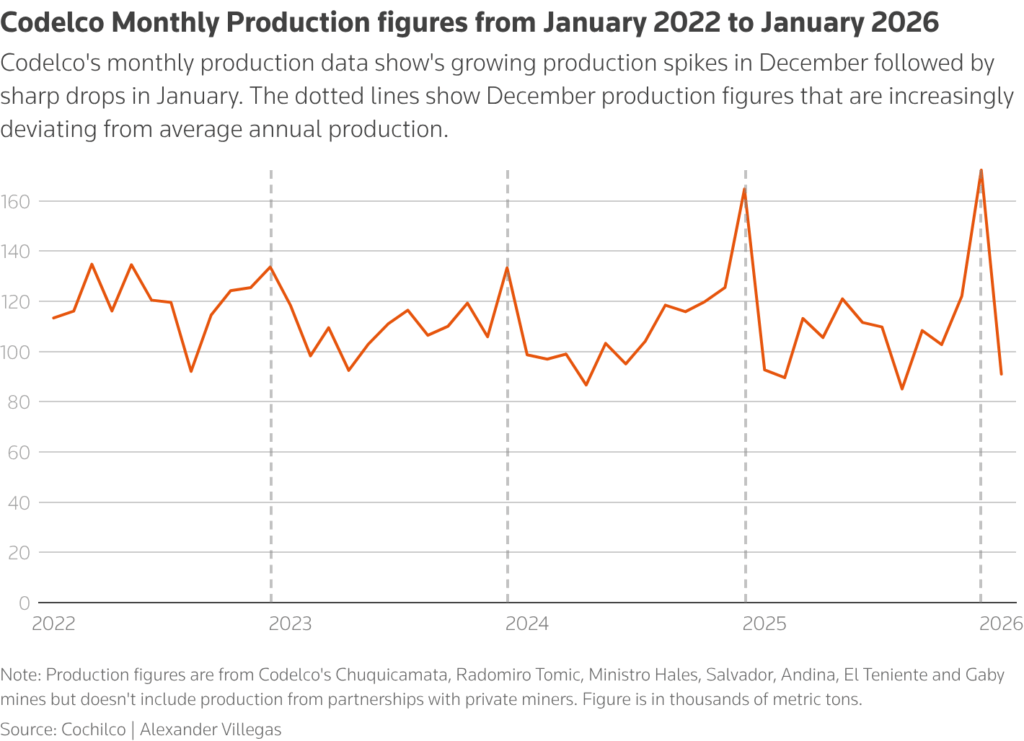
Last week, Chile’s state copper commission Cochilco reported that Codelco produced 91,000 metric tons, its fourth-lowest monthly production figure this decade. The January figure represents a year-on-year drop of 1.8% and a decline of 47% from December.
In December, the company reported its largest monthly output figure of 172,300 metric tons. It was its largest monthly output for the decade so far, and far exceeded the monthly average of 105,600 tons from January to November.
Industry insiders have been questioning how the surge was achieved, whether the figure represented fully refined copper, and what it signals for the miner’s long-term goals to boost production toward its goal of 1.7 million tons by 2030.
“Figures are always embellished across the industry to better meet targets, but there are significant differences here that are at least questionable,” a former senior executive at Codelco told Reuters, speaking on the condition of anonymity due to his current work in the industry.
“At the very least, there was poor planning,” the former executive said. Reuters spoke to four former Codelco executives who expressed doubts about the figure and the company’s 2030 goal.
Codelco’s production levels slid to a quarter-century low in 2023 due to declining ore grades and problems with major construction projects to overhaul key mines. The miner was able to boost production in 2024 and surpassed that number by 3,000 tons in 2025 for a production of 1.33 million tons.
According to an internal production document seen by Reuters, December production from oxides at Codelco’s Chuquicamata mine reached 25,000 tons, more than six times the projected 4,000 tons.
Its Andina mine registered its highest monthly production figure since 2014 and its small Salvador division produced 11,500 tons, far surpassing the projected 4,600.
When asked about the figures, Codelco said its production boost was due to the increased use of stockpiled inventory, unplanned sources of material and improved performance at some divisions.
“This result is especially significant considering the contingencies faced, confirming the corporation’s technical and human capacity to sustain its productive performance,” the company told Reuters.
The company said the use of leach yard inventory in Chuquicamata helped raise production volume while Andina’s production was driven by better ore grades and higher processing rates.
For Salvador, Codelco noted the division was helped by the ramp-up of the Rajo Inca project and inventory stockpiled from a stoppage of its Potrerillos smelter in June.
Juan Ignacio Guzmán, CEO of mining consultancy GEM, said that while end-of-year production surges are normal, he thinks a strong deviation raises warning flagsor signals a calculation error.
“When expectations differ widely from reality, an internal audit is needed to understand what went wrong in the original estimate and to improve future forecasts,” Guzmán said.
The commission told Reuters it regularly and periodically audits Codelco but it had no publicly available information explaining operational, technical or management factors behind production deviations at divisional level.
Cochilco noted it is legally required to keep much of its oversight work confidential.
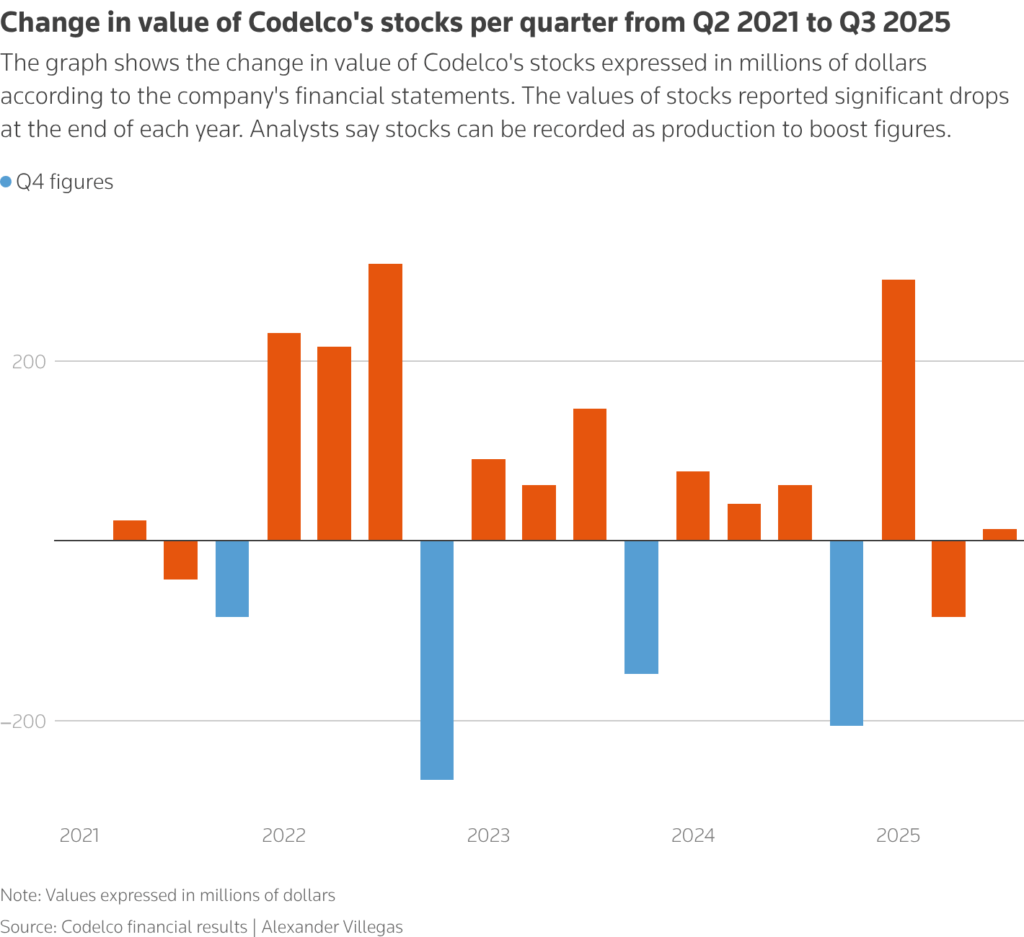
Juan Carlos Guajardo, head of consultancy Plusmining, said use of leach inventories helped lift output toward year-end, noting that Codelco has relied on unusually high inventory use in November and December since 2022.
“Another factor is the year-end operational push, reinforcing a pattern of December rebounds seen in previous years,” he said.
Long-term competitive issues remain
Codelco still faces long-term problems with low ore grades. Structural projects designed to offset this have suffered delays and cost overruns, weighing on output.
Guzmán said the miner has had trouble competing with private-sector peers due to bureaucracy and lack of focus.
“Codelco’s production has fallen, among other reasons, because these projects haven’t even been close to come together how they should have and that’s due in part to Codelco’s projects not being developed competitively,” Guzman said.
“When companies stop competing and adopt practices that aren’t market-competitive, you start to see ‘kitchen-sink’ accounting so the numbers don’t look as bad,” he said.
Codelco had a fatal accident at a project in its flagship El Teniente mine that left six workers dead in July and triggered a judicial investigation. Several underground areas were shut and are restarting gradually, while others remain halted.
The company said it is reassessing business and development plans to gauge the impact on future production. Despite the accident, El Teniente missed its December target by only about 900 tons. Codelco attributed this to the mine performing above expectations earlier in the year.
For 2026, Codelco has set a production target of 1.344 million tons, about 0.7% above 2025 levels. Analysts wonder whether the company can sustain growth and reach that level.
“There is obviously distrust in the business world and in the private sector over whether these (competitiveness) problems at Codelco are also triggering this, or more directly, whether this is yet another symptom of the internal problems it has,” Guzman said.
(Reporting by Fabian Cambero; Editing by Alexander Villegas and David Gregorio)
More News

{{ commodity.name }}
{{ post.title }}
{{ post.date }}


Comments