Glencore metals traders made record profits as energy cratered
Glencore Plc’s metals traders just notched up their best half-yearly performance on record, yet their energy and coal-trading peers struggled to even turn a profit.
The results highlight the differing fortunes of the two markets: in metals, physical traders have been enjoying the best conditions in a generation, as President Donald Trump’s threat of tariffs spurred a giant premium between US and global copper prices, while tight markets for semi-processed concentrates and soaring precious metals prices have also inflated trading profits.
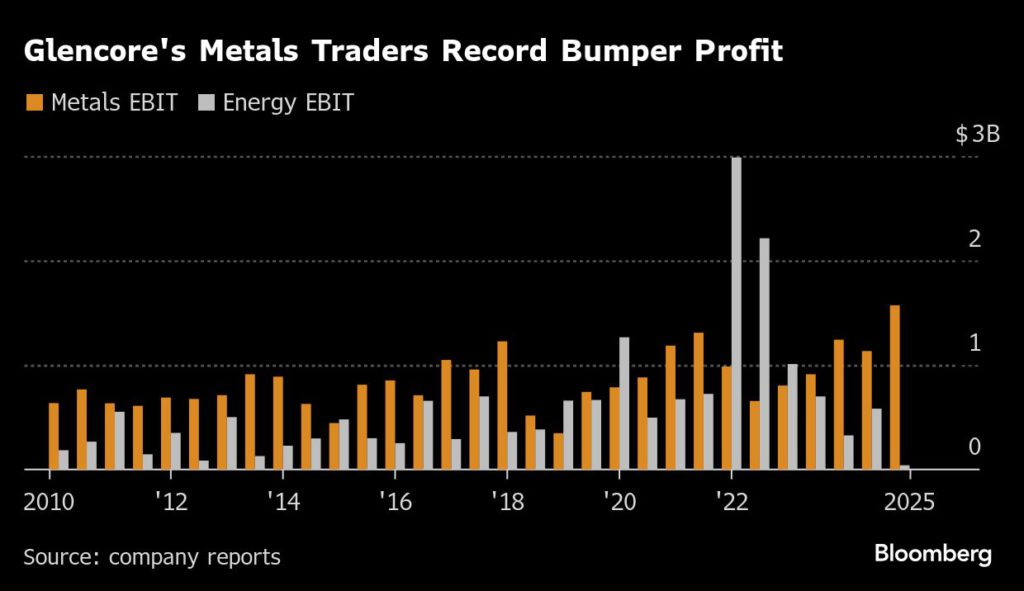
Meanwhile, energy traders have struggled with markets that have been whipsawed by geopolitical events. Glencore earned just $40 million before interest and tax from trading oil, gas and coal in the first six months of the year — the weakest in records going back to 2010, when the company first broke out half-yearly trading results in the lead-up to its 2011 initial public offering.
The tiny profit is a black eye for the storied commodity trading division at Glencore, which traces its history back to Marc Rich, the godfather of the industry. Ben Davis, an analyst at RBC Capital Markets, called the weak performance “alarming.” It comes after the unit incorporated trading the output of Teck Resources Ltd.’s large metallurgical coal business, which Glencore bought last year.
In contrast, Glencore’s metals traders delivered adjusted Ebit of $1.57 billion in the first half of 2025, the highest on record.
Copper markets have been roiled by Trump’s tariff plans, which drew massive volumes of metal into the US as traders rushed to take advantage of huge premiums that developed.
However, Glencore chief financial officer Steve Kalmin said that the US copper arbitrage had been “a relatively minor part” of the metals trading bonanza, attributing the outperformance to overall copper market conditions, including tight concentrates markets and regional dislocations.
Bloomberg reported earlier this year that Glencore was taking delivery of Russian copper from the London Metal Exchange to deliver to customers in China — including metal which British companies and citizens are barred from buying under UK sanctions. While Glencore’s parent company is listed in London, the firm’s copper desk operates from Switzerland and trades through a Swiss entity.
Commenting on energy markets, chief executive officer Gary Nagle echoed comments by oil executives including TotalEnergies SE boss Patrick Pouyanne, that the brief, geopolitics-driven price moves in recent months were difficult to trade on.
He also said that Glencore had emerged “just fine” from the collapse in US copper prices last week, after Trump revealed that the main traded form of the metal would be exempt from his import tariffs.
(By Jack Farchy and Thomas Biesheuvel)
{{ commodity.name }}
{{ post.title }}
{{ post.date }}
Comments