Gold price falls from record as traders take profit after torrid rally

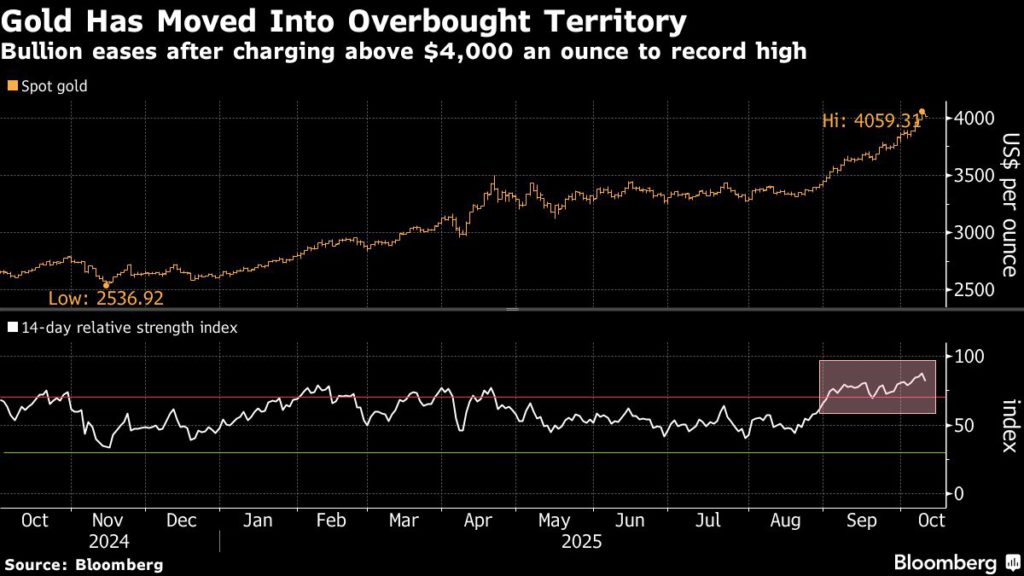
Gold dipped after peaking at an all-time high above $4,000 an ounce on Wednesday, following a torrid rally that’s left prices vulnerable to pullbacks amid signs that the precious metal is trading at overheated levels.
Bullion declined as much as 0.7% in early Asia trading on Thursday to around $4,015 an ounce, after closing 1.4% higher in the previous session. Technical indicators show gold’s been trading in overbought territory for the past month, likely leading to some profit-taking by investors following a scorching four-day run.
Meanwhile, some of gold’s haven appeal waned as US President Donald Trump said a peace deal in the Middle East was “very close,” after officials from Israel and Hamas were cautiously positive about the prospect that talks underway in Egypt would bring an end to the two-year war in Gaza.
Gold remains more than 50% higher this year, boosted by a plethora of uncertainties over global trade, the Federal Reserve’s independence and US fiscal stability. Heightened geopolitical tensions have also boosted demand for haven assets this year, while central banks have continued to buy bullion at an elevated pace.
Spot gold was down 0.7% to $4,014.24 an ounce at 7:29 a.m. in Singapore, after notching its new all-time peak of $4,059.31 an ounce. The Bloomberg Dollar Spot Index was little changed.
Platinum and palladium also eased on Thursday following strong gains in the previous session. Persistent market tightness and inflows into exchange-traded funds backed by the metals have provided support for prices. Silver edged lower but remained close to a record high according to Bloomberg intraday data going back to 1993.
(By Sybilla Gross)
More News

Contract worker dies at Rio Tinto mine in Guinea
Last August, a contract worker died in an incident at the same mine.
February 15, 2026 | 09:20 am
{{ commodity.name }}
{{ post.title }}
{{ post.date }}



Comments