Gold price set for worst week in 4 decades as war curbs rate-cut bets
Gold headed for its biggest weekly loss since 1983, as war in the Middle East boosted energy prices and reduced expectations for interest-rate cuts.
Bullion’s decline deepened as the dollar and bond yields rallied after CBS reported that the US is preparing to potentially deploy ground forces into Iran. Traders increased their bets on rate hike to 50% by October amid concern that a protracted conflict could stoke inflation. Higher rates hurt gold as it doesn’t pay interest.
Iranian officials have become reluctant to even discuss reopening the Strait of Hormuz as they focus on surviving the attacks, according to a person involved in direct, high-level contacts with Tehran. The Wall Street Journal reported that the Pentagon is sending three warships and thousands of additional Marines to the Middle East.
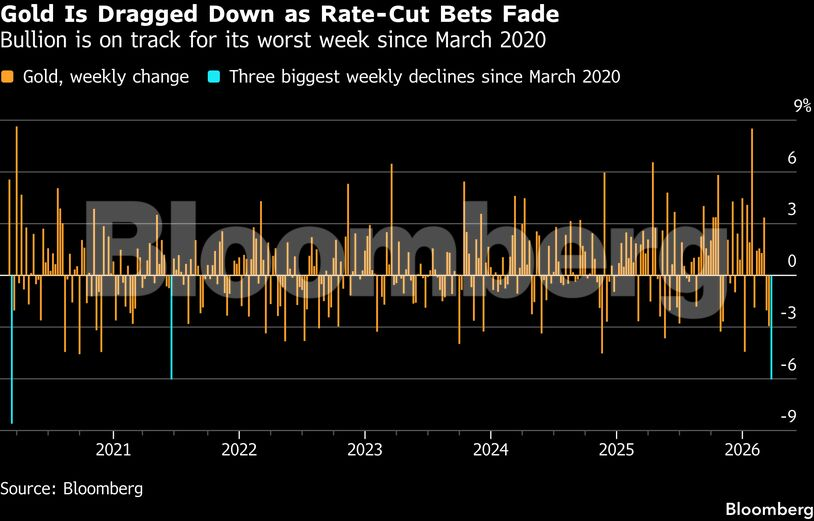
Gold — widely viewed as a haven — has dropped every week since the US and Israel attacked Iran last month. The retreat has come as the US dollar gained ground while investors sold stocks and bonds amid concerns over the ripple effects of elevated energy costs to inflation and global growth.
Gold’s pullback reflects a combination of profit-taking and liquidation amid concerns about less monetary easing, according to Rhona O’Connell, an analyst at StoneX Financial.
Prices above $5,200 had attracted a lot of buyers, leaving the market vulnerable to correction, O’Connell said. When prices started to fall, many investors hit their stop-loss levels — automatic instructions to sell if prices drop to a certain point — so selling quickly accelerated, she said. Technical signals, particularly moving averages, added to the downward pressure, she added.
Forced selling tied to the equity rout may also have contributed to gold’s decline, while slower central bank buying and outflows from exchange-traded funds have further weighed on sentiment, according to O’Connell.
Bullion-backed ETFs are set for a third week of outflows, with holdings falling more than 60 tons in that period, data compiled by Bloomberg show.
Despite the recent pullback, gold remains about 4% higher this year. Prices touched a record just below $5,600 an ounce in late January, supported by a wave of investor enthusiasm, central-bank buying, and concerns over threats to the Fed’s independence posed by President Donald Trump.
Gold fell 3.1% to $4,508.96 an ounce as of 3:03 p.m. in New York, on course for a eight-day losing run, the longest since October 2023. That drop dragged the metal’s 14-day relative-strength index — a gauge of momentum — below 30, a level that some traders see as oversold.
In other precious metals, silver fell 6.3% to $68.20 an ounce, down by more than 15% this week. Palladium and platinum were also on track for weekly losses. The Bloomberg Dollar Spot Index rose 0.5%.
(By Yvonne Yue Li)
{{ commodity.name }}
{{ post.title }}
{{ post.date }}



Comments