Laps of icy roads in China show sodium batteries making an EV breakthrough
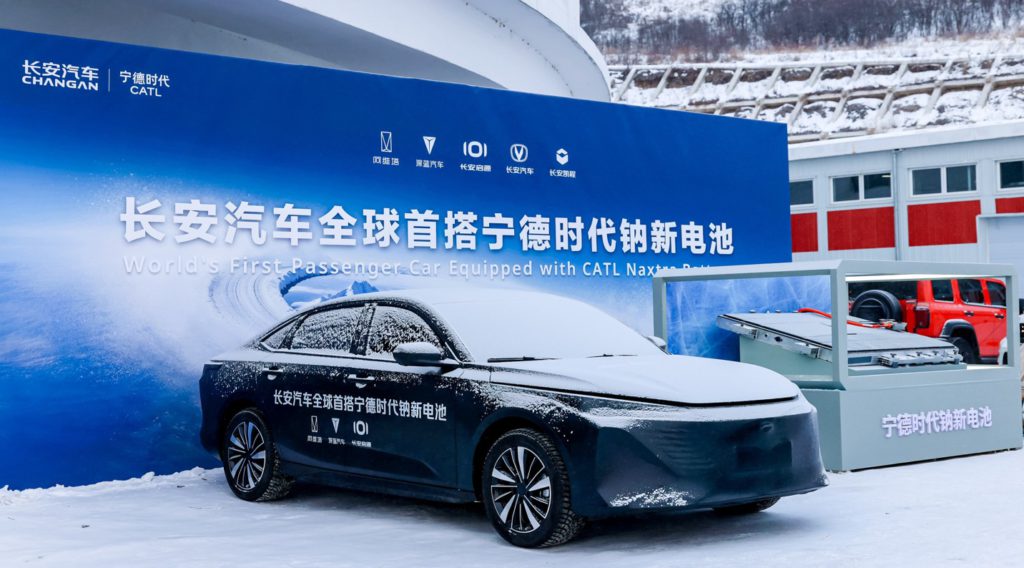
With a thick outdoor jacket to protect against -30C (-22F) temperatures and bitter winds, Calvin Quek joined car and technology enthusiasts huddled by a test track on the outskirts of a picturesque ski region in Inner Mongolia.
They watched Chongqing Changan Automobile Co. electric SUVs and a sleek battery-powered coupe effortlessly navigate icy roads and steep snow-dusted slopes at the facility in Yakeshi, northeastern China. Yet for the crowd at the February demonstration, the most impressive factor was out of view.
Batteries powering the vehicles used sodium as their key raw material component, rather than lithium — the metal that’s become synonymous with electrified transportation and the storage of renewable energy. The tests were a showcase for one of the world’s first mass-production passenger EVs fitted with the alternative technology — an innovation that’s long promised to deliver safer and low-cost rechargeable cells.
“I think this signaled a breakthrough moment for sodium-ion battery technology in EVs,” said Quek, executive director for nature finance at the Oxford Sustainable Finance Group, and a veteran observer of the energy transition.
By the middle of this year, Changan — a state-owned Chinese automaker and a local partner of Ford Motor Co. — will begin sales of models fitted with sodium-ion technology from Contemporary Amperex Technology Co. Ltd., the world’s dominant EV battery manufacturer.
Innovations by CATL have increased the energy density of sodium batteries by 50%, overcome engineering challenges, and brought the products to a “milestone stage,” chief technology officer Gao Huan told reporters Tuesday at an event in Beijing. “The era of sodium and lithium shining together has arrived” and the supplier will begin mass-production in the fourth quarter of this year, he said.
2026 “could prove to be a pivotal year” for sodium batteries, and see the category begin to displace at least some demand for more familiar lithium-ion technology, according to the International Energy Agency.
“There has been increasing interest in adopting sodium-ion cells into EVs and stationary storage applications” over the past three years, said James Frith, principal at Volta Energy Technologies, a US-based venture capital fund. “We’re at the point now where we’re seeing sodium-ion systems being commercialized in these applications.”
Sodium-based batteries have become more appealing with advances in energy density, which mean they’re now capable of powering vehicles and no longer restricted to less demanding categories like energy storage. The equipment also has a driving range between recharging that’s almost comparable with some conventional equipment. For a typical SUV, a sodium-ion battery would likely offer about 350 kilometers (217 miles) of driving, compared to between 400 and 600 kilometers for lithium-based options, the IEA calculates.
Equally important is the technology’s role as a potential shield from volatility in lithium prices. While still far below a peak touched in late 2022, prices of lithium carbonate in China surged almost 190% from a recent low last June to April 20, adding to pressure on battery costs from more expensive raw materials.
While not yet necessarily cheaper than the lowest-cost lithium options, sodium can help bolster supply chain resilience as the material is globally abundant. Batteries using sodium-based chemistries can also require a different mix of additional raw materials to some lithium-based technologies.
CATL, which has added more than 300 staff and invested almost 10 billion yuan ($1.5 billion) in sodium-ion research and development in the past decade, has described the segment as “alternative risk management,” offering a hedge against wild swings in lithium.
Yet even with recent advances, the sodium sector faces challenges. The technology isn’t likely to compete against lithium on energy density — and therefore on battery performance — and may only achieve cost parity with traditional options around 2030, according to CRU Group, a consultancy. Continued improvement in lithium iron phosphate, or LFP, batteries “poses a moving target for sodium-ion,” said Sam Adham, head of battery materials at CRU.
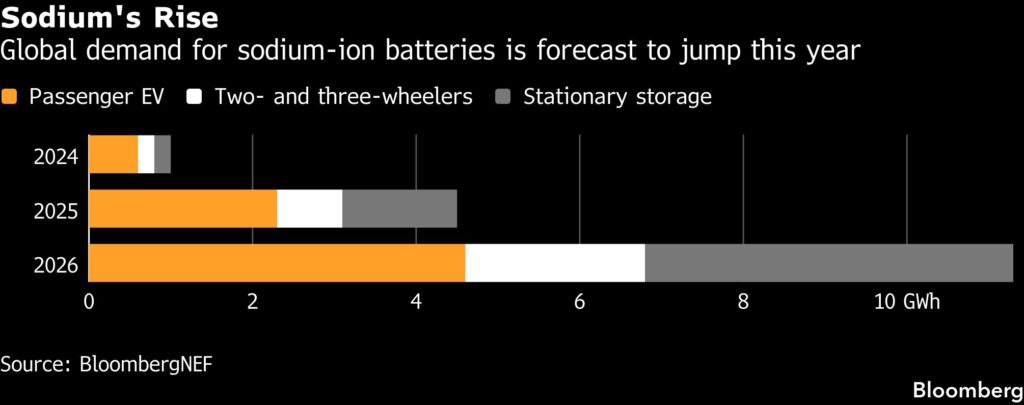
Demand for sodium-ion is expected to increase 2.5 times this year to about 11 gigawatt-hours, BloombergNEF said in a January report. Even so, that forecast annual deployment is a tiny fraction of the overall battery market, and sodium-ion may only account for about 2% of total cell demand by 2030, according to Benchmark Mineral Intelligence, an industry researcher.
In April last year, Chicago-based sodium startup Bedrock Materials returned capital to investors and halted development. “Even in the best case, it didn’t yield a product meaningfully better than today’s lithium iron phosphate,” co-founder Spencer Gore said in a LinkedIn post explaining the decision. In September, US sodium battery manufacturer Natron Energy Inc., which had planned a $1.4 billion production facility, also ceased operations.
Still, demand for sodium is projected to rise swiftly and to capture a slice of an increasingly diverse market as renewable energy storage grows and as sales of electric two- or three-wheelers and long-distance trucks add to requirements for passenger cars.
Sodium products can offer better performance than lithium alternatives in extreme cold climates, opening up opportunities to expand EV sales in frigid locations like northern Europe, Canada and parts of Japan. The products are also likely to win adoption in budget models that require a shorter range.
CATL’s biggest competitor, BYD Co., is also advancing the technology, while South Korea-based LG Energy Solution Ltd. in January said it aims to achieve commercial production of sodium batteries, and has announced a pilot manufacturing line in Nanjing, China.
“It absolutely is an emerging technology now that can’t be discounted,” said Evan Hartley, senior analyst at Benchmark Mineral.
(By Annie Lee)
More News
{{ commodity.name }}
{{ post.title }}
{{ post.date }}
Comments