Navarro sees US ending Chinese dominance of critical minerals
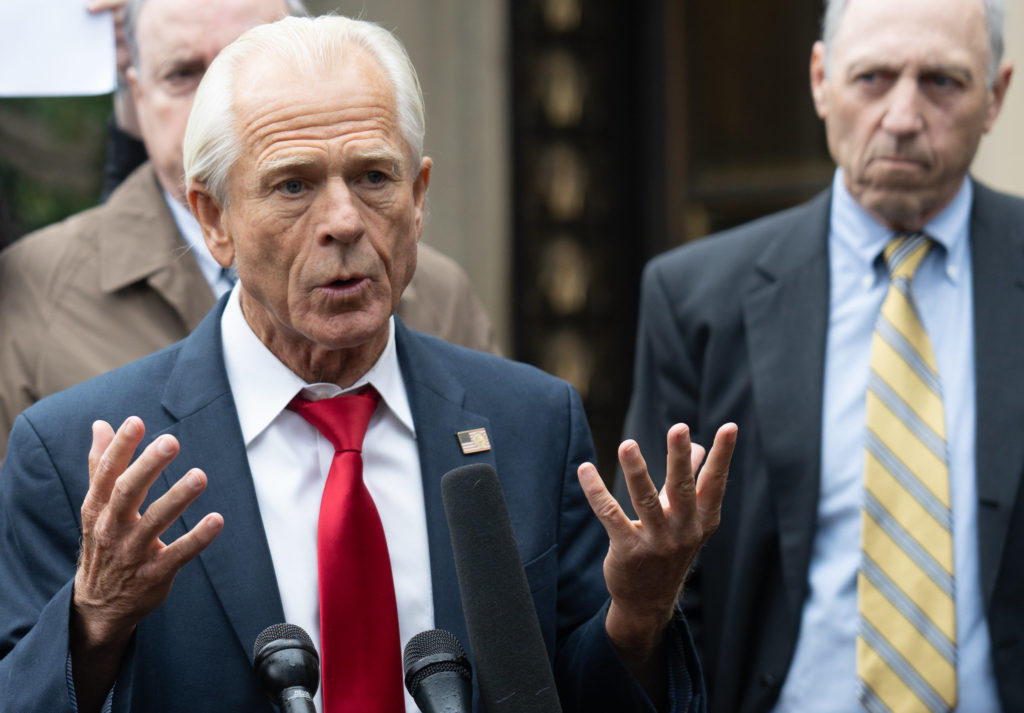
US President Donald Trump’s White House trade adviser predicted American industrial breakthroughs would help boost domestic production and eliminate China’s market dominance of rare earths.
“China has been flexing its muscles now in Europe, in India, in the United States saying, basically, we’re gonna do what we want, and if you try to stop us, we’re gonna take away your critical minerals,” Peter Navarro said in an interview on Bloomberg’s The Mishal Husain Show. “Because they have, they think they have a monopoly on it, but that’s just a matter of time.”
American innovation would “quickly wipe away” China’s “weaponization,” he continued.
China is the world’s dominant supplier of rare earths, and Beijing’s efforts to withhold supplies last year helped fuel a trade war with the US that saw both sides raise tariffs to astronomical levels.
Trump and Chinese President Xi Jinping reached a trade truce last October, but Washington has continued to pursue policies intended to wean the nation off Chinese supplies of magnets used in a wide variety of consumer products, including autos and electronics.
“So what do you do in the meantime? You do diplomacy. And if people want to call that soft, then they don’t understand the chessboard,” Navarro said.
Under the agreement, China consented to a one-year suspension of tighter export controls. In return, Trump halved tariffs on Chinese goods that were enacted in response to the flow of chemical ingredients for fentanyl into the US to 10%.
Navarro said it was critical to Trump’s efforts to maintain open lines of communication with “vicious dictators,” a group that the aide said included Xi, Russian President Vladimir Putin and Turkey’s Recep Tayyip Erdogan.
China is home to more than 90% of global rare earths and permanent magnets refining capacity, compared with just 4% for second-place Malaysia, according to the International Energy Agency, a Paris-based intergovernmental organization.
The US has sought out agreements with eight allied nations as part of a broader effort to strengthen supply chains and reduce Western dependence on China for critical minerals. US officials met with their counterparts from Japan, South Korea, Singapore, the Netherlands, the UK, Israel, the United Arab Emirates and Australia in December to strike agreements on energy, critical minerals, advanced manufacturing, semiconductors, AI infrastructure and transportation logistics.
Trump and Commerce Secretary Howard Lutnick suggested to reporters aboard Air Force One on Sunday the US could also tap into supplies of rare earths in Venezuela following the capture and arrest of leader Nicolas Maduro.
EU pressure
In his interview with Husain, Navarro also urged the European Union to impose higher tariffs on China, a request that could raise fresh tensions in the transatlantic trade relationship that has already been marred by a dispute over digital taxes on American firms.
“We are strongly encouraging Europe to adopt exactly the same level of tariffs that we adopt for the simple reason that when the president puts up tariffs to defend America from Chinese cheating, China can’t sell as much here,” he said. “Where does it sell it? Dumps it in Europe, dumps it in Mexico.”
As the 2026 midterm elections approach, Navarro acknowledged that the White House bears responsibility in alleviating economic pain felt by Americans. He said the president’s tariff regime would eventually boost US manufacturing and create jobs.
He likened the scenario to former President Ronald Reagan inheriting his predecessor Jimmy Carter’s economy, suggesting it took time for the Republican’s policies to take hold. When faced with voters during the 1982 midterms, Democrats won back the House and “paralyzed government,” he said. Trump, he added, faces a similar predicament.
“We understand that history and we’re trying to make sure we don’t get caught in that same vise,” he said. “So what we have to do is explain very clearly to the American people.”
Price concerns
The administration in recent months has focused on addressing affordability, a major voter concern that propelled Democrats to office in November’s state and local elections in Virginia, New Jersey and New York.
Navarro conceded that the administration’s tariff policy on some kitchen-table products has added to economic pressures facing American households. The administration has since reduced tariffs on more than 200 food products including staples such as beef, tomatoes, coffee, orange juice and bananas.
“I’m totally supportive of no tariffs on products we don’t make,” Navarro said. “It happened and now we make adjustments.”
The administration’s shifting trade policy throughout its first year has added to the economic uncertainty. US manufacturing activity shrank in December by the most since 2024, capping a rough year for American factories.
The Institute for Supply Management’s manufacturing index edged down to 47.9 from 48.2, according to data released Monday. The measure has been below 50, which indicates contraction, for 10 straight months.
(By Courtney Subramanian and Mishal Husain)
{{ commodity.name }}
{{ post.title }}
{{ post.date }}

Comments
Tim LeClair
Navarro is a crackpot at the best of times…maybe in 20 years with a crap-ton of government subsidies.