Pentagon doubts over rare earths deal provoke White House clash

The Pentagon is weighing whether to scrap an $80 million conditional loan offer to rare earths refiner ReElement Technologies Corp., touching off a clash with the White House over an agreement that was meant to help break China’s chokehold on critical minerals.
The Pentagon’s Office of Strategic Capital announced the agreement with ReElement in November. Since then, officials vetting the company have raised doubts about its ability to scale its technology, as well as its long-term revenue forecasts, according to people familiar with the process.
The ReElement deal hasn’t been canceled and may still go ahead, according to the people, who asked not to be identified discussing matters that aren’t public. At the time the agreement was announced, the Pentagon made clear that ReElement still needed to undergo due diligence before getting any money. The Pentagon hasn’t disbursed the loan yet, according to one of the people.
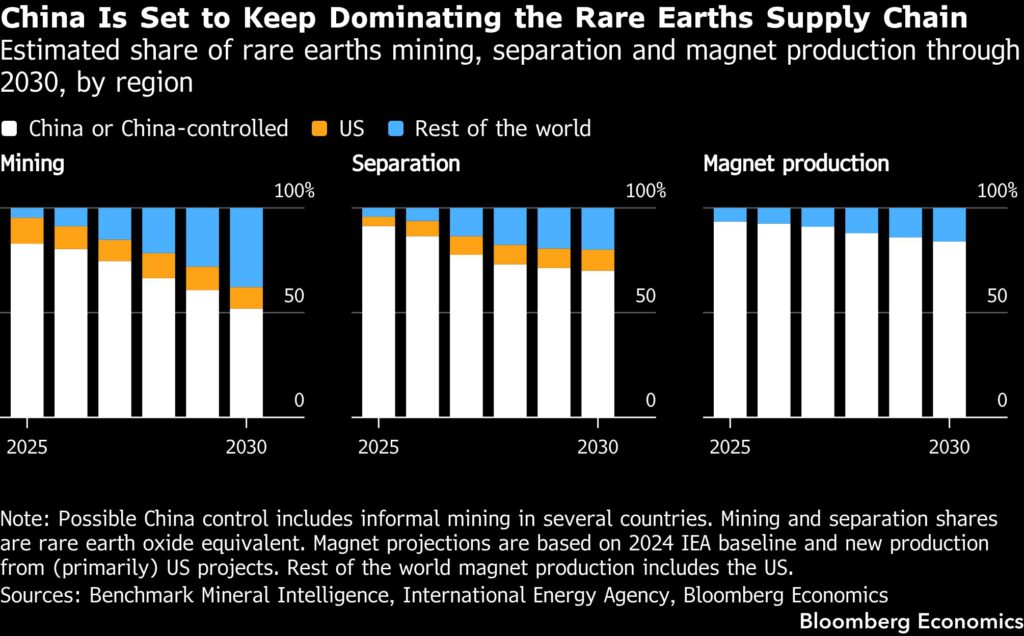
The deal, part of a bigger $1.4 billion critical minerals agreement that also included Vulcan Elements Inc., was heralded as part of the Trump administration’s multibillion-dollar drive to develop domestic production of rare earth elements. They are used in products from microwave ovens to missiles and have become a key source of Chinese leverage in trade talks with the US.
The administration has employed a variety of financial tools in the effort including offering loans and taking equity stakes and warrants to buy stock in many of the companies involved. It’s emphasized the need to move fast and make big bets given the severity of the problem.
The desire to act quickly and conduct rigorous vetting has spurred tension with the White House.
Shortly after Bloomberg News contacted ReElement for comment, Peter Navarro, the White House senior counselor for trade and manufacturing, reached out independently to Bloomberg to criticize the Pentagon’s handling of the deal.
“The due diligence cops within OSC with a private equity background have no experience how to manage a crisis at warp speed,” Navarro said, referring to the Pentagon’s Office of Strategic Capital.
“Their over-burdensome due diligence disproportionately penalizes small innovative emerging companies,” he said. “ReElement represents exactly the kind of asymmetric bet we should be making.”
Pentagon spokesman Sean Parnell called the team overseeing the agreements “the finest private equity dealmakers in the world, professionals whose unmatched expertise and qualifications stand second to none.”
The Office of Strategic Capital “expertly balances lightning speed with rigorous diligence to close high-impact deals that directly strengthen America’s defense and empower our warfighters,” Parnell said. The critical-minerals effort is being overseen by Deputy Defense Secretary Stephen Feinberg, the private equity billionaire who co-founded Cerberus Capital Management.
A White House official, speaking on condition of anonymity, said the administration is working together — as well as with private industry — on the matter. The official praised ReElement as one of many great emerging companies working with the government.
Mark Jensen, ReElement’s chief executive officer, declined to address questions about the loan but said the company is proud to partner with the government. He said the company is going ahead with a facility in Indiana to refine critical minerals and produce rare earths oxides.
“From ReElement’s perspective, we confirm that our work with the US government is ongoing,” Jensen said. “Nobody else in the country can or has produced the products we produce today at ReElement which are needed for defense, commercial and the energy transition.”
When the Pentagon announced the deal, it said it would get warrants in Vulcan and ReElement.
But it also cautioned that the loan agreement specified steps Vulcan and ReElement must take to fulfill “financial, legal, technical, and other due diligence requirements.”
It was unclear if the Pentagon ever received warrants for ReElement or Vulcan. ReElement didn’t respond to inquiries about the warrants. Vulcan didn’t respond to a request for comment.
According to the agreement, ReElement was to produce high-purity rare earth oxides from electronic waste and end-of-life magnets. Vulcan would then manufacture new magnets from those oxides. The Pentagon earlier said the companies anticipated producing up to 10,000 metric tons of magnet materials in the next several years.
It’s unclear if Vulcan will need to find a new supplier of the oxides if ReElement doesn’t get the loan. Two of the people familiar with the matter said pulling funds from ReElement wouldn’t affect Vulcan’s deal.
Even with the caution about due diligence, the government’s plan amounted to an early vote of confidence in ReElement, which has yet to produce oxides at scale. At a critical minerals summit in February, the State Department touted how the deal had “crowded in” an additional $200 million in private funding for ReElement.
That appeared to be a reference to ReElement having secured $200 million in strategic equity from Transition Equity Partners, an agreement announced in January. Transition Equity cited ReElement’s “collaboration” with the government. TEP didn’t respond to a request for comment.
While the Pentagon has only announced a small number of deals aimed at locking down critical supply chains, the potential ReElement loan is among hundreds of tie-ups the agency is currently considering, according to one of the people familiar with the matter.
In September, the Pentagon’s industrial buildout program, known as IBAS, made a two-year $2 million investment in ReElement.
ReElement was until last year a subsidiary of Nasdaq-listed American Resources Corp. It described ReElement in an October 2025 filing as being in a “pre-revenue development stage.”
(By Joe Deaux and Kate O’Keeffe)
More News

Bomb attack damages Ecuador mining agency probing illegal gold
It’s the second blast in recent weeks affecting Arcom offices.
June 29, 2026 | 12:28 pm


{{ commodity.name }}
{{ post.title }}
{{ post.date }}
Comments