Top gold buyer Poland to ramp up purchases as geopolitical hedge
Poland’s central bank, the world’s biggest reported buyer of gold, is boosting purchases by another 150 tons as it braces for more of the geopolitical instability that has driven prices to record highs.
Surging gold prices aren’t a major obstacle for the National Bank of Poland, which just approved plans to raise its holdings to 700 tons, management board member Artur Sobon told Bloomberg News. Gold has hit new heights as a growing standoff between the US and Europe over the future of Greenland causes investors to pile in to safe havens.
“Our primary goal is to build an appropriate portfolio for these unstable geopolitical times, one that will guarantee Poland stability, security, and credibility,” Sobon said. “The price is not a primary consideration for us.”
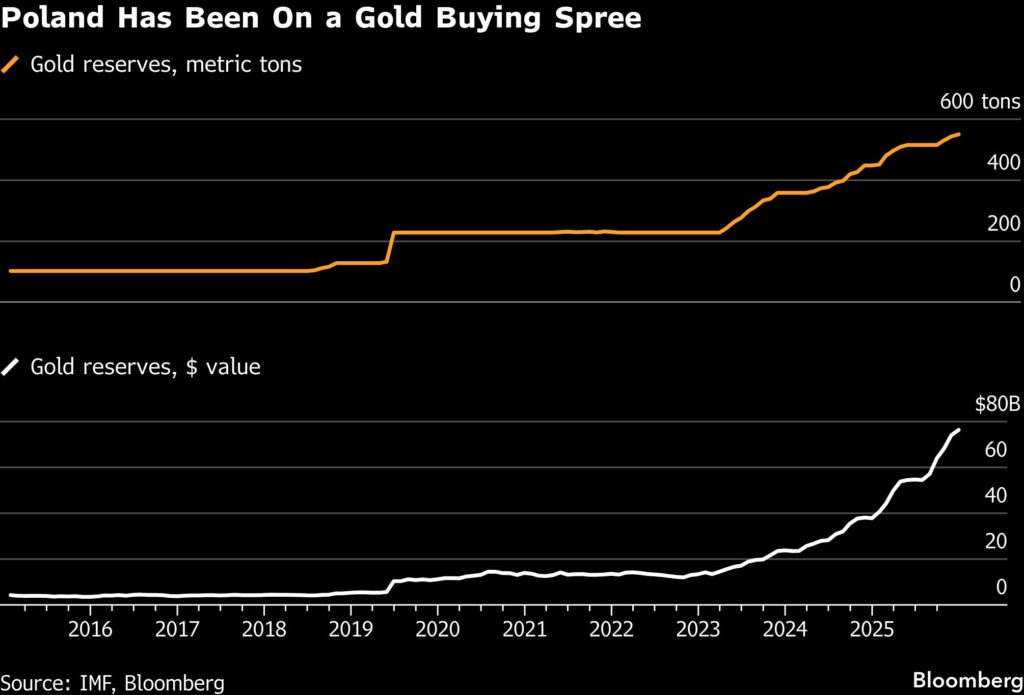
While Poland doesn’t have a deadline to reach its new gold holding target, purchasing 150 tons at current market prices would cost more than $23 billion.
Buying by central banks has been a key driver of gold’s blistering rally, which has seen the metal double in price over the past 18 months. The pace of purchases jumped in 2022 after Russia’s foreign reserves were immobilized following its full-scale invasion of Ukraine. The move underscored the appeal of bullion, which can’t be frozen.
The NBP’s gold purchases of 100 tons last year were the largest among those officially reported by central banks. Industry analysts say, however, that some state institutions — particularly in China — have ramped up gold buying without declaring it in recent years.
Governor Adam Glapinski has spearheaded efforts to raise the ceiling for gold holdings, which amounted to 550 tons at the end of 2025. Until now, the bank could allocate as much as 30% of its overall reserves to bullion, and soaring prices have pushed the metal to about 28%.
“Given our new goal, the National Bank of Poland will most likely remain a leader among central banks regarding purchases of gold,” Sobon said.
Sobon said it is up to NBP traders to “determine the pace, scale, and frequency of purchases.” There may be months when Poland won’t buy any bullion, he said. “We treat gold, even taking into account a correction in its price, as a long-term anchor of security,” he added.
Geopolitical divide
Russia’s war in Ukraine has created a geopolitical fault line across eastern Europe, increasing security risks even as Poland and many of its formerly communist neighbors joined NATO and the European Union. In this riskier environment, Poland’s gold holdings are taking on added significance, Sobon said.
“We cannot deceive our geographic location, and gold undoubtedly strengthens the credibility and financial stability of the Polish state,” he said. “After Poland’s historical experiences, we don’t need to convince Poles of the importance of having gold reserves.”
Poland can bankroll its gold spree because its foreign-currency reserves are ballooning due to inflows of EU funds, most of which are exchanged into zloty directly at the central bank. The country’s official reserve assets, which include gold, currently stand at around $271 billion, compared with $36 billion when Poland joined the EU in 2004.
“We now have the space to build an appropriate portfolio and structure our reserves, as in the future we will no longer receive such large funds,” Sobon said. As Poland gets richer, EU flows aimed at helping the bloc’s poorest regions will likely be directed elsewhere, he said.
Glapinski has said Poland plans to hold about a third of its bullion domestically, with the rest split evenly between London and New York. Currently, about 80% of the gold is held abroad, Sobon said.
He added that it’s not the Polish central bank’s place to comment on the outlook for gold, but added that the current global situation is very different from that at the end of the Cold War, when gold prices plummeted along with international tensions.
“Today, no one harbors any illusions that geopolitically unstable times are here and will remain here,” he said. “And every day, the decisions of key global players — the US, China, and Russia — confirm this.”
(By Wojciech Moskwa and Agnieszka Barteczko)
{{ commodity.name }}
{{ post.title }}
{{ post.date }}
Comments