Prabowo puts Indonesia on collision course with global investors
As Indonesia’s stocks plummeted last week, a group of executives thousands of miles away were starting to panic for a different reason.
Reports emerged that Danantara, a sovereign wealth fund that reports directly to President Prabowo Subianto, was considering a takeover of one of Indonesia’s largest gold mines. Key investors of Jardine Matheson Holdings Ltd., a Hong Kong-based conglomerate that controlled the mine, were getting anxious, according to people familiar with the situation. The investors wanted Jardine to answer a simple question: Do you still own the gold mine or not?
The episode underscores the quandary facing investors looking at Southeast Asia’s biggest economy: Is the “New Indonesia” envisioned by former leader Joko Widodo — one that would propel the nation into the ranks of the world’s top five economies by 2045 — still on track?
For the moment, the answer remains unclear. On the one hand, regulators reacted quickly to MSCI Inc.’s warning that Indonesia may be relegated to frontier-market status, halting a two-day market meltdown and reassuring many money managers about the nation’s long-term prospects. But at the same time, the threatened gold mine seizure suggests that Prabowo may yet find himself on a collision course with foreign investors and Indonesia’s most influential tycoons.
Moody’s Ratings on Thursday lowered its outlook on the country’s credit rating to negative, citing “reduced predictability in policymaking” and poor communication by Prabowo’s government. Stocks, bonds and the rupiah all slid on Friday, even as Finance Minister Purbaya Yudhi Sadewa pushed back and said Indonesia was in a “better position” than other countries regarding its fiscal deficit and growth prospects.
“Overall I see the state as more centralized and predatory under Prabowo,” said Eve Warburton, research fellow at the Coral Bell School of Asia Pacific Affairs at the Australian National University and author of Resource Nationalism in Indonesia: Booms, Big Business and the State. “Understandably, the domestic private sector is anxious and foreign investors are spooked.”
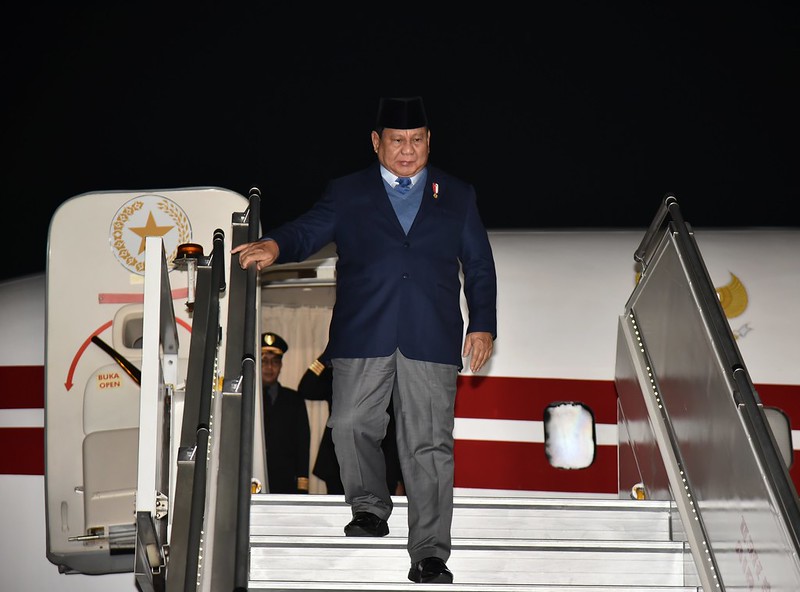
Having waited in the wings for decades, including as a military leader under the late dictator Suharto, Prabowo is now in a hurry. In power for a little more than a year, the 74-year-old former special forces commander is centralizing control, squeezing tycoons, expanding the military’s role in government and putting confidants into key roles, including installing his nephew at the central bank.
After deadly protests broke out last year over inequality and the cost of living, he responded by firing his finance minister, the well-regarded technocrat Sri Mulyani Indrawati, and elevating a loyalist more willing to loosen the fiscal strings. His government last year came close to hitting a long-held fiscal ceiling imposed after the 1997 Asian Financial Crisis.
For Prabowo, the changes are necessary. The goal of Danantara is to harness Indonesia’s wealth, make state-run companies more efficient and provide funds to invest in industries of the future. Land seizures are all about enforcing the law.
Speaking at the World Economic Forum in Davos last month, Prabowo railed against “robber barons” and “greednomics” while vowing to lift up poorer citizens who live in shacks with no clean water or toilets. He has already begun targeting the nation’s tycoons and billionaires, including considering a new law that would allow authorities to seize assets of individuals allegedly involved in corruption without waiting for a criminal process to prove their guilt.
“Let me say this clearly: There is no investment climate without the certainty of equitable rule of law,” Prabowo said. “Nobody will come in to invest in a country that’s lawless or of dubious legal tradition.”
The Martabe gold mine in Sumatra, Indonesia’s westernmost main island, is just the latest bellwether for where Indonesia might be heading. The communications have been confusing throughout, and it remains unclear how the dispute will be resolved.
Within Danantara, an agency created by Prabowo last year that brought Indonesia’s state-owned enterprises under one roof, a debate has been brewing over the merits of obtaining the gold mine. The fund’s mining unit has yet to communicate plans internally to initiate a takeover, according to one person familiar with its inner workings, noting there is some concern among Danantara executives that a seizure would hurt investor sentiment.
Jardine’s executives initially told institutional investors they didn’t know the status of the gold mine and were racing to find out, according to people familiar with the matter. Senior officials at Danantara eventually told Jardine that the sovereign wealth fund had no intention to take over the mine, but they needed to wait for guidance from Prabowo before formally responding, one of the people said, asking not to be identified discussing private conversations.
Prabowo’s communications office declined to comment and referred questions to Danantara, which didn’t respond to requests for comment. Asked for comment, Jardine said Thursday that its subsidiaries hadn’t received any formal communication from Prabowo’s government about the status of the mine. Discussions are ongoing with Indonesian regulators but next steps are still to be determined, the company added.
Although Indonesia has many things going for it — a young and large population, relatively high levels of consumption and abundant resources like nickel, coal and gas — the negatives are adding up both for companies making investments and traders looking for alternatives to the dollar.
Amid one of the biggest selloffs in Indonesia in decades, officials in Jakarta last week raced to stem the bleeding: They vowed to quickly address MSCI’s concerns over the transparency of shareholding structures, including by doubling the free float to 15% — a figure on par with Thailand though below the 25% in India. The heads of the stock exchange and Financial Services Authority resigned.
The flurry of activity worked, at least for a bit, with the index appearing to halt its freefall despite large swings in recent days. Market players noted that the MSCI move mainly affected equities, without much initial impact on the currency and bonds.
But they also said the index provider had a point. The problems had been festering for years, with regulators taking little action to make changes before MSCI stepped in with a statement. Now Indonesian officials have until May to prevent a downgrade, and many investors are hopeful that the episode will spur reforms that ultimately boost market sentiment in the long term.
“If they don’t shape up, they will have lost a big opportunity,” said Greg Lesko, portfolio manager at Deltec Asset Management, citing Indonesia’s demographics and the global rate cycle as positives. “Hopefully the MSCI was a wakeup call.”
That sentiment was echoed even by key officials with Danantara. Pandu Sjahrir, its chief investment officer, said at an economic forum last week that MSCI had long been clear about what the overseers of Indonesia’s stock market need to do.
“I’ll leave it up to the regulators to decide how they want to work on this,” he told an audience at the Grand Ballroom of the Ritz Carlton Pacific Place, across the street from the stock exchange. “I think the information is accurate, and you can’t blame anyone. I think what MSCI did was right.”
The swift reaction by Prabowo’s government to the MSCI statement stood in stark contrast to the confusion over the land seizures. His government last year confiscated an area the size of Switzerland, describing the land as being used illegally. Prabowo last month suggested he could double those holdings in 2026 to fight what he called “hundreds of illegal mines.”
In Davos, the president made no apologies.
“Perhaps these rapacious so-called entrepreneurs feel that they need not recognize the sovereignty of the Indonesian government,” Prabowo said.
The Martabe mine, which is controlled by Jardine through subsidiary PT Astra International, is among 28 operations that had licenses revoked for alleged environmental damage in the wake of devastating floods in December that killed more than 1,100 people in Sumatra. Jardine said Thursday that government investigations into whether the mine impacted flooding are still ongoing.
The dripfeed of statements on government actions regarding the Martabe mine are adding to the confusion, along with Danantara’s role in the episode. The plan for a new company called Perminas to take over the gold mine slipped out when Dony Oskaria, Danantara’s chief operating officer, made the disclosure last week to reporters at a public forum.
At a business forum in Jakarta this week, Purbaya — who took over as finance minister in September — said MSCI’s warning was good for Indonesia. He also called Prabowo’s government “very fair,” saying the revocation of permits for some mining companies was a step toward fostering a positive investment climate.
“It’s not the end of the game,” Purbaya said, referring to the disputed gold mine. “Jardine can always complain, or complain to our government, as long as they conduct their business properly.”
Separately, Hashim Djojohadikusumo, Prabowo’s younger brother and one of his closest advisers, said Tuesday that the 28 companies could appeal the decisions in the courts. In particular, he noted, firms with operations unrelated to floods should have them restored.
“The president has said several times, including to me, that he doesn’t want a miscarriage of justice,” Hashim said. “If the company objects, they should immediately file an objection. I think that’s absolutely right.”
PT Agincourt Resources, which directly operates the Martabe mine, didn’t respond to requests for comment. PT United Tractors, the listed unit that controls Agincourt, said late Thursday in a response to a stock exchange inquiry that Agincourt hadn’t received any information regarding the proposed transfer of the mine to Perminas. Astra International didn’t respond to a request for comment.
Indonesia has refrained from outright cancellation of contracts since 1998, when Suharto’s order to suspend all infrastructure projects led to a prolonged international legal battle over a power plant that involved US investors, according to Kevin O’Rourke, a principal at Jakarta-based consultancy Reformasi Information Services, who has written about the country’s business climate for decades.
“If the government does indeed proceed with unilateral revocation of Agincourt’s contract, this would inevitably reverberate in all economic sectors and further hamper prospects for valuable FDI,” O’Rourke said.
The episode also lands at a moment investors are watching a broader set of signals about how power is being exercised — from court cases that draw international attention to changes that touch core economic institutions.
Prabowo raised eyebrows last year when he backed Suharto, his former father-in-law who led Indonesia for three decades, as a national hero — a move that infuriated human rights groups. Critics have questioned the military’s expanding role, including new development battalions linked to the food-security push behind Prabowo’s free meals program, even as troops have been used to accompany teams seizing illegal plantations.
The narrative of a “New Indonesia” took hold a decade ago when the country elected Widodo, its first president from outside the military or political elite. He presided over an expansion of infrastructure in Indonesia, including a planned new capital outside Jakarta, but he also disappointed many supporters by eroding democratic institutions during his second term.
The concentration of power in the presidency under Widodo has now accelerated under Prabowo, according to John Sidel, director of the Saw Swee Hock Southeast Asia Centre at the London School of Economics and Political Science.
“The election and inauguration of Prabowo has marked a real low point in terms of the evolution of Indonesian democracy,” he said. “Arguably it could be worse, and perhaps there is worse to come.”
(By Ben Otto, Rosalind Mathieson, Abhishek Vishnoi and Echo Wong)

{{ commodity.name }}
{{ post.title }}
{{ post.date }}
Comments