Trump coal regulator to boost state role in mining oversight
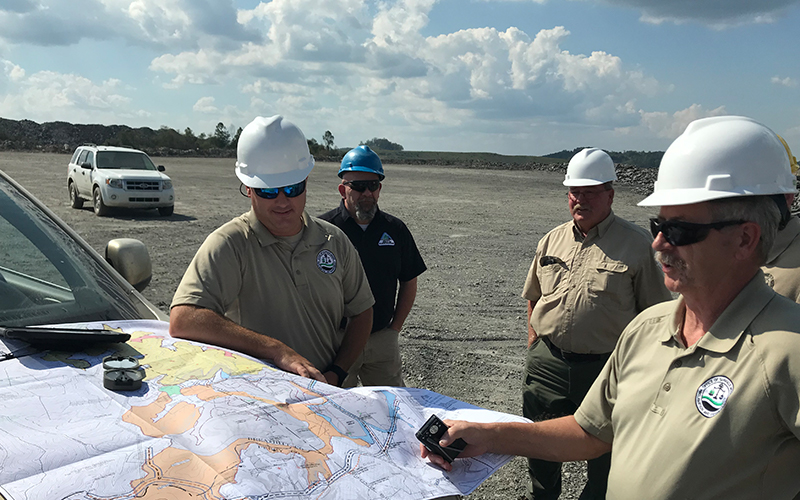
Lanny Erdos is the son of a coal miner whose father toiled underground in Ohio. Now, Erdos is on the front lines of President Donald Trump’s bid to revive coal demand and production.
On Wednesday, Erdos’ Interior Department Office of Surface Mining Reclamation and Enforcement will lift 2024 requirements that made it easier for citizens to compel coal operators to address potential violations.
Conservationists warn the shift will slow enforcement and delay OSM notices requiring states to correct violations or explain why they can’t. But Erdos argues the Biden-era policy went too far in limiting coordination between federal and state officials after complaints were filed, leading to duplicative investigations and adversarial relationships.
“If they received a citizen complaint, OSM was not permitted or allowed to call the state and gather information,” even if the state had already conducted its own investigation, Erdos said. “They couldn’t call the state, which makes zero sense to me as a former state regulator.”
The regulation being published Wednesday requires citizens to notify state regulators first and removes some deadlines, replacing them with mandates for corrections “as soon as possible.” The Interior Department has said the earlier timelines weren’t required by federal law and risked stifling informal discussions between federal and state regulators.
Erdos says federal-state consultation before a potential 10-day notice will foster collaboration, not confrontation.
The reviews will “be just as timely as they’ve always been,” he vowed. “We need to work with the states and not against the states.”
Conservationists and grassroots advocacy groups say the changes weaken a key enforcement tool. They argue it dilutes urgency in responding to complaints about potential air and water pollution by introducing an open-ended federal-state consultation process. Some have threatened to challenge the rule in court, reprising their fight against a similar regulation from Trump’s first term that was later repealed under former President Joe Biden.
“That consultation period inserts an uncertain time frame before that 10-day clock starts ticking, so now there’s effectively no mechanism to move the process along,” said Matt Hepler, an environmental scientist with Appalachian Voices. “It potentially becomes a huge black hole.”
Still, the move is consistent with the federal government’s approach to coal under Trump, who’s hailed the fossil fuel as “the most reliable, dependable” form of energy and tasked his administration with boosting its use.
Trump has ordered the Pentagon to buy coal-fired power, his Energy Department has directed some plants to keep running and his Interior Department is offering more federal land for coal leasing. The Trump administration has also withdrawn some federal subsidies for renewable power projects and is easing regulations that encouraged a shift away from coal. Last week, flanked by coal miners and industry leaders in the White House, Trump hoisted an award from an industry group proclaiming him the “Undisputed Champion of Coal.”
For Erdos, 67, the issue is personal. The regulator grew up in New Athens, Ohio, a town of 438 people where his grandfather, uncles and friends’ parents worked in the mines. His father spent roughly three decades at the Y.&O Coal Company Nelms No. 2 Mine, many of them underground operating a machine that shears coal, before later taking a job at a power plant that burned it.
“Virtually everything I ever had as a child growing up came from coal,” Erdos said. “All the folks that I knew and all the kids that I ran around with, all their parents worked in the mining industry. From a very young age, mining provided everything for me.”
Erdos led the OSM during Trump’s first term too and previously served as a coal regulator in Ohio as well as an executive with the coal company Eagle Specialty Materials LLC. Erdos said his experience in Ohio informs his view that state regulators are best positioned to understand mining conditions within their borders, a belief that underpins both the revised 10-day notice policy and his broader push for federal-state collaboration.
In his Interior Department office, Erdos has hung a photo showing a massive power strip mining shovel known as the Silver Spade — a mechanical beast whose 105-cubic yard bucket was capable of scraping up 315,000 pounds of rock and soil in a single scoop. It isn’t visible inside the photo frame, but about a quarter mile away is his childhood home.
(By Jennifer A. Dlouhy)
More News
{{ commodity.name }}
{{ post.title }}
{{ post.date }}

Comments