US shale drillers seen lifting crude output on Hormuz-driven price rally
US shale drillers are expected to follow President Donald Trump’s call for higher oil production — but not just because he said so.
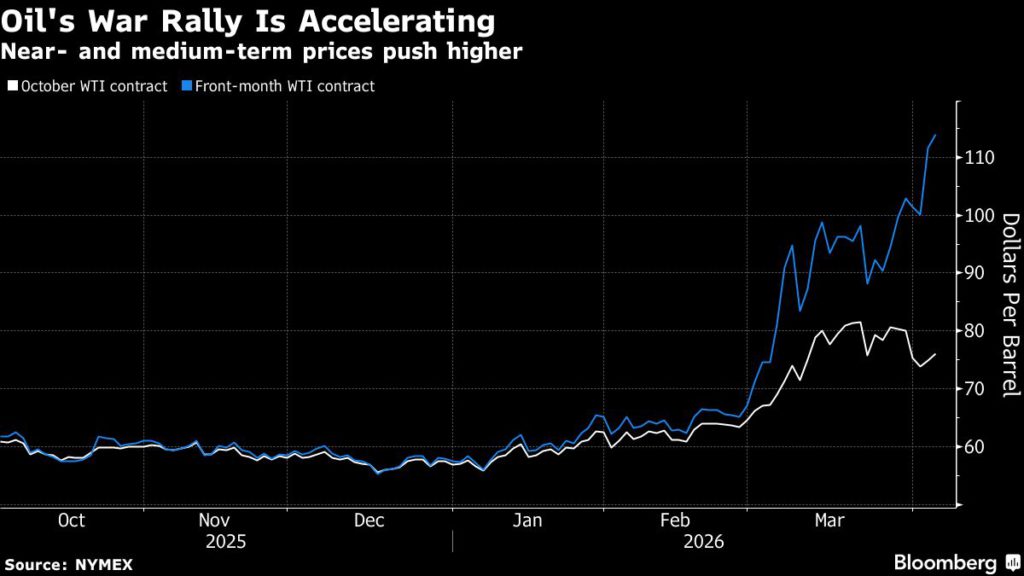
The 68% surge in crude prices since the US and Israel commenced attacks on Iran roughly five weeks ago is incentive enough to compel American oil executives to ramp up output, according to observers as diverse as Citigroup Inc., Enverus Inc. and government analysts at the Energy Information Administration.
Shale explorers require oil prices somewhere between $62 and $70 a barrel to turn a profit on new wells, according to the Federal Reserve Bank of Dallas. As of midday Monday, the US benchmark was close to $113.
“Elevated prices are certainly going to increase production in the United States,” Mike Sommers, chief executive officer of industry lobby group the American Petroleum Institute, said during a Bloomberg Television interview. “You are going to see that over the course of the next few months.”
Billionaire wildcatter Harold Hamm was the first prominent shale boss to publicly commit to lifting production last week when his Continental Resources Inc. boosted its capital budget and output target. Even among rivals that have yet to sign on to pumping more crude, hedging has been rampant to lock in elevated pricing for the barrels they’re already planning to extract.
The Trump administration has repeatedly called on US companies to increase crude output, often to no avail because management teams were loathe to sink capital into new wells when oil prices weren’t high enough to meet profit thresholds.
But that’s all been turned on its head since the biggest oil-market disruption in history kicked off with the Feb. 28 attacks on Iran and subsequent closure of almost all vessel traffic through the vital Strait of Hormuz.
It may take months to begin to see the uptick in production from shale fields in places like the Permian Basin on West Texas and New Mexico because of the lead time required to drill, frack and turn on new wells, according to forecasters Enverus and Rystad Energy.
The production boost will initially come from wells that have been drilled but await fracking, according Alex Ljubojevic, head of US supply at Enverus. Those are known as drilled-but-uncompleted wells, or DUCs.
“You will definitely see operators that can, bring forward those DUCs just to get those volumes online,” Ljubojevic said.
The process of drilling and bringing a new shale well online can take as long as nine months, which means the futures curve is more important than current prices for planning purposes. On that curve, West Texas Intermediate crude futures for October delivery have averaged almost $76 since the conflict erupted and topped the $84 mark two weeks ago.
To be sure, daily injections of a few hundred thousand barrels would pale in comparison to the scale of supply disruption underway because of the Hormuz shutdown, which JPMorgan Chase & Co. estimates will reach 13 million barrels a day this month.
And the response from the US is likely to be more muted that in 2022 — when Russia invaded Ukraine — because so many fast-growing small producers have been acquired by large corporations, Ljubojevic said.
Exxon, Chevron
“You don’t have all these little independent privates going out there seeing price and just responding to it,” he said. “That’s a really big thing.”
Exxon Mobil Corp. and Chevron Corp., two of the biggest Permian Basin drillers, have a “higher probability” than peers of increasing shale output, according to Jason Gabelman, an analyst at TD Cowen. Exxon already had aggressive growth plans through 2030 while Chevron had previously guided to a production “plateau” after years of rapid increases.
“Our take in the first couple of weeks was that operators will look for a signal that price growth or high prices will be sustained before committing any capital into drilling new wells,” Matthew Bernstein, vice president for North America oil and gas at Rystad, said during an interview. “Now, a month into the conflict, I think we’re starting to see that signal emerge.”
(By David Wethe and Kevin Crowley)
More News
Miners escape from attacked coal mine in Russian-controlled Ukraine, official says
April 06, 2026 | 12:31 pm

Panama moves to unlock copper from First Quantum mine
April 06, 2026 | 11:03 am
{{ commodity.name }}
{{ post.title }}
{{ post.date }}
Comments