Vietnam traders back gold reforms as draft plan is unveiled

Vietnam’s plans to loosen the state’s grip and reform the gold market will help reduce currency volatility and narrow an outsized gap between domestic and global prices, according to the nation’s gold association.
“The policy move will better regulate the gold market, limit smuggling and help stabilize the dong,” Huynh Trung Khanh, vice chairman of the Vietnam Gold Traders Association, said in a Sept. 25 interview in Ho Chi Minh City.
The State Bank of Vietnam on Monday asked ministries for feedback on rules that will set quotas for shipments of gold based on monetary policy goals, market demand, and foreign reserves, according to a copy of the draft circular from the central bank. The regulations will take effect from Oct. 10 and are in line with previously disclosed plans to end the government’s monopoly on imports and exports of bullion, let some companies and banks obtain licenses, and allow trading on a state-run exchange.
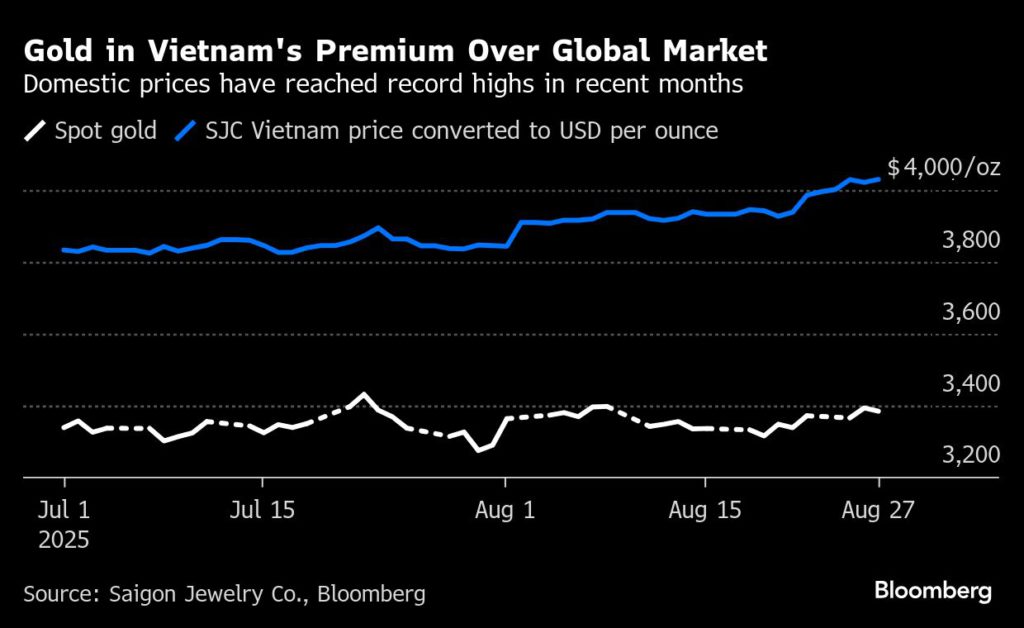
The moves come because prices in Vietnam’s existing gold market have become distorted, with the local premium over offshore prices leading to smuggling and pressure on the dong.
“The Vietnamese government is proceeding with the opening of its market in a careful and controlled manner, given that more than half of the eight approved banks are state-owned,” Lee Liang Le, a Singapore-based analyst from Kallanish Index Services, said before the central bank released the draft. “Nonetheless, this is welcome progress for both Vietnam and its regional counterparts, particularly the easing of restrictions on gold imports.”
The changes have been described as representing a “pivotal shift” for Vietnam, and encapsulate the country’s broader move away from state control to private enterprise.
They also come as investor and central bank demand have helped gold become one of the world’s best-performing commodities this year. But Vietnam’s prices have often run ahead of global rates, despite government efforts to reduce the difference. Gold hit a fresh record above $3,800 an ounce on Monday.
The price gap surged to as much as 20 million dong ($758) per tael last month before easing to about 14 million dong, or a 10% premium to offshore prices, according to Khanh. The government aims to narrow the spread to just 2–3%, he added.
According to the draft released Monday, the central bank will set up a council chaired by a deputy governor to handle gold import and export quotas. Those must be set and assigned no later than December 15 each year.
Vietnamese authorities have said they plan to impose a personal income tax on gold trading to curb speculation in the metal. They are also weighing a requirement for gold transactions to be conducted via bank transfers, to improve market transparency.
That comes after neighboring Thailand said it’s considering a tax on baht-denominated gold trades, amid concern at the market’s impact on the Thai currency.
Khanh said the reforms could have a broader impact than just the gold market.
“Vietnam has the skills and low labor costs to build a world-class jewelry industry,” Khanh said. “With the right policies, we could export billions of dollars’ worth of jewelry, just like our neighboring countries, and we can import gold from the US to process and re-export to China, helping balance trade with both countries.”
Based on import licenses issued in the past, Vietnamese households could be sitting on at least 500 tons of gold, according to Khanh. With the country having seen multiple conflicts in the past century, many people hoard their gold at home, away from the banking system.
“That’s a huge volume of gold sitting idle,” he said. “Bringing it into circulation would spur business activity, curb hoarding and speculation, and ease pressure on the dong.”
(By Francesca Stevens and Nguyen Dieu Tu Uyen)

{{ commodity.name }}
{{ post.title }}
{{ post.date }}



Comments