Chinese firm keeps Canada’s only antimony mine idle
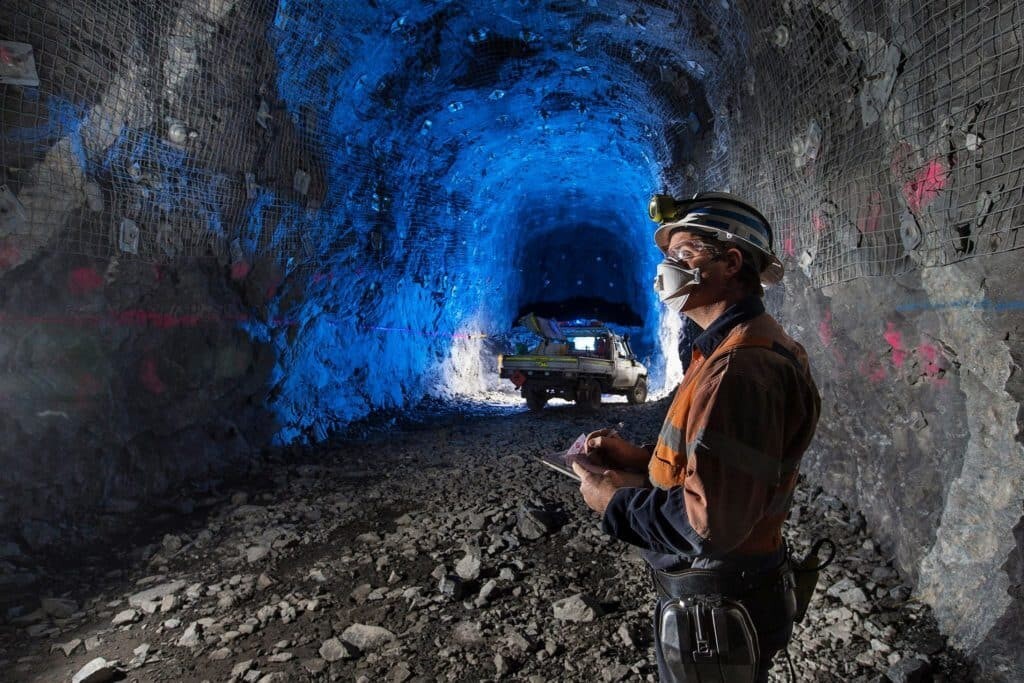
Canada’s only primary antimony mine, the Beaver Brook operation in Newfoundland and Labrador, has remained idle despite rising demand for the strategic metal, highlighting growing concerns over Western dependence on foreign-controlled critical mineral supply chains.
The Beaver Brook mine, located about 45 km southwest of the town of Glenwood, is currently owned by China Minmetals, a Chinese state-owned mining group. Originally acquired in 2009 by Hunan Nonferrous Metals Corp. for $29.5 million, the mine has been under Minmetals’ control for the past 15 years.
Antimony is considered a strategic critical mineral due to its use in flame retardants, lead-acid batteries, semiconductors, and a range of defense technologies including ammunition, infrared sensors and night-vision equipment.
Operations halted despite strategic value
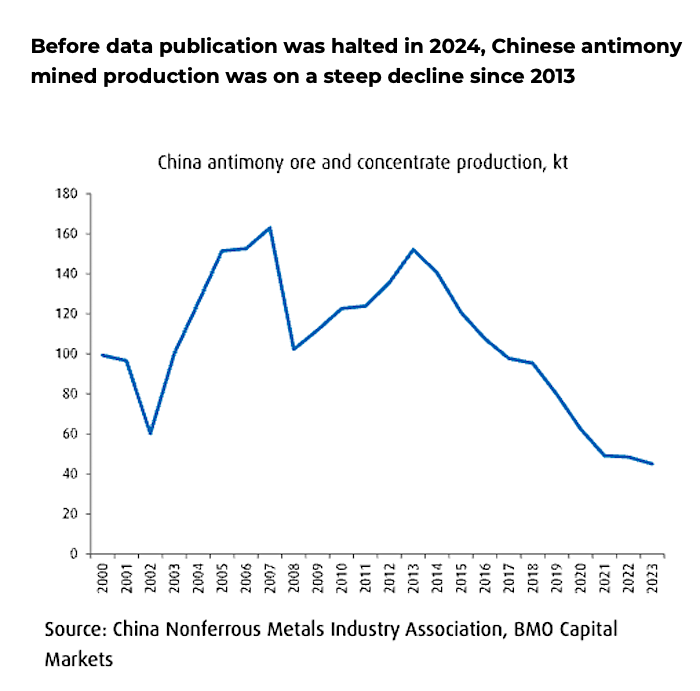
Beaver Brook first began producing antimony concentrate in 2012 but suspended operations the following year amid weak market conditions. The mine briefly restarted in 2019 before shutting down again in 2023.
At full capacity, the project has the potential to produce roughly 6,000 tonnes of antimony concentrate annually, which analysts say could account for about 5% of global supply.
The shutdown came just as countries in North America and Europe began to wake up to the idea of establishing a secure, diversified supply of minerals like antimony under the current geopolitical environment.
China, the main US economic rival, currently dominates the global antimony supply chain, controlling the majority of the mining, refining and processing capacity. In 2024, Beijing began restricting its exports of the mineral, leading to a sharp rise in global antimony prices and exposing the market’s overreliance on one source.
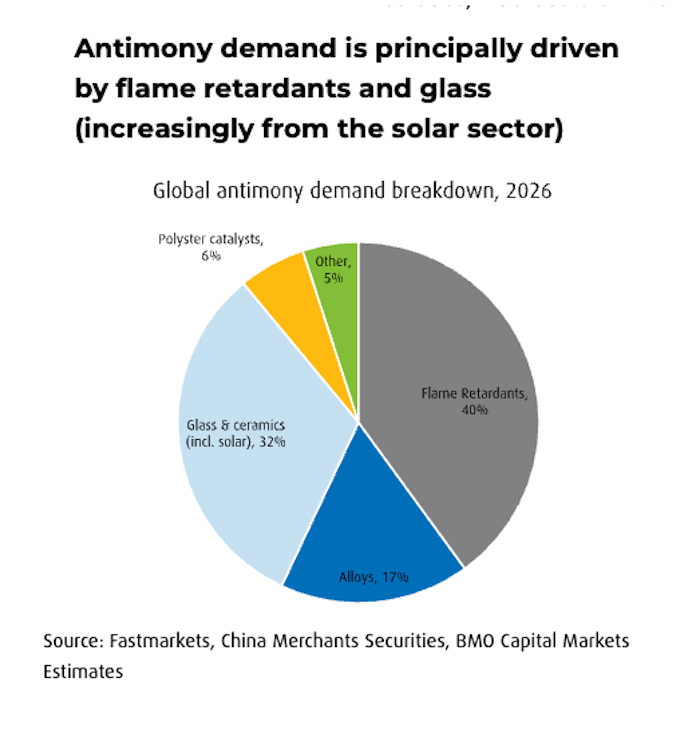
“Antimony has been in a persistent deficit for years, driven by declining ore grades, stagnating Chinese mine investment and strong demand growth from the solar sector,” BMO analysts Helen Amos and George Heppel said in a recent report on the commodity.
“The introduction of Chinese export controls in 2024 served as a catalyst for a dramatic price rally, with Western prices rising from about $13,500 per tonne in April 2024 to nearly $60,000 per tonne by mid-2025,” they said. “The spike created major shortages in Western markets, even forcing some consumers to declare force majeure due to a lack of supply.”
Strategic mineral under the spotlight
The situation has attracted attention from policymakers and industry observers who say the dormant Canadian mine underscores the West’s vulnerability in critical minerals, as highlighted by investigative journalist Sam Cooper.
The Northern Miner president Anthony Vaccaro, during a 2025 presentation cited in Cooper’s report, noted that there has been industry chatter in Canadian mining and political circles about Beijing’s possible strategic intentions for the asset.
“I will tell you, there’s rumors that the Chinese use this — that Beaver Brook is on care and maintenance, but if the price of antimony stays high and other projects come on, they can turn the tap on, flood the market a little bit, drive the price back down, discourage others from entering,” Vaccaro said.
While Canada has pushed to reduce Chinese involvement in parts of its mining sector — ordering Chinese companies in 2022 to divest from several Canadian lithium exploration firms on national security grounds — the Chinese ownership of Beaver Brook has remained unchanged.
The threat of Beijing “manipulating” the global antimony market highlights just one of many complex challenges facing Western governments as they attempt to build resilient supply chains while balancing investment flows and geopolitical considerations.
Critical minerals race intensifies
Demand for antimony is expected to increase as Western governments accelerate spending on defense, electronics and energy infrastructure. The US, Canada and their allies have all launched initiatives to rebuild domestic critical mineral production and processing capacity, aiming to reduce dependence on Chinese supply chains.
In the US, Washington has begun channeling funding toward domestic producers and projects that could supply antimony and other strategic metals. Companies such as United States Antimony (NYSE: UAMY), which operates processing facilities in Montana and Mexico, and Perpetua Resources (NASDAQ: PPTA), developer of the Stibnite Gold project in Idaho, have attracted millions in funding support as part of efforts to rebuild a secure domestic supply of the metal.
Industry insiders echoe BMO’s report, saying that projects such as Beaver Brook could become increasingly important as countries look to secure reliable sources of strategic metals.
“Even though the recent surge in artisanal mining in Myanmar has helped ease shortages and pushed prices down from their peak, antimony remains a market of key strategic importance,” Amos and Heppel said.
“The metal is extremely difficult to substitute in many military applications, while mining and refining capacity remains heavily concentrated in China, Russia and Tajikistan. For that reason, we continue to characterise antimony as a ‘most critical’ metal for Western supply security.”
For now, however, Canada’s only antimony mine remains on care and maintenance, leaving the country without domestic production of the metal.
More News

{{ commodity.name }}
{{ post.title }}
{{ post.date }}
10 Comments
Lepre Chaun
Buy AMG Critical Materials on stockmarket Amsterdam AMX they have antimony and other critical materials such as vanadium, lithium, antimony , tantalum and lithium hydroxide and other
Clint price
The mine should be producing. A massive carbon tax on imported antimony should do it.
Juris Zdanovskis
The Canadian government should force China to sell the mine to a Canadian company. Do the same as we did concerning lithium.
Bronson Dietrich
America will not let China continue to control and manipulate the ore market in Canada. The liberals in Canada are selling their country physically to China. It’s only going to go so far before Daddy Trump or someone with his mindset steps in to put a big halt to this market manipulation and foreign owned mines by China.
Garn
Bronson – “America will not let….”
America is in crisis. America is in a period of decline. America is being led by a felon with impending charges for pedophilia. America is being led by someone Canada, and the entire world despise, do not trust, and is moving away from. America is losing relevance.
Ozzie Awesome
Harper was pm when this mine was sold to Chinese firm.
Paul andrie
Canada, europe and all of the democratically elected free world need to wake up to china. Theyhave long term well executed plans to dominate the world. Controlling rare earths is part of that plan. Canada should not give them opportunities to do that. Canada has world class resources and world class minig companies. Dont let the chinese control canada!
Dave mann
Nationalize it have Canada company start operation
Randall L Files
Canada better get out of bed with China, before they get financially raped.
Ozzie Awesome
Trump is also a convicted sex offender,a pathological liar and will be further charged once he leaves office.How such a person can retain the office he has shows the huge faults in the American system of government.Countries like Canada should be thankful for American neighbors and support through the years and I would say they generally are but America owes much to its allies also and shouldn’t be so arrogant when discussing these matters.As is already taking place with many new trade deals,Canada’s and others dependence on American economic dominance is rapidly declining and will continue to do so all because of poor policy and myopic decisions by a very amateur administration.Lokk for your next government in America to desperately try to repair the damage done by Trump.