US deploys AI agents to speed critical minerals recovery

A US Department of Energy (DOE) research team has developed AI agents capable of designing and optimizing critical minerals recovery methods from industrial waste in days instead of the months or years typically required through manual laboratory work.
The team at the Pacific Northwest National Laboratory (PNNL), led by materials scientist Elias Nakouzi, built a semi-autonomous system called Computer Intelligence for Critical Elements Recovery and Optimization, or CICERO, that combines AI agents, robotics and analytical instruments to evaluate mineral recovery methods and assess their economic and industrial feasibility. The researchers detailed the results in the journal Materials Horizons.
“We connected a liquid-handling robot, a sample handling device, and two analytical instruments and created an AI-aided workflow that quickly isolated critical minerals from industrial samples,” Nakouzi said. “Developing an effective method to isolate one element from the soup can take months or years. We have reduced that time to days with CICERO.”
The researchers at PNNL, one of ten national laboratories owned by the DOE, tested the system on spent magnets and wastewater from oil and gas extraction. AI agents analyzed the feedstocks and recommended recovering magnesium from wastewater, as well as neodymium, praseodymium and samarium from magnet waste.
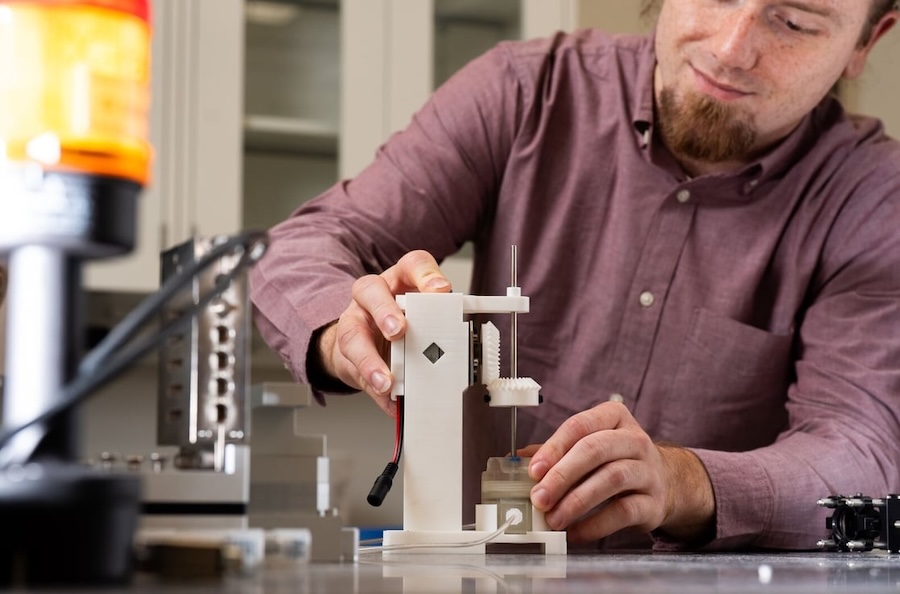
The agents used scientific literature to design 96 simultaneous experiments within a day, including chemical recipes, sequencing and timing instructions, before robotic systems carried out the procedures.
The work highlights growing efforts to secure domestic supplies of critical minerals used in electric vehicles, renewable energy systems, aerospace technologies and nuclear reactors.
Researchers said CICERO could help industry extract value from waste streams using chemicals and separation methods already common at industrial scale, potentially reducing dependence on new mining projects while boosting US supply chain resilience.
More News
{{ commodity.name }}
{{ post.title }}
{{ post.date }}
Comments