Ground view Kazakhstan: The visibility bargain
Kazakhstani steel and mining company Qarmet inherited mines from its Western predecessor that had killed more than fifty people in the prior year. It answered with a near-total tracking and surveillance system that would shock most Westerners. It is also a stunning display of humanity.
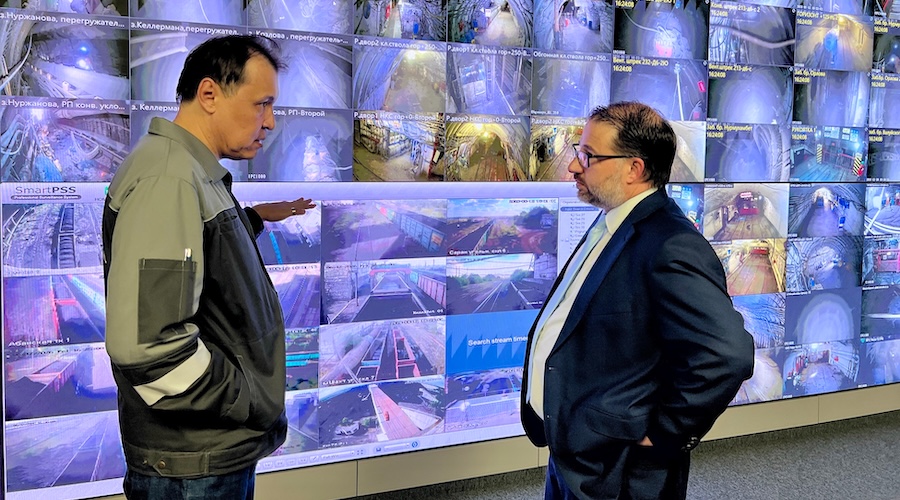
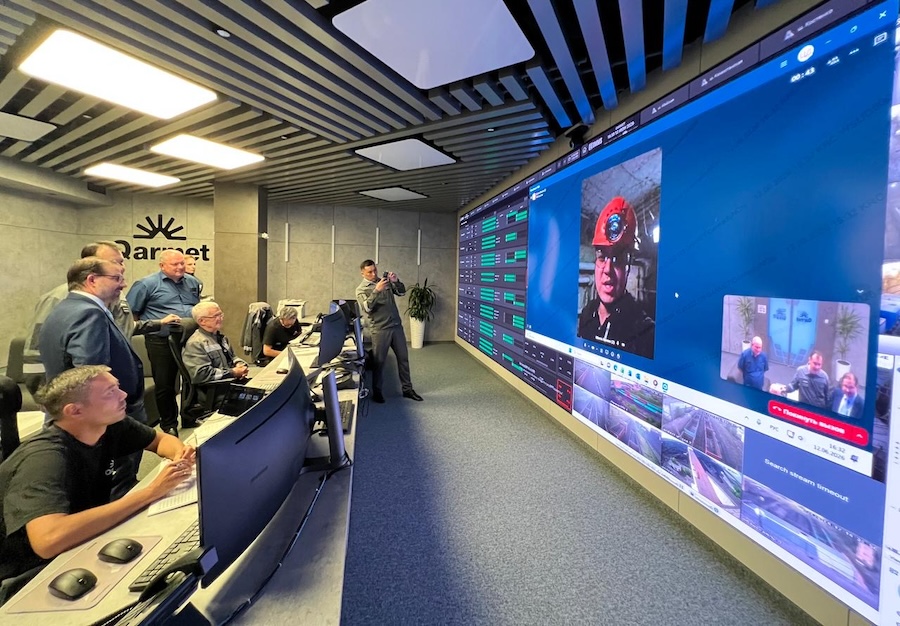
In a control room in Karaganda, a wall of screens showed the schematic of a coal mine, and on it a scatter of moving points, each point a miner somewhere underground. My hosts invited me to choose two of them at random. Within seconds an operator opened a video call to the first miner’s company-issued phone, and there he was, a kilometer below ground in a nearby mine, face lit by his headlamp, lifting a gloved hand to a stranger from Tennessee he would never otherwise meet. Then the second man, the same way.
I had come to observe Qarmet’s new safety system. What I was shown instead was harder to file: a workforce that is, at every minute of every shift, located, reachable, and recorded.
I will be honest about the first thing I felt, which was not unease but awe. I was not prepared for how advanced the operation was, or for the fact that a Kazakh company had built so much of it with its own people. The unease came later, as the awe wore off, in the recognition that a tool this capable, aimed slightly differently, becomes the architecture of a place no one would choose to work. Then I remembered what it was built on top of.
On October 28, 2023, a methane explosion tore through the Kostenko mine, then owned by ArcelorMittal’s Kazakh subsidiary in Temirtau. Forty-six men died. It was the worst industrial disaster in the history of independent Kazakhstan, and it was not isolated. Five miners had been killed months earlier in a conveyor fire at another of the same company’s mines, with the state’s emergency minister finding the employer wholly at fault.
Across the ArcelorMittal era, which began in 1995, more than 180 workers died in some eighteen significant accidents at these operations. “Safety measures are built on blood,” Yerbol Ismailov, the Qarmet managing director who led my visit, told me, and he did not offer it as a slogan. He said it the way a man delivers a painful truth he has had to personally live with.
This story begins with those men who died that October day, and with what their new employer decided to do so that the failures of their predecessor would never be repeated.
After Kostenko, President Tokayev ordered an end to the state’s investment cooperation with ArcelorMittal. Within weeks the Kazakh business was sold to a state fund and renamed Qarmet, with operational control passing to a domestic group under the businessman Andrey Lavrentiev and a new chief executive installed at the president’s direction. A Western multinational had been removed from a strategic asset on safety grounds, and a national company was rebuilding it.
A disclosure belongs here. My trip was facilitated by the Astana Mining and Metallurgy Congress and coordinated with Kazakhstan’s Ministry of Foreign Affairs, which assigned a liaison who handled logistics, translation, and introductions. This Qarmet visit was not on any official itinerary. It grew out of a booth I passed on the exhibition floor an hour before an unrelated interview with a company executive, and a question I asked afterward about filming the safety display. Instead of footage, I was offered a tour of the control center the next afternoon, three hours’ drive each way.
What I was shown was the embodiment of what is called the Visibility Bargain: Qarmet has bought a dramatic improvement in safety by imposing near-total observation of the underground miners it employs. Stated in the abstract, this level of surveillance in an office or a city describes something we would expect in a dystopian novel. Stated in a gassy coal basin that buried forty-six miners in a single afternoon, it describes something closer to mercy. Both readings can be true at once, and it is the context, not the technology, that decides between them. Ismailov uses a Russian proverb for it: it is hard to catch a fish in unclear water, so you clear the water first. You cannot prevent what you cannot see. Today, Qarmet sees everything.
The watching begins before a miner is underground. At the portal sits what looks like a more serious version of the blood-pressure booth in an American pharmacy. A worker steps in for about a minute while it checks, among other things, blood pressure, pulse, signs of eye fatigue, and alcohol, and each booth can clear roughly fifty people an hour. On an average day, about one in a hundred fails and does not descend. That one percent is the most quietly humane figure I encountered, and the most intimate reach of the bargain, because it makes a man’s own pulse a condition of his shift.
Below ground, the observation is continuous. Each helmet carries a camera recording to a terabyte of onboard storage, uploaded at the end of every shift, so that there is a record of essentially everything that happens at the face. The live layer is the one I watched in the control room: every worker a point on the mine plan, any of them a video call away. Qarmet built the system almost entirely in house, Ismailov said, with a team of about thirty people for each of its eight mines. When it arrived, the workforce resisted it for the better part of a year before the resistance faded, partly through habit and partly because it began to produce results they could see.
The hard question is not whether this is surveillance. It plainly is. The question is what separates surveillance that protects from surveillance that controls. The answer cannot be the good intentions of the people running it, because intentions are the one thing you cannot audit. The test that holds up is concrete: who is the watching for, can the watched see its benefit in their own lives, and can they refuse it?
On the first two, Qarmet’s case is strong. The beneficiary of a methane sensor and a pre-shift pulse check is, first, the miner, and for now the tools track safety rather than dissent. The benefit is also visible a mile from the control room, at the company’s own medical center, built with private money and no state funding, running about two hundred checkups a day with twenty-two doctors. Every miner gets at least one examination a year and can ask for more. We walked through the half of the building still in the condition Qarmet inherited in 2023, which Ismailov described as “anti-human”; the unfinished half could pass for a haunted house. “You can’t expect productivity from employees if you don’t invest in them,” he said. The clinic is now good enough that other companies pay to send their workers to it.
The third question, whether the watched can refuse, is where I have the least to go on, and where the setting counsels caution. Resistance that fades is not consent freely given, and a workforce in a company town in central Kazakhstan does not bargain from strength.
And even when the answers come out well, they come out well because of how this company is run at this moment. Ismailov is, by every sign I saw, a true believer: two decades in oil and gas, a doctorate in social stability, and a sober passion for the welfare of his workforce that is hard to fake. He calls the whole effort, safety and monitoring and health, an “ecosystem,” and refuses to let any piece of it stand alone. He is, in the honest sense, the hero of this story. But you cannot institutionalize a man. The network that locates a miner in a collapse also locates one who lingers too long on a break, and the cameras that clear a crew can document its every move. A successor who keeps the productivity mandate and lets the welfare half of the ecosystem wither would inherit a powerful tool already built and already accepted.
None of this counts for much if the safety gains are not real. Qarmet told me that since the system went in, not one worker has died in these mines, even as production roughly doubled. If it holds, that is the whole argument in a sentence: a basin that killed fifty-one people in 2023 has since buried no one. Safety incidents have also plummeted to almost zero. Given the impromptu nature of the visit, I could not obtain or verify the granular record of reportable incidents and lost-time injuries that a U.S. regulator would treat as the real audit trail, so I report the claim as the company’s. But based on what I observed, I find the reported safety results to be very credible.
What I can credit beyond the company’s word is a structural reason the gains might last. Only three of the eight operations were running when Qarmet took over at the end of 2023; all eight run today, with six beating their production targets on the control-room displays. I had assumed part of any improvement would be compositional, the deadliest mines simply idled and reported as progress. The opposite is true: the company reopened every mine and raised output across them. As for why conditions decayed so far by 2023, Ismailov offered the most persuasive explanation I heard. Under ArcelorMittal, he said, it had grown cheaper to source coking coal elsewhere than to mine it here, and a mine that is no longer essential to its owner stops being cared for. Almost all of Qarmet’s coal now feeds Qarmet’s own furnaces. These are captive mines, and if he is right, 2023 was less an accident than a destination, and the recovery less luck than the predictable result of the mines mattering again. That is the most durable safeguard on offer, and it carries its own limit, because mines that must run can be pushed as easily as protected.
So I do not know whether the bargain will continue to hold as it does currently. The man who drives it today is a true believer driven by a noble mandate, and the mines now matter too much to be abandoned again; those are real reasons for hope. Neither is a guarantee, because belief is mortal and strategy can change its mind. What would make it safe is not a purer motive or a larger budget but rules written into institutions rather than into one man’s conscience, rules that hold no matter who is watching the screens.
On the drive back to Astana, at dinner, a Kazakh university student assisting our group, barely into his twenties, told me something I had not specifically asked about. Like many of his peers, he had grown up assuming that foreign meant quality and domestic meant second best. Seeing what his country’s own engineers had built at Qarmet had changed that. He recalled hearing about Kostenko in 2023 and seeing the outrage among the people. Now seeing how a Kazakh company fixed it so thoroughly using a Kazakh-built solution gave him an additional sense of pride in his country.
He is right to be. The two miners chosen at random on the screen went home that night because they were never, for a moment, out of sight. That is the bargain, and Kazakhstan has paid it in full. What no one could yet tell me is who holds the lens once the man who guides it now is gone.
* Erik Groves is a contributing analyst for MINING.COM and Corporate Strategy and In-House Counsel at Morgan Companies. He recently attended the 16th International Mining and Metallurgy Congress and Exhibition (AMM) in Astana, Kazakhstan. He will be sharing insights gathered at one of Central Asia’s most important mining events.
{{ commodity.name }}
{{ post.title }}
{{ post.date }}
Comments