Canada bets on digital hub to speed mine permitting
Canada is using a centralized digital platform to help accelerate reviews of major mining and infrastructure projects by giving regulators, companies, Indigenous communities and the public access to the same authoritative science and regulatory information.
The Open Science and Data Platform (OSDP), developed by Natural Resources Canada, brings together geospatial science, environmental monitoring, mapping tools and regulatory records from federal, provincial and territorial governments into a single online portal. The platform supports the federal Major Projects Office, launched in 2025 to speed nation-building projects while maintaining environmental standards and reconciliation commitments.
“By providing centralized access to authoritative scientific data, environmental monitoring information and regulatory records, this really makes the impact assessment process more efficient for proponents and regulators, while increasing transparency for all Canadians,” Sonja Kosuta, Senior Director of Impact Assessment and Science Capacity at Natural Resources Canada, told MINING.COM. “It’s a great example of the digital innovation that’s part of Canada’s broader regulatory modernization.”
One example is Newmont’s (NYSE: NEM) (TSX: NGT) proposed Red Chris mine expansion in British Columbia‘s Golden Triangle, where the OSDP provides a curated collection of information ranging from Treaty boundaries and species at risk to existing infrastructure, transmission lines, watersheds and nearby projects. Users can layer multiple datasets on an interactive map, download information for further analysis or connect directly to the original data sources, which update automatically through application programming interfaces rather than static uploads.
Fewer duplicate studies
For mining companies, particularly junior explorers with limited budgets, the platform can reduce both time and cost during the early planning stages. Instead of commissioning studies to locate existing environmental information or government datasets, proponents can access much of that material through a single portal before preparing project descriptions.
“Having access to all this data that’s produced through the government system avoids duplication because companies don’t have to reproduce studies or data that’s already publicly available,” Kosuta said. “That helps avoid unnecessary costs and helps fast-track the assessment process.”
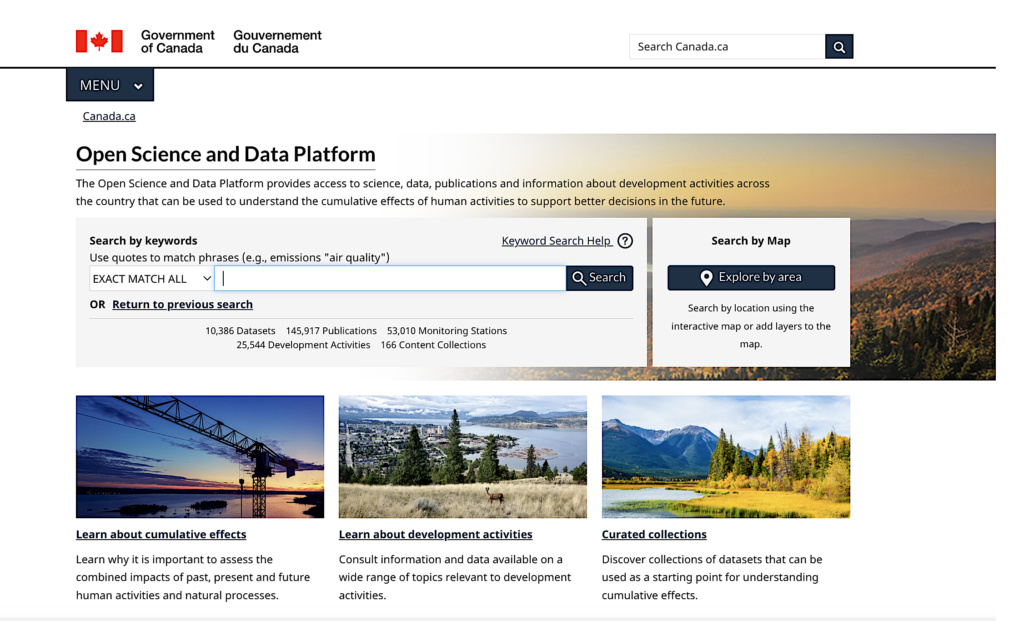
Colter Kelly, Senior Impact Assessment Officer at Natural Resources Canada, said the platform allows users to build a detailed picture of a project area within minutes by combining information from multiple government sources.
“It creates an ecosystem where the datasets used throughout the assessment process are all in one place,” Kelly said. “Whether you’re looking at roads, land cover, First Nation locations or existing monitoring stations, you can layer everything together or download the raw data for further analysis.”
Unlike conventional databases that rely on static copies, the OSDP remains connected to its original data providers through automated interfaces. As provincial and federal agencies update their information, those changes are reflected on the platform without manual intervention, reducing delays and improving confidence in the data, according to NRCan officials.
Ongoing expansion
The platform continues to expand by roughly 10% annually as new datasets become available. Future plans include incorporating additional authoritative non-government sources, introducing artificial intelligence to improve search capabilities and metadata tagging, and converting historical assessment records into machine-readable formats. Officials said any future inclusion of Indigenous-owned information would respect Indigenous data sovereignty and the OCAP principles governing ownership, control, access and possession.
Natural Resources Canada estimates the platform now serves about 200,000 unique users, with roughly 70% returning more than once. Officials said growing public use suggests the platform is becoming an increasingly valuable resource for governments, mining companies, researchers and communities seeking trusted information about Canada’s major projects.
More News
{{ commodity.name }}
{{ post.title }}
{{ post.date }}
Comments