China’s grip on rare earths remains tight amid Xi-Trump showdown

China’s rare earth export controls continue to squeeze global supply chains despite ongoing talks between Beijing and Washington over extending a temporary trade truce, according to Chinese customs data reviewed by Reuters.
The restrictions — first imposed in April 2025 in retaliation for US President Donald Trump’s “Liberation Day” tariffs — have evolved into one of the most consequential legacies of the Sino-American trade dispute, disrupting industries ranging from defense and aerospace to semiconductors and electric vehicles.
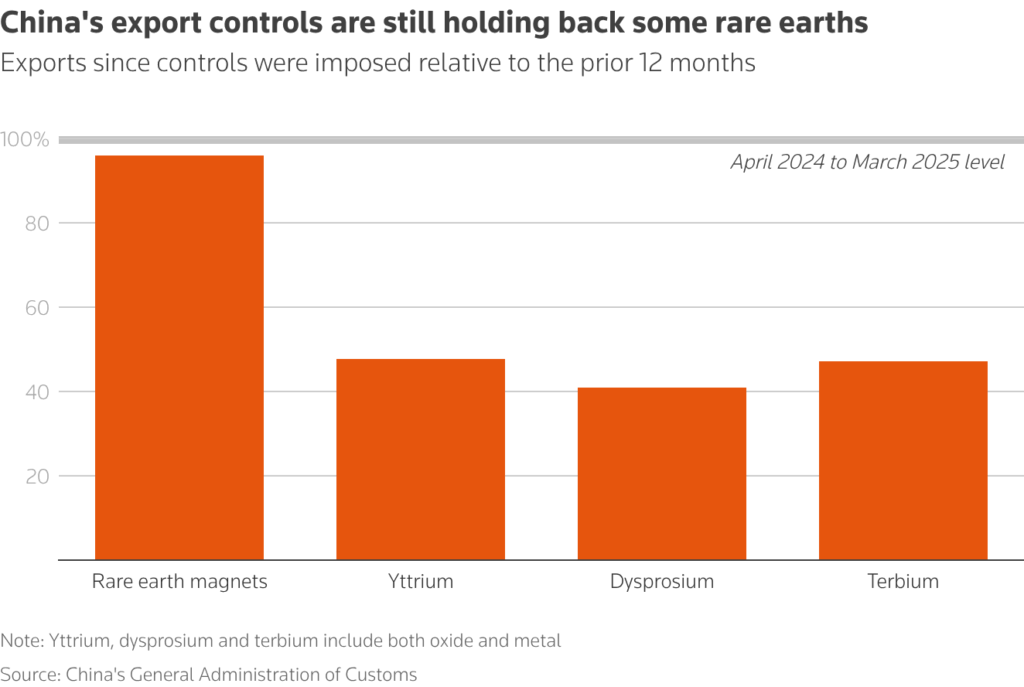
While overall Chinese rare earth exports have largely recovered over the past year, shipments of key heavy rare earths remain sharply constrained. Exports of yttrium, dysprosium and terbium are still down roughly 50% compared to the 12 months preceding the controls, customs data showed.
Those materials are critical inputs for advanced technologies. Dysprosium and terbium are used to strengthen high-performance permanent magnets found in EV motors, wind turbines and military systems, while yttrium is essential in aerospace applications, including thermal coatings for turbine blades.
“Headline export volumes can be misleading,” Ilya Epikhin, senior principal at consultancy Arthur D. Little, told Reuters.
“China appears to be selectively licensing exports while preserving leverage over supply chains considered strategically sensitive, particularly where defense or advanced technology applications are involved,” he added.
The ongoing restrictions stand in contrast to statements from the White House following a summit in South Korea last October, where Washington said China had agreed to “effectively eliminate” current and proposed export controls on rare earth elements.
Although Beijing eased a broader set of trade restrictions after the summit, the April 2025 controls remain firmly in place. China’s Ministry of Commerce has consistently defended the measures, saying export applications are being approved for eligible buyers, according to Reuters.
Trump-Xi talks begin
The issue of rare earths is expected to feature prominently in discussions during Trump’s visit to China this week, his first since 2017.
One US official cited by Reuters stated that discussions between both countries are ongoing, and both sides are seeking stability in rare earth supply chains. However, another official said these shortages continue to affect American manufacturers.
Reuters‘ sources also revealed that the White House was recently forced to intervene directly with Beijing to secure export approvals for a major US industrial group with both civilian and defense operations, after the company reportedly lost hundreds of millions of dollars in monthly revenue because of supply disruptions.
The supply squeeze has already hit the aerospace sector. Reuters reported earlier this year that several US aerospace companies temporarily paused production due to shortages of yttrium.
“The President’s team is engaging continuously with China to ensure the flow of rare earths while building out trusted and resilient supply chains,” a White House official was quoted.
Allies squeezed harder
The impact of China’s controls is being felt well beyond the United States.
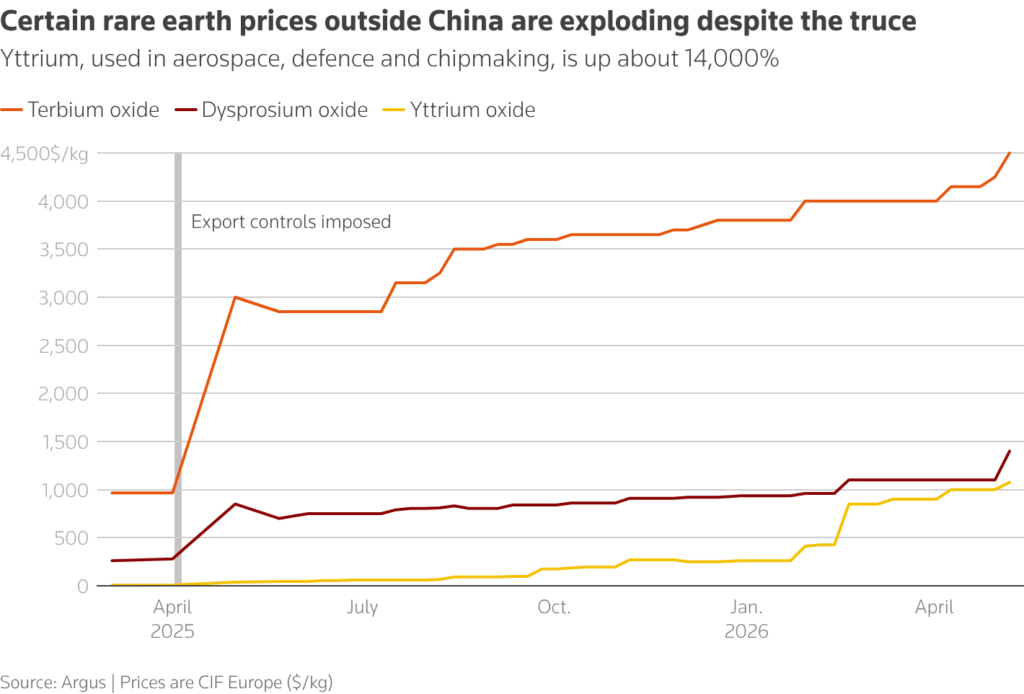
Prices outside China have surged dramatically since April 2025, with dysprosium and terbium prices rising four- to five-fold, while yttrium prices have skyrocketed by about 140-fold, according to data from consultancy Argus.
Japan and Germany — two of the largest consumers of Chinese rare earth materials outside the US — have seen some of the steepest supply disruptions.
Japan, the world’s largest rare earth magnet producer outside China, has received just 4% of its previous dysprosium import volumes since the restrictions began, according to customs data. Germany has reportedly received none.
Manufacturers are now paying between 1.5 and three times more for magnets than before the controls, Benchmark Mineral Intelligence said.
The supply shock has accelerated efforts by the US, Japan, Germany and other G7 nations to diversify away from China’s dominance of the rare earth supply chain through new mining, refining and magnet manufacturing projects.
Still, analysts warn meaningful alternatives remain years away.
“The situation looks set to get worse before getting any better,” David Merriman, research director at consultancy Project Blue, told Reuters.
(With files from Reuters)
More News
{{ commodity.name }}
{{ post.title }}
{{ post.date }}
Comments