Hemlo hits 16g gold at namesake Ontario mine
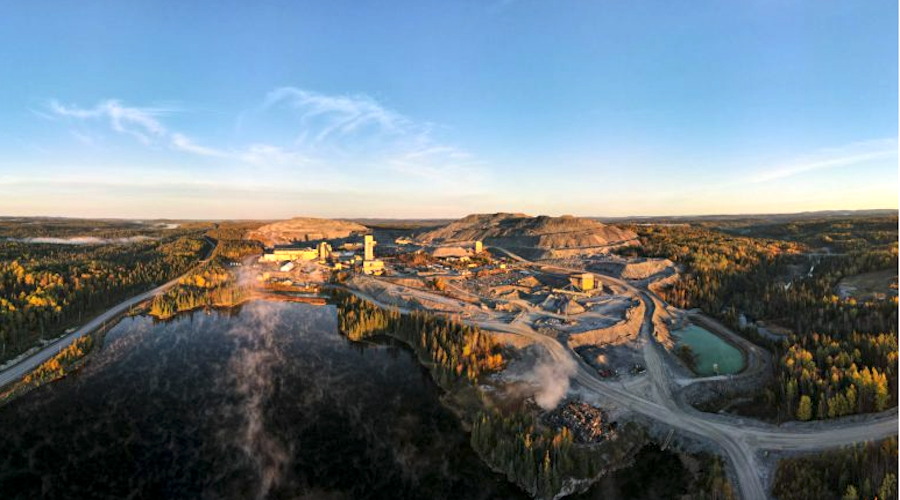
Canadian producer Hemlo Mining (TSXV: HMMC) reported grades as high as 16.1 grams gold per tonne over 8.1 metres from drilling at its namesake gold operation in northern Ontario as the company seeks to expand near-mine resources.
That intercept, from 99 metres depth in hole 7652606 of the South-Rim zone, included a short bonanza assay of 2 metres grading 59.7 grams gold, Hemlo said Thursday in a statement. South-Rim lies immediately south of the mine’s producing C-Zone. The operation is about 800 km northwest of Toronto.
The ongoing drilling activity “potentially unlocks a new high grade mineralized zone 50-150 metres away from the actively mining C-Zone, giving the company a near term low-cost option to increase resources and reserves and extend mine life,” Scotia Capital mining analyst Ovais Habib said Thursday in a note.
Located near the town of Marathon, on Lake Superior’s north shore, the Hemlo camp is one of Canada’s most prolific gold districts. It has produced roughly 25 million oz. gold from underground and open-pit operations since mining began four decades ago.
Toronto-based Hemlo is about one-fifth of the way through a 130,000-metre exploration drilling program planned for 2026 – its first full year of activity since Carcetti Capital acquired the property from Barrick Mining (TSX: ABX; NYSE: B) for about $1.1 billion in November. The program will serve as the foundation of an updated resource that’s expected in the second half of 2027.
Priority target
South-Rim was selected as one of four priority growth targets on the property, Hemlo said. It was identified through a reinterpretation of geological data and proximity to existing infrastructure.
Geologists recently reassessed all available drill data, recognizing for the first time that the intersections are part of a single, plunge-controlled mineralized structure extending over more than 1.5 km vertically and within a 300-metre-wide east-west corridor, Hemlo said. The ongoing drilling campaign is designed to validate this new interpretation.
Mineralization in the area includes significant pyrite, pyrrhotite, and magnetite mineralization with uncommon accessory barite, roscoelite and molybdenite, Hemlo said. It occurs in sub-parallel lenses associated with silicification and carbonate alteration.
Other notable results released Thursday include hole 7652603, which cut 11 metres of 5.79 grams gold from 124 metres depth, and hole 7652607, which returned 5.7 metres of 3.44 grams gold from about 149 metres downhole.
Eastward shift
Drilling is ramping up as planned, Hemlo said. Five drills are operating underground and one at surface, while two other drills are expected to start turning this month.
The first seven holes completed in the 20-hole South-Rim program all intersected mineralization, with the company noting that the system remains open along strike and down plunge.
With South‑Rim now established, exploration is shifting east toward the B‑Zone, where historical intersections remain largely untested, Hemlo said. Company executives believe they could find widths and grades comparable to the C-Zone.
Hemlo shares rose 3.9% to C$6.35 Thursday morning in Toronto, valuing the company at about C$1.9 billion ($1.4 billion).

{{ commodity.name }}
{{ post.title }}
{{ post.date }}
Comments