Mine operators face worsening wildfire seasons
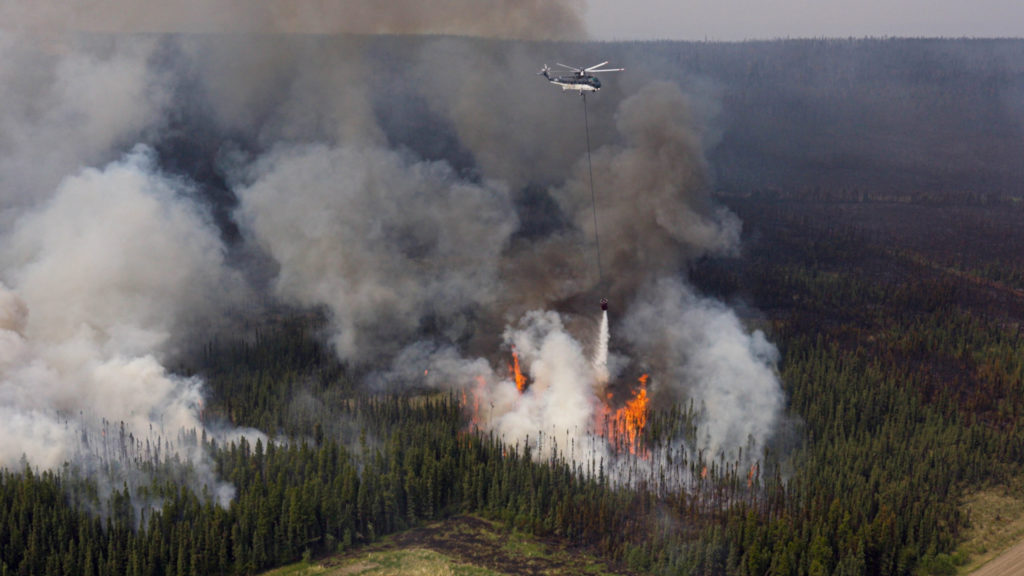
With drought conditions persisting across parts of British Columbia and forecasters calling for a warmer-than-average summer amid a looming El Niño, mining companies are preparing for a wildfire season that could test operations across Western Canada.
Some areas of the province experienced below-normal snowpack and limited spring precipitation, variables that can elevate wildfire risk, Forrest Tower, spokesperson for the B.C. Wildfire Service, said in an interview.
“We’re not seeing as many early wildfire starts this year as we have for the past three years,” Tower said. “It could take a two-day period with a large number of ignitions and from that point on, that’s basically what we’re dealing with for the rest of the summer.”
This year’s El Niño, a climate pattern where Pacific Ocean surface temperatures warm up, is predicted to be very strong and significantly alter weather, amplifying drought and warm winds, which contribute to a more intense wildfire season, according to a seasonal outlook released in June by Environment and Climate Change Canada.
“Once we have fire on the landscape, then all the other conditions come into play, and it just makes those fires more difficult to put out,” Tower told The Northern Miner.
The B.C. Wildfire Service identified several areas of concern, including the Chilcotin, Cariboo and Thompson-Okanagan regions. Teck Resources (TSX: TECK.A/TECK.B; NYSE: TECK) operates the Highland Valley Copper project in the Thompson-Okanagan area, 17 km west of Logan Lake and 50 km southwest of Kamloops.
“We closely monitor wildfire risks across our operations and have comprehensive management plans in place, with employee health and safety being the top priority,” the company said in an emailed statement to The Northern Miner about the compounding effects of El Niño in the back half of the year. The Vancouver-based miner had to suspend operations at the project in August 2021 due to wildfire risk and an evacuation order issued by the District of Logan Lake.
Growing concern
Wildfire seasons in Western Canada have intensified over the past five years, culminating in the record 2023 season when more than 2,240 fires burned about 2.84 million hectares in British Columbia, while Alberta recorded over 1,080 fires. Saskatchewan had roughly 500 wildfires that year.
“Typically, what happens in seasons [like 2023] is we’ll have two to three weeks of really stable air mass over some parts of the province,” Tower said. “Then we’ll have a breakdown of that air mass, a big lightning storm, and hundreds of ignitions.”
While the wildfire risk has always existed, 2023’s record season marked a turning point for miners, Raul Munoz, mining leader at risk adviser Marsh, said by phone. “It shifted the discussion from occasional perils that would happen to now something that is being discussed at more of a board level,” Munoz told The Northern Miner.
“Wildfires can significantly affect operations even when the fire doesn’t touch the site,” Munoz said.
While 2023 was particularly intense, many wildfire seasons have triggered widespread evacuations, major highway closures and disruptions across key resource corridors.
In B.C., Artemis Gold (TSX-V: ARTG) evacuated all non-essential personnel in 2023 and 2024 from its Blackwater gold and silver mine due to regional wildfires. Osisko Development (TSX; NYSE: ODV) temporarily paused non-essential activities at its Cariboo Gold project in B.C. and removed staff following a local wildfire evacuation order in 2024. In 2021, Cameco (TSX: CCO; NYSE: CCJ) evacuated all non-essential personnel from the Cigar Lake uranium mine in northern Saskatchewan in response to wildfires.
As wildfires intensify, they’re increasingly disrupting access roads and power infrastructure. That pressure is creating operational bottlenecks that are influencing mine planning, emergency preparedness and capital allocation decisions.
Business interruption
Power reliability has become a growing concern. Many remote operations rely on long transmission corridors that can be vulnerable to wildfire activity far from the mine itself. Even if a site remains outside an evacuation zone, damage to power infrastructure can interrupt production and affect critical systems, Munoz said.
As a result, some companies are evaluating backup generation capacity and other contingency measures to maintain essential services during prolonged outages. BC Hydro also uses preventative measures alongside regular inspections, including applying fire retardant or fire-resistant steel-mesh pole wraps coated with heat-activated barriers.
The disruptions have also attracted attention from insurers. The 2023 Okanagan and Shuswap wildfires cost Canadian insurers over $720 million. The 2024 Jasper wildfire’s insured losses were estimated at $1.3 billion.
Insurance providers are increasingly asking companies detailed questions about wildfire exposure and preparedness, similar to the scrutiny environmental, social and governance issues received several years ago, Munoz said.
While coverage remains available, insurers are paying closer attention to business continuity planning, emergency response procedures and how companies assess climate-related risks.
Those risks extend beyond fire, Munoz said. He points to the drier, hotter conditions created by El Niño. “We’re starting to see that temperature rise across the world, particularly in some of the northern latitudes,” he said. “How is the company dealing with rising temperatures for staff and working conditions outdoors?”
Designing for fire
The growing focus on wildfire risk is changing how mining projects are planned, built and operated.
“[Wildfire mitigation] starts back in the planning of a new facility,” Rob Carter, senior principal risk assessor at engineering firm WSP Canada, said. “Don’t build it halfway up a slope . . . fire goes up slopes. You want to be at the top, set back from the ridge.”
Natural barriers like lakes, rivers and mountain ridges, as well as human-made barriers like hydro and pipeline cut lines, are also being factored into project development plans to protect facilities against wildfires. Distance between buildings, materials used, and design are also being influenced by the growing threat.
“Don’t have complicated roof systems because that’s where embers and debris will start to accumulate,” Carter said. “If we get these ideas in early to put a steel roof on versus an asphalt roof, the cost is minimal. We’re trying to save them from having to make those choices later.”
The other side of risk assessment is looking at when a company’s operations might be a direct cause of the wildfire. It often involves identifying planned periods of higher energy draw during the drier part of the season, and where energy systems might be close to dry vegetation.
“We can’t forecast out years, but at least now, maybe weeks out, we can start budgeting where maintenance should happen,” Carter said. “We can start looking at vegetation management and maybe pre-position crews based on the probability of something happening next week.”
Compounding risk
“Climate change is a modifier of risks,” Sean Capstick, principal and senior climate change specialist at WP, said. Capstick worked with the Mining Association of Canada in 2020 to develop guidance on climate adaptation for mine infrastructure.
As part of the association’s guidance, Capstick said it’s imperative that mine operators ask themselves what’s a future risk and what mitigation or resilience activities are critical now. Capstick said the Canadian Centre for Climate Services recently released a tool forecasting the climate’s normal for the next 30 years, which mine operators can use to see how far out of the normal range the regional temperature will be.
“You want to say what are my decade projections for fire? Am I still okay?” Capstick said. “It’s too late to say, what am I going to do for this season? You’re going to be reacting.”
More News
Mine operators face worsening wildfire seasons
July 06, 2026 | 11:15 am

Op-Ed: Molybdenum and the geopolitics of substitution
July 06, 2026 | 10:09 am
{{ commodity.name }}
{{ post.title }}
{{ post.date }}
Comments