Op-Ed: The decoy effect — how Beijing steers western mining capital
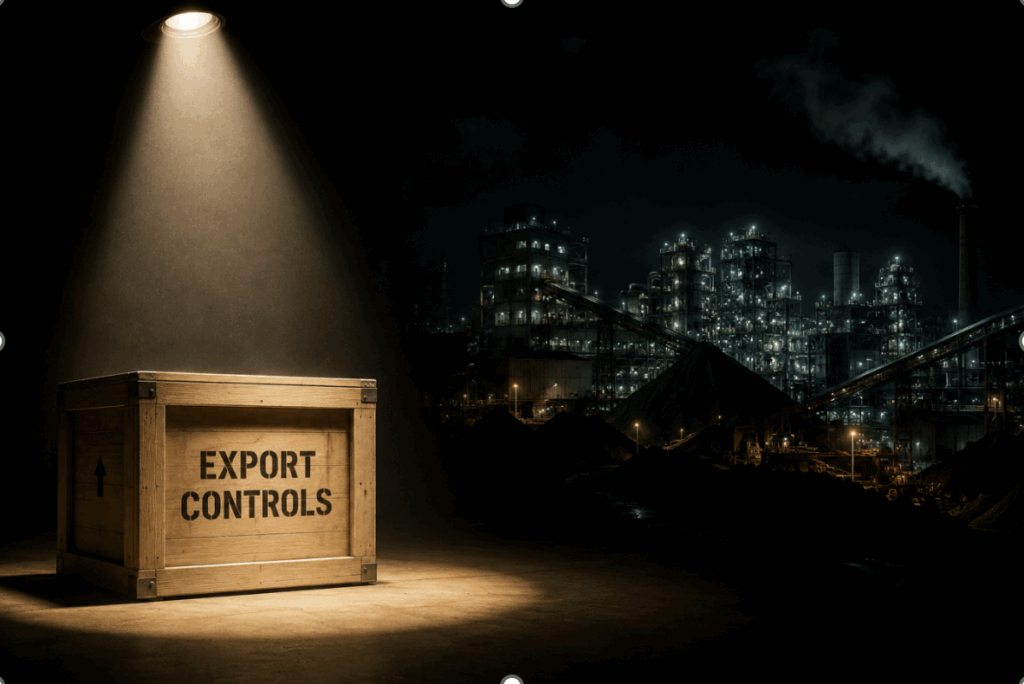
It’s no secret that I, like many, have a habit of assuming that when China makes a policy move, the topic is almost never the goal. It’s a masterclass in misdirection.
Have you ever heard of the Decoy Effect?
Imagine this. You walk into a coffee shop, and you’re presented with two options: a small cup for $2 or a large for $4. You don’t really need that much coffee, so you settle on the small. Then the barista casually mentions there’s also a medium for $3. Suddenly, the medium seems like the sensible choice because it’s only $1 more. But then you think, “well, if I’m already willing to spend $3, I may as well spend $4 and get the large.” See what happened there?
You weren’t really given more choice. Your perception of value was manipulated. It’s a fairly well-known psychological sales technique. Now consider it in geopolitics.
Every time China’s Ministry of Commerce (MOFCOM) updates its export licensing catalogue, expands its dual-use controls, or announces a new regulatory framework, Western media rings the alarm bells. The response from Washington, Brussels, and Canberra is entirely predictable: a reactive rush of state-backed subsidies, emergency stockpiling, defensive capital injections into any project with a halfway decent drilling result, and countless Op-Eds about China’s dominance (the irony is not lost on me).
But what if we’ve been focusing on the wrong problem? What if the threat of scarcity isn’t the strategy at all, but the decoy? Whilst Western governments scramble to defend themselves against the possibility of restricted supply, consumed by “focused discussions” and “strategic talks”, Beijing is busy deploying its real weapon, the one nobody notices: aggressive oversupply.
The asymmetric weapon
The beauty of a good decoy isn’t that you believe it, it’s that it stops you from paying attention to anything else. By periodically rattling the sabre of export restrictions, such as the recent targeting of Western upstream producers like MP Materials and USA Rare Earth, Beijing deliberately keeps geopolitical anxieties at a boil. Governments and investors naturally interpret the problem as one of access, encouraging policies centred on securing raw material supply.
Ignore the regulatory theatre and look at the actual pricing. Across much of the critical minerals midstream, pricing has been under relentless pressure. Lithium, cobalt and nickel prices have fallen sharply from their post-pandemic highs, whilst treatment and refining charges for metals such as copper and nickel have been squeezed as processing capacity has expanded faster than raw material supply. Coincidence?
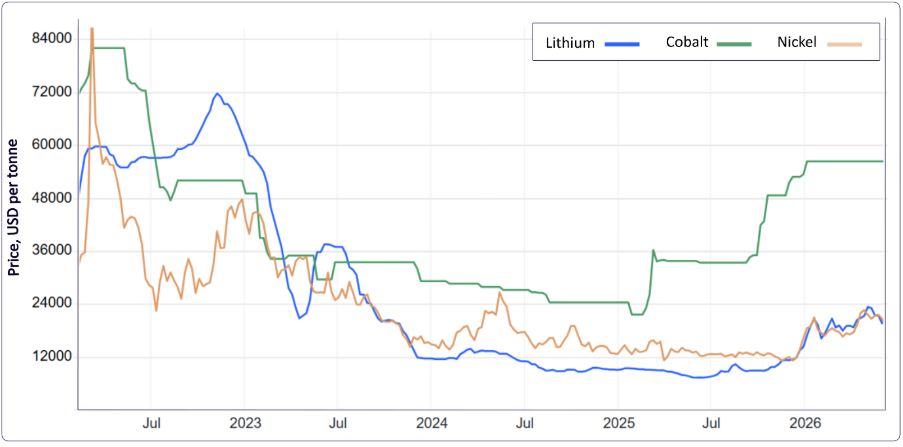
Figure 1. Price trends for lithium, cobalt, and nickel from mid‑2022 to mid‑2026, showing sharp declines relative to their post‑pandemic highs (Source: Tradingeconomics.com).
Sure, market cycles undoubtedly play a role, but it would also be naïve to ignore the role industrial policy can play in shaping those markets. China has spent decades expanding processing capacity, supporting domestic refiners and backing major overseas projects (from Indonesian nickel to domestic rare earth separation hubs). This raises a more strategic possibility: that oversupply has itself become an instrument of industrial policy.
The decoy (i.e. the loud threat of a ban) keeps the West focused on exploration and securing raw supply. Meanwhile, the reality (persistently weak prices) ultimately starves alternative refining capacity of the private financing it needs to exist in the first place. After all, no private equity fund or commercial bank can honestly justify financing a multi-billion-dollar refinery when a state-backed competitor can comfortably dump refined material onto the market at a whim, well below Western operating costs.
That is market capture 101. This decoy nudges the West to waste its capital on upstream exploration, whilst oversupply ensures that nobody else gets to refine it.
The fallacy of linear substitution
This brings us neatly to the core flaw of the West’s standard defensive response: I call it the “fallacy of linear substitution”. The logic goes something like this: “If we mine one tonne of critical minerals in an allied country, we have successfully replaced one tonne of Chinese supply.” It sounds perfectly reasonable, but it also completely misses the point. Critical minerals are not liquid, generic commodities like crude oil in the 1970s. There is no allied critical minerals “cartel” to help maintain stability and control. They are highly integrated, highly bespoke chemical, metallurgical and manufacturing value chains.
The recent G7 Critical Minerals Alliance meetings in Evian highlighted a rather belated realisation that Western projects cannot compete on pure geology or raw operational efficiency when pitted against a state-backed monopoly that sets the reference price.
By the time a mining project has fought its way through the five-to-ten-year permitting, financing and construction process, the Chinese supply machine has already adjusted the global price floor to ensure the new entrant can never service its debt. The hole in the ground becomes a stranded asset before it even achieves commercial scale.
And I’ll give you one guess who picks up that stranded asset for pennies on the dollar. It’s a cycle that has been playing out for years and one which most of us have watched in real time.
Breaking the cycle
If the West wants to escape this scarcity trap, it must stop reacting to Beijing’s administrative theatre and start targeting its economic leverage.
Funding more extraction is a pointless exercise if the resulting material is destined to drown in a flooded, uncommercial global market. Genuine supply chain resilience requires moving beyond basic mining grants toward robust market-insulation mechanisms. “Sew the bag before you collect the marbles”.
Governments must stop offering simple grants and start deploying real, binding, long-term offtake guarantees and price floors for allied-produced materials. Essentially creating a regulatory firewall that protects midstream refiners from predatory pricing.
Investors must decouple the strategic value of processing capacity from volatile, spot-market commodity prices. The capacity to refine must be valued as long-term security, not a cyclical mining play (granted, this is something that would almost certainly need the support of national policy).
From an industry and societal perspective (this is a personal point of contention), we must become far more serious about material retention. Every gram of refined critical metal already inside the allied economy should be treated as a permanent strategic asset. Once it enters the system, the goal should be simple. Never let it leave!
So, just as you leave that hypothetical coffee shop holding a large cup, feeling rather grand with yourself for spending “only $1 extra”, the West will continue to chase a supply chain mirage until we recognise that China’s primary weapon is the decoy effect. The danger isn’t that China will refuse to sell us these minerals. It’s that it will sell them so cheaply that we never build the capacity to refine them ourselves.
By the time the coffee shop closes, we’ve forgotten how to roast the beans.
Dr. Nicholas Vafeas is an economic geologist specializing in critical raw materials, mineral value chains, and strategic resource policy.
More News

{{ commodity.name }}
{{ post.title }}
{{ post.date }}
Comments