A startup confronts water shortages by pulling it out of the air
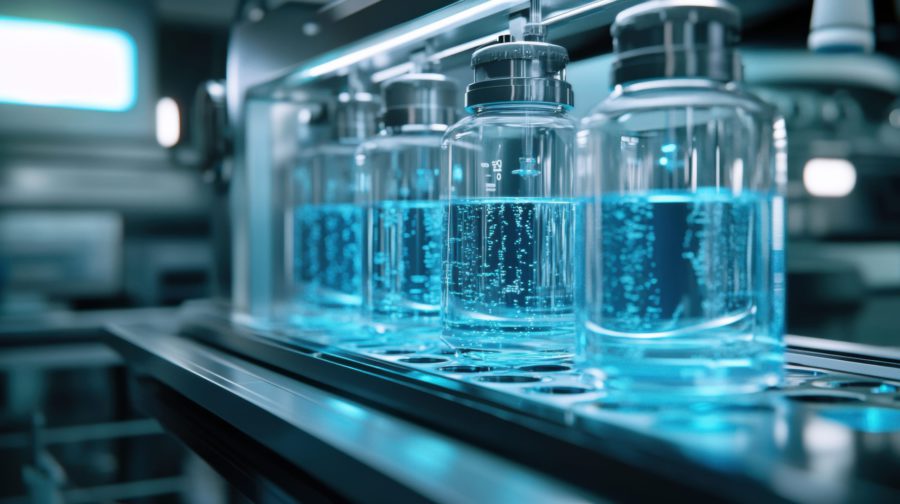
The large metallic white box sits in a Southern California parking lot, looking unremarkable until water starts flowing from a hose attached to it. Peer inside, though, and it’s nearly empty but for some wires, tubes and a container of light-colored material.
The water isn’t being conjured out of thin air by magic but by MOFs— metallic organic frameworks. MOFs are nanocrystalline structures engineered at an atomic level to attract specific molecules. In this case that’s H2O and the machine made by startup Atoco is silently harvesting molecules from the surrounding air and storing them in the material’s porous cavities that serve as microscopic water tanks.
Atoco founder Omar Yaghi shared the 2025 Nobel Prize in chemistry for pioneering MOFs and on an April morning he gave Bloomberg News an exclusive demonstration of the commercial prototype of its atmospheric water harvester in the lot outside the company’s Orange County laboratory.
In the wake of the Iran war, interest in the technology has risen as the giant desalination plants that supply water to tens of millions of people in the Middle East have become military targets. “There’s a new realization of the vulnerability and security risk of centralized water systems,” said Samer Taha, Atoco’s chief executive officer, who is based in Irvine, California.
Set to go into production later this year, the shipping container-sized machine will produce up to 4,000 liters (1,057 gallons) of water daily and can be installed at data centers, hospitals and other critical infrastructure. An off-the-grid model that operates on ambient sunlight and produces less water can be deployed to communities where water must now be trucked in.
“This becomes absolutely essential in alleviating the problems we are facing on our planet in terms of water scarcity,” said Yaghi, 61, a University of California at Berkeley chemistry professor who started Atoco in 2021.
Climate change is only intensifying those risks as drought and heat waves dry up rivers and reservoirs, with half the global population experiencing water shortages, according to the United Nations. In the US, Colorado River flows that supply water to 40 million people are declining dramatically amid record-low snowpack. Communities across the country are battling artificial intelligence data centers that threaten to drain already depleted aquifers while nearly a million Californians lack access to safe drinking water largely due to agricultural pollution. Some 500,000 people in Corpus Christi, Texas, face running out of water next year from a lack of rain.
“You’re going to see more Corpus Christis around the world,” said Wendy Jepson, who researches water security at Texas A&M University, adding that crumbling infrastructure and poor policy decisions are exacerbating the water crisis.
Those cities have few options to acquire water. One is to build plants to desalinate seawater, a multibillion-dollar, years-long undertaking that requires enormous amounts of electricity and harms marine life.
“You have societies and economies that are highly dependent on desalination with few backups and alternatives,” said David Michel, a senior associate for water security at the Center for Strategic and International Studies. He said atmospheric water harvesting is unlikely to replace desalination in the near term but “seems very well placed to extend the water supply.”
Atoco’s technology, which can operate in arid climates, promises the advent of a new decentralized water source, just as solar panels and batteries have allowed homeowners and businesses to tap the sun and insulate themselves from an increasingly unreliable power grid.
For instance, in Ethiopia, where many residents have sporadic access to water, an off-the-grid Atoco atmospheric harvester could supply about eight households in a village. It would take around a dozen of the machines to service a water-efficient data center in California.
Yaghi, the son of Palestinian refugees, grew up in Jordan in a one-room dwelling shared with nine siblings and the family’s cows. The house had no electricity or running water and his task as a child was to fill as many containers as he could find when the government delivered water to his village every week or two.
“We want everyone on our planet to have water independence where you’re in control of your own water,” said Yaghi. “We’re showing this today to show the power of being able to harness an infinite resource of water that is the air.”
The unassuming appearance of the water harvester prototype belies its mind-bending physics. Largely constructed of common elements such as carbon, nitrogen, hydrogen, copper and aluminum, an ounce of MOF material can contain the surface area of a soccer field. (Imagine crumpling up a sheet of paper. It’s now a fraction of its original size but contains the same surface area within the folds.)
After the MOFs invisibly gather H2O, the harvester rumbles to life to apply heat to the material to dislodge the molecules. A condenser converts the water vapor into liquid, which starts pouring from a slender tube. Yaghi fills a glass for Taha and then grinning, drinks from the hose before handing a glass to Gray Davis, Atoco’s legal advisor and a former California governor.
There’s so much water in the atmosphere – more than all the world’s lakes and rivers – that’s constantly being replenished that harvesting H2O wouldn’t disrupt that cycle, according to Atoco.
Atoco expects to make and sell 200 harvesters in 2027. The company isn’t taking orders yet, but it said it has more expressions of interest in purchasing the machines than current production capacity. Samer said the company has been testing the machine with partners around the world, including in the desert southwest of the US. Atoco hasn’t disclosed pricing though it notes the production model will be capable of supplying water for a few cents a liter, which is more expensive than desalinated water.
But since the MOFs only attract H2O molecules, the water is free of PFAS, microplastics and other contaminants often found in the water supply. Atoco and competitor AirJoule Technologies are targeting data centers and semiconductor plants, which need pure water for cooling and manufacturing but often seek to operate in water-stressed communities.
“They’re under all kinds of pressure for water,” said AirJoule Chief Executive Officer Matt Jore, whose company expects to begin production later this year of a MOF-based atmospheric water harvester that can produce 2,000 liters a day. He said the company, a joint venture with GE Vernova, is testing its technology in the Middle East and has seen a spike in interest from the region since the Iran war.
In the US, atmospheric water harvesting could help alleviate water strains from the AI boom, according to Jepson, the Texas A&M professor. “If this kind of technology can be integrated into data centers, you’re offloading the pressure on water systems for people, which potentially is a really huge gain,” she said.
(By Todd Woody)
More News
{{ commodity.name }}
{{ post.title }}
{{ post.date }}
Comments