Antofagasta seeks to link ore sales to spot market
Chile’s Antofagasta Plc has approached Chinese copper smelters with a proposal to price contractual sales of copper ore using spot-market indexes, a fresh sign that a decades-old system based on fixed-price deals is under strain.
The proposal was delivered recently to at least two Chinese smelters as part of talks for shipments for semi-processed ores known as concentrates in the second half of this year and first half of 2027, according to people familiar with the matter, who asked not to be named discussing a commercial matter.
Since the 1980s, the so-called treatment and refining charges for concentrates have been the subject of annual negotiations in which a top miner — in recent years Antofagasta — strikes a deal with a top smelter that’s used as a benchmark for the industry.
But several factors are challenging that system: from China’s growing reliance on imported ore to an unprecedented plunge in spot-trading fees as smelter capacity outruns mine supply, and a growing amount of traders competing for ores.
Copper smelters receive the processing fees, known as TC/RCs, to turn concentrates into metal. The charges — which are deducted from the value of the metal contained in concentrates — are crucial to keep the furnaces running, as they typically account for almost one-third of smelters revenues. But they’ve collapsed to record lows in the spot market as shortages of concentrates have deepened.
Rather than setting a fixed TC/RC, Antofagasta’s proposal for the mid-year contracts would see the charges set against averages of regular market assessments produced by third-party price reporting agencies.
It’s the first attempt by the Chilean miner to push for index-pricing mechanisms, and an impasse in negotiations could result in a lack of feedstock for Chinese smelters, which process almost half of the world’s copper. It’s also an early sign of the commercial strain that smelters are likely to face in benchmark negotiations for supply in 2027, which typically kick off in October.
There was no indication the offer had been accepted by Chinese copper smelters as of June 12, the people said.
An Antofagasta spokesperson said their negotiations were confidential and they would not discuss them with third parties.
Antofagasta’s shift is likely based on a widening gap in profitability between annual fixed-price sales and deals linked to the spot market, where traders and smelters are bidding aggressively to secure ores.
Last year, the parties agreed on treatment charge of $0 a ton for both mid-year contracts and annual contracts for 2026. Chinese authorities have “firmly opposed” smelters accepting contractual fee below zero.
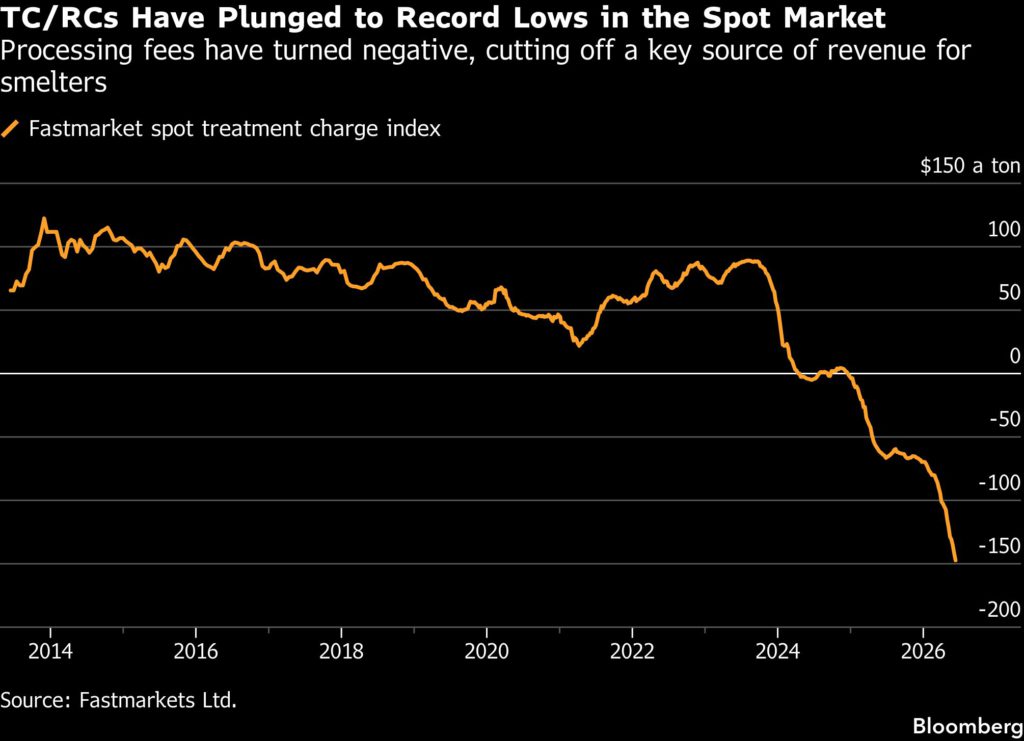
But fees have already fallen well below zero in the spot market, meaning the charges are now being added to the cost of concentrates rather than deducted from them. TC/RCs tracked by pricing agency Fastmarkets fell to an all-time low of -$147.3 a ton last Friday.
Antofagasta’s offer circles back to the recurring question about how many copper miners will remain loyal to the benchmark system, in use since 1980s.
By end of each year, a miner has to reach agreement with a major buyer to provide a benchmark, which is then referenced in global contracts the following year. The benchmark system remains in place for sale of zinc and lead concentrates.
Critics argue that an annual fixed price no longer reflects the fast-changing appetite and economics of copper shipments.
Australian miner BHP, the biggest copper supplier to China, has already started setting it’s own numbers every quarter, while US miner Freeport McMoRan Inc., which set the benchmark previously, has also indicated it wants to break away from the system to protect the profitability of its smelting business.
(By Julian Luk)
{{ commodity.name }}
{{ post.title }}
{{ post.date }}
Comments