Thieves are stealing Chile’s solar panels and cashing in on the black market
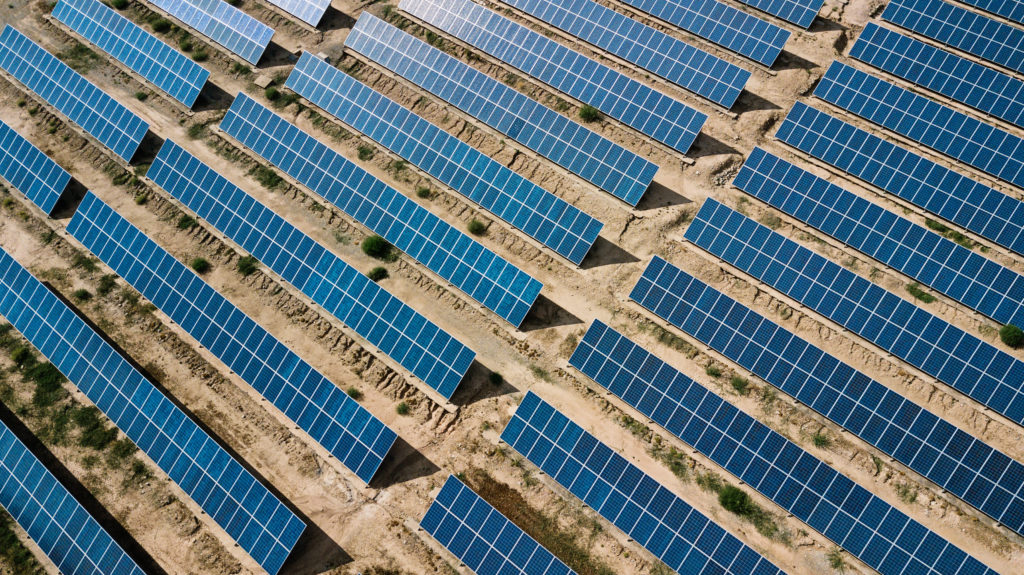
Just before midnight, two men in white coveralls and black gloves scale an electric fence at a solar farm in Chile’s Atacama Desert, then slip soundlessly into rows of sleek panels. Others use a poultry shear and electric angle grinder to breach the main gate. Three pickups without license plates pull in so the gang can load up their loot and race away.
The thieves typically have less than an hour before police arrive to disable cameras, slice cables and extract dozens of panels before vanishing into the dunes. In this case, there was only one security guard, who was instructed to hide in case of an intrusion. They tied him up anyway.
Chile is witnessing a surge in theft on solar farms. Many in the industry privately confirm they’ve been hit, yet few are willing to say so publicly as the stolen equipment slips into black markets.
In this narrow strip of the Andes, exceptionally sunny conditions, market-based electricity pricing and a favorable investment climate have fueled a swift photovoltaic build-out, from just 3% of total installed capacity in 2015 to a third of the system today, according to government data. Following a pattern in other places like California and the UK, this solar boom has brought crime along with it. But here the trend is turbocharged by more remote expanses and entrenched organized crime, posing risks for Chile’s critical infrastructure, with potential consequences for grid reliability and foreign investment.
“The theft of cables, panels or electronic equipment can temporarily shut down entire solar parks and cause significant economic losses,” said Erwin Plett, chief executive officer of renewable energy advisory Low Carbon Chile SpA, adding that it also drives up security and insurance costs. “Chile remains one of the most attractive renewable markets in the region, but maintaining that leadership requires ensuring the security of energy infrastructure.”
Five years ago, panel theft was rare, according to a service delivery manager who oversees more than 60 parks in Chile and wasn’t authorized to speak publicly. Since March last year, the manager’s portfolio recorded more than 30 thefts. In one case, a single site was hit five times in less than a month.
Fernando Navarro, project manager at Tritec-Intervento, the Chilean unit of a European solar energy company, says theft has become increasingly organized over his six years in the industry. At first incidents were minor — one or two panels disappearing over an eight-month construction period. Losses have since evolved into coordinated raids, with trucks hauling away four or five boxes at a time, with each box holding at least 30 panels.
The fragile panels weigh about 30 kilograms (66 pounds) and usually cost $60 to $70 apiece, and perpetrators know what to shut off and which components to target while avoiding safety risks to remove them, Navarro said. Often they dismantle the complex equipment to extract copper and make off with batteries, fencing and control systems too.
“The profile of these criminal groups committing these robberies is that they understand the utility of the equipment,” said Ana Lía Rojas, executive director of Chile’s Association of Renewable Energy and Storage, or Acera. “And there is a market willing to buy it in order to use it in ways different from what it was originally developed, purchased and installed for. That’s a major concern for us.”
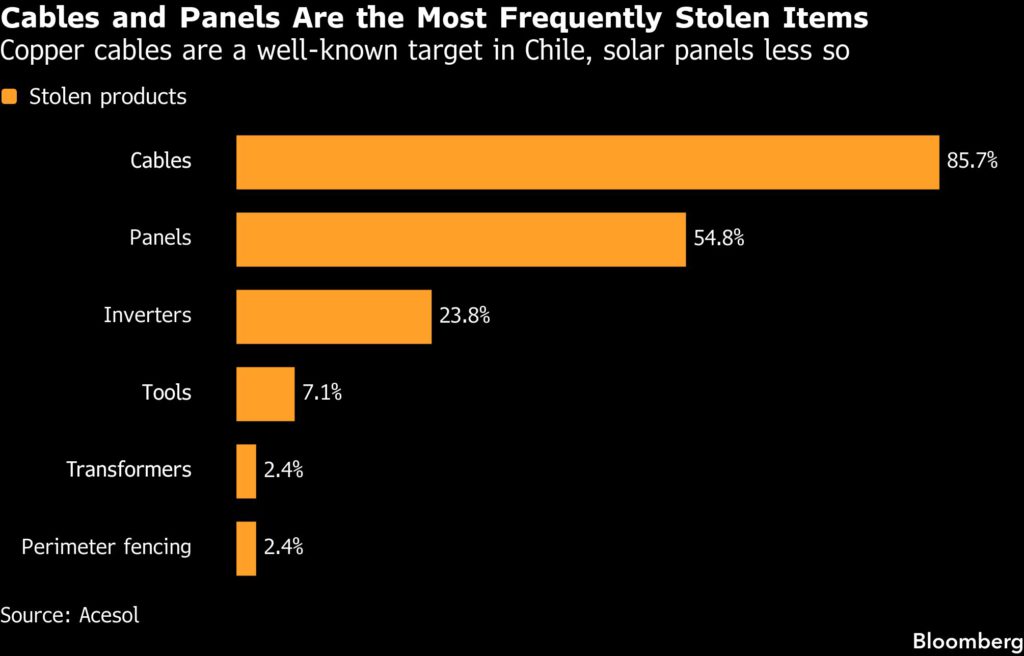
Cables are the most frequently stolen components, accounting for 85.7% of cases, followed by PV panels at 54.8%, according to data from Chile’s Solar Energy Association, or Acesol.
Chile is hardly alone. “The rapid growth of solar energy, combined with the high value density of modules and the difficulty of tracking equipment without standardized identification, creates ideal conditions for theft in any country,” said Felipe Javier Ríos Ledesma, researcher at the Solar Energy Institute at the Polytechnic University of Madrid. “However, Chile has local conditions that make it particularly vulnerable.”
Opaque channels
Benjamin Sovacool, a professor of earth and environment at Boston University and the University of Sussex, has studied solar panel theft around the world. He estimates that around 20% of stolen panels are damaged during removal or transit, reflecting the fragility of glass-based systems and components such as inverters and batteries. Of the remainder, about 30% is resold in domestic markets and roughly half ends up in international markets, he said, based on a pattern he studied in Indonesia.
In Chile’s case, far-flung sites and vast footprints make solar farms difficult to secure, while dormancy in the desert’s dark night gives thieves a clear window to operate. Sprawling sites may have only one or two unarmed guards.
More importantly, the country’s porous borders can invite contraband. Remotely located solar farms “are often very close to borders and to unauthorized or uncontrolled crossings,” Rojas said. “So it’s easy to move the equipment to neighboring countries like Peru, Bolivia and Argentina.”
Copper in particular can be aggregated and ferried through the value chain for export, making its final destination difficult to trace at a time of buoyant prices for the red metal. In April, Chilean authorities dismantled an organized criminal network that had moved more than $900 million worth of stolen copper between 2020 and 2025, trucking it to the northern port of Iquique before shipping it to China.
Navarro says projects are particularly vulnerable in early phases when uninstalled materials are stored in boxes or on pallets, security systems are not yet fully operational, and there is constant movement of workers and subcontractors.
As the crime flourishes, investors are increasingly incorporating theft and vandalism into their risk assessments, raising insurance, security and overall project costs, said Plett.
“So far, they have not slowed investment, but they do constitute a warning sign that the country must address urgently,” he said.
Sense of impunity
Before dawn on Feb. 24, thieves broke into the Eléctrica Altos de Til Til solar farm north of Santiago, stealing copper wiring in what general manager Andrés Guerrero describes as the third incident since late September. The farm, which was designed mainly to supply the nearby San Pedro mineral processing plant, had operated for years without incident until this recent string of attacks.
“They knew exactly what they were doing,” Guerrero said. Before cutting the copper cables that power the system, the intruders disabled security cameras and penetrated the control room. Then they rolled up the cables and carried them down an adjacent hillside, navigating terrain inaccessible to vehicles. Some of the bundles were stashed among the trees, concealed for later retrieval.
The perpetrators typically strip plastic sheaths, extract the copper and sell it for scrap. Rising metal prices have helped to fuel the incidents, Guerrero said, adding that costly theft-related damage can take weeks to repair.
The criminals might steal a cable worth only around 1,000 Chilean pesos (close to $1), but replacing it can cost 30 to 40 times more, said Michael Minnes, general manager of CarbonFree Chile SpA, which specializes in solar development and financing.
Chile’s investigative police, or PDI, says it is actively investigating crime at solar farms. “The theft of solar panels and batteries is indeed occurring in northern Chile, and it feeds into a market that is also international or transnational in nature,” said Marcos Ramírez, who heads the PDI’s national theft division.
In one 2023 case, the PDI in the northern city of Arica contacted Acesol after intercepting a pickup carrying panels near the border with Peru. The serial numbers matched those of a set stolen from one of the group’s members.
Yet more often than not, the perpetrators get away, creating a climate of impunity, victims say. “There’s no incentive to report because no results are expected,” said Guerrero.
Another renewable energy executive, who was not authorized to speak publicly, said security cameras only seem to be there so victims can watch thefts unfolding in real time.
Acera expects Chile’s new Security Ministry to address the problem as part of the government’s broader anti-crime campaign. “From Acera, we are fully available to provide information and to develop further proposals,” Rojas said.
An Energy Ministry spokesperson said an initial working group on cable theft was broadened to cover energy infrastructure and was ultimately transferred to the Security Ministry, which didn’t reply to a request for comment.
Meanwhile, insurance premiums are going up. All-risk construction policies often carry high deductibles, meaning thefts are typically absorbed by contractors. As the crime has ballooned over the past three years, insurers have tightened conditions and raised costs, reducing the effectiveness of coverage, according to Navarro.
Some companies have begun replacing copper cables with less-valuable aluminum at vulnerable sites, removing a key incentive for theft. Other operators have introduced nighttime vehicle patrols, but the costs can erode already thin margins in a fiercely competitive market.
“This is an issue we need to address rather than just worry about,” said Rojas. “We’re still far from this becoming such a big concern that it slows development or reduces interest in renewables. But the point is to act today so the problem doesn’t turn into a systemic issue.”
The solar community needs to work together to achieve results, says Ríos at the Polytechnic in Madrid. “What we’re seeing in Chile is not an isolated case, but rather the local expression of a global problem that will continue to grow alongside photovoltaics unless coordinated measures for traceability and security are implemented from the installation phase.”
The solar industry is indeed starting to pay closer attention, with discussions around insurance and enhanced security measures like tracking devices, says Gilbert Michaud, an assistant professor in the School of Environmental Sustainability at Loyola University Chicago.
“With global supply chain pressures and rising equipment costs, theft will likely be a bigger issue looking into the future,” Michaud says. “Ultimately, addressing this will help ensure a more resilient energy system.”
(By Antonia Mufarech)
More News

{{ commodity.name }}
{{ post.title }}
{{ post.date }}
Comments