China’s top ETF is now gold, not stocks
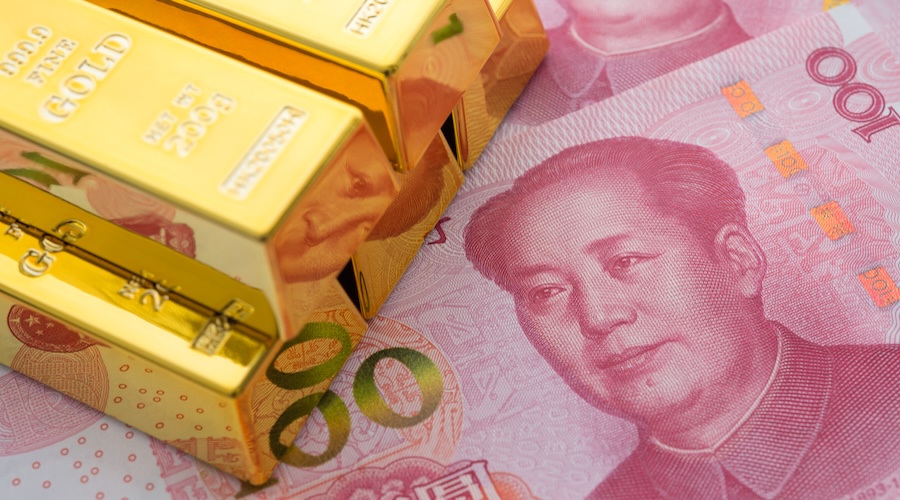
Central banks just made their second-largest monthly purchase of the year. China’s biggest ETF is now a gold fund. And Citi just took a seat inside global bullion clearing. All three signals landed within five days of each other.
In the space of one week, three separate parts of the global financial system all moved in the same direction: official central bank reserves, Chinese domestic capital markets, and Western bullion-trading infrastructure.
The official number: central banks bought 41 tonnes in May
New data from the World Gold Council shows central banks added a net 41 tonnes of gold to reserves in May 2026, which was the second-highest monthly total of the year, behind only February. Poland led with 18 tonnes, China added 10 tonnes (its largest single-month increase since December 2024), and Uzbekistan and Kazakhstan continued their own accumulation. Singapore returned as a net buyer for the first time since September 2025, adding 4 tonnes. Turkey and Russia were the only net sellers, trimming a combined 9 tonnes.
The year-to-date scenario reinforces the trend rather than complicating it. Poland has now added 64 tonnes in 2026 alone, pushing its reserves to 614 tonnes as it closes in on a stated 700-tonne target. China’s 25 tonnes of buying this year marks its 20th consecutive month of accumulation, lifting its official reserves to 2,331 tonnes, about 9% of its total reserves. Uzbekistan has added 33 tonnes YTD, and gold now makes up an extraordinary 87% of its total reserves.
What matters most may not be what’s already happened, but what central bankers say is coming next. The WGC’s ninth annual Central Bank Gold Reserves Survey found that 89% of central bankers expect global gold reserves to rise over the next 12 months. A record 45% said they expect their own institution’s reserves to increase (up from 43% last year and just 29% two years ago.)
The domestic signal: China’s biggest ETF is no longer an equity fund
Away from central bank vaults, a separate and arguably more striking shift has been playing out inside China’s own capital markets. According to Bloomberg, the Huaan Yifu Gold ETF overtook the Huatai-PineBridge CSI 300 ETF – long one of China’s flagship equity funds – to become the country’s single largest exchange-traded fund of any kind, with roughly 90 billion yuan in assets against the CSI 300 fund’s 83 billion.
That is more than a league-table curiosity. For years, China’s largest ETFs were overwhelmingly tied to broad equity benchmarks, reflecting both investor faith in domestic growth and the periodic presence of state-backed support in the stock market. A gold ETF moving to the top of that list suggests the preference is no longer simply for market beta, but for insulation. It also matters because Chinese investors do not face the same menu of escape routes as global allocators. Capital controls limit offshore diversification, the property market remains impaired, bank deposit yields are low, and domestic equities have struggled to rebuild confidence. In that setting, a liquid, exchange-traded gold product becomes a particularly clean vehicle: it offers a hedge against currency weakness, financial repression, and policy uncertainty without requiring investors to move money out of the country. The symbolism is hard to miss. Gold is no longer just something held in bars by the People’s Bank of China or bought as jewelry by households. It is now sitting at the center of China’s modern ETF market, displacing the country’s most important broad stock-market proxy.
The timing is not incidental. The flip comes as Beijing’s so-called “national team” appears to be pulling back the support of state-linked funds that have repeatedly stepped in to prop up Chinese equities during periods of market stress. As official buying continues underneath, ordinary Chinese investors and domestic institutions are independently choosing gold over the stock market, at the exact moment the state’s own backstop is fading.
Put together, the central bank data and the ETF flip describe the same phenomenon at two different altitudes: official reserves and private domestic capital are both rotating toward gold, in response to what looks like the same set of pressures.
The infrastructure signal: Citi buys into the plumbing
The third piece landed almost unnoticed by comparison. Citi has become the fifth bank admitted to clear transactions in London’s over-the-counter gold market – the world’s largest bullion trading hub, worth roughly $160 billion a day – joining HSBC, ICBC Standard Bank, JPMorgan and UBS in the London Precious Metals Clearing Limited (LPMCL) network. It’s the first new entrant to the clearing group in a decade.
“Citi and the London Precious Metals Clearing Limited (LPMCL) today announce Citi’s admission as a clearing member of LPMCL, adding Loco London settlement services for gold, silver, platinum and palladium,” Citi said in a release.
“The addition of Citi as a clearing member of LPMCL demonstrates the openness and transparency of our membership process, allowing new entrants to join and participate in the clearing and settlement of the predominate global over the counter precious metals market,” said James Cressy, Chair of LPMCL.”
Taken in isolation, a bank joining a clearing network is a back-office story. Taken alongside the same week’s central bank and ETF data, it reads differently: a major Western financial institution securing a direct role in gold-market settlement infrastructure at the precise moment official and Chinese domestic capital are both moving the same way. It suggests at least one large institutional player sees this rotation as durable rather than a short-term positioning trade.
Why it matters for investors
None of this requires a view on where the gold price goes next week. The signal here is structural. Sovereign reserve managers, Chinese private capital, and global bullion-market infrastructure are all moving toward gold simultaneously, driven by forces that reinforce, rather than simply mimic, one another.
Whether this accelerates into a broader shift away from dollar-denominated reserve assets (as some macro strategists have argued) or simply marks a particularly convergent month, is something only time will resolve. But for an investor trying to separate durable structural change from noise, three unconnected systems moving in the same direction in the same week is a considerably stronger signal than any one of them alone.
More News

Mine operators face worsening wildfire seasons
July 06, 2026 | 11:15 am

Op-Ed: Molybdenum and the geopolitics of substitution
July 06, 2026 | 10:09 am

{{ commodity.name }}
{{ post.title }}
{{ post.date }}
Comments