Schiff: ‘Trapped’ Fed sets up $200 silver, $10,000 gold
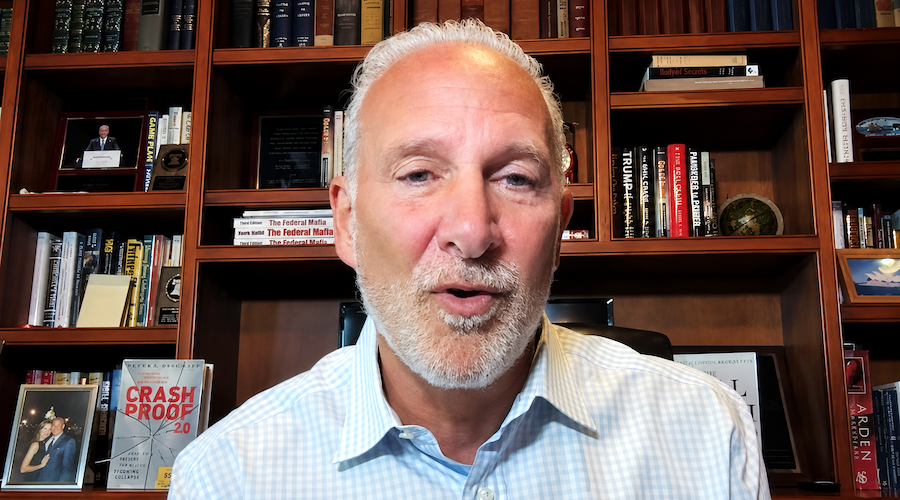
The US Federal Reserve is trapped by soaring national debt and will ultimately inflate it away, sending silver to $200 an ounce and gold to $10,000, longtime dollar bear Peter Schiff says.
Gold climbed back above $4,100 an ounce after June payrolls rose by 57,000, well below economists’ expectations of 100,000, fuelling bets the Federal Reserve will hold interest rates steady. Schiff said investors are focused on the wrong signal. He argues that a national debt nearing $40 trillion, annual deficits approaching $3 trillion and interest payments heading toward $2 trillion have left the central bank unable to restore price stability without triggering a financial crisis.
“I think investors are being fooled by the Fed’s rhetoric,” Schiff said on MINING.COM’s Top of Mine. “He did admit that inflation is a choice, and it’s exactly what he’s going to choose.”
Schiff argues the alternative to higher inflation would be a sharp stock market decline, falling home prices, recession and fiscal restraint in Washington — outcomes he believes policymakers will avoid. Instead, he says the Fed will continue allowing inflation to erode the real value of government debt because raising rates sufficiently would make servicing that debt unaffordable.
Silver case
Schiff remains even more bullish on silver than gold after the metal’s recent rally and pullback.
He said silver’s retreat from recent highs offers a buying opportunity and expects the metal to hold above $50 an ounce, the level that capped rallies in 1980 and 2011.
“The old resistance is the new support,” he said. “We really just started a new bull market in silver.”
Schiff expects silver to reach $200 an ounce, with $50 becoming long-term support, while gold climbs first to $5,000 and ultimately $10,000. He also sees mining shares repricing as investors accept higher metal prices as sustainable, while the US dollar gradually loses its reserve currency role to gold.
He called a $200 silver target conservative, noting the metal has climbed from roughly $4 an ounce since he began buying in the late 1990s. In his view, the gains will reflect the declining purchasing power of the US dollar rather than dramatic changes in silver itself.
“It’s really the US dollar going down,” he said. “You’re going to need a lot more dollars to buy silver, and to buy everything.”
Demand drivers
Schiff sees industrial demand and monetary demand reinforcing each other.
Growing electricity consumption and expanding industrial applications should tighten physical supplies, while silver historically outperforms gold during precious metals bull markets, he said. If gold reaches $5,000 and eventually $10,000, Schiff expects silver to appreciate by an even greater percentage.
Mining stocks
Mining shares remain undervalued because analysts continue to treat higher gold and silver prices as temporary, Schiff said.
“They don’t understand why the prices have risen,” he said. “They don’t assume it’s sustainable.”
Once investors accept that elevated precious metals prices are permanent rather than cyclical, mining equities should undergo a broad revaluation, he argued.
Reserve shift
Schiff believes the implications extend well beyond metals markets.
Central banks are already diversifying reserves away from the US dollar and into gold, he said, reversing a monetary system that has existed since the dollar replaced gold as the world’s primary reserve asset in 1971.
“Gold is the replacement for the dollar,” he said, “because gold was the reserve before it became the dollar.”
Track record
Schiff’s forecasts have long drawn criticism because the dollar remains the world’s reserve currency, Treasury auctions continue to attract buyers and markets have not suffered the collapse he has predicted for decades.
Schiff counters that gold purchased below $300 an ounce in the late 1990s has outperformed the S&P 500 and argues investors suffered greater losses by holding cash or US government bonds. He also rejects the “permabear” label, pointing to his long-standing support for foreign dividend-paying stocks.
The reckoning has taken longer than he expected, Schiff said, but the delay has only made the eventual adjustment more severe.
“We succeeded in kicking the can down the road,” he said. “But because we did that, there’s a lot more to reckon with.”
More News
{{ commodity.name }}
{{ post.title }}
{{ post.date }}
Comments