Gold price: record gold output, record cost per ounce
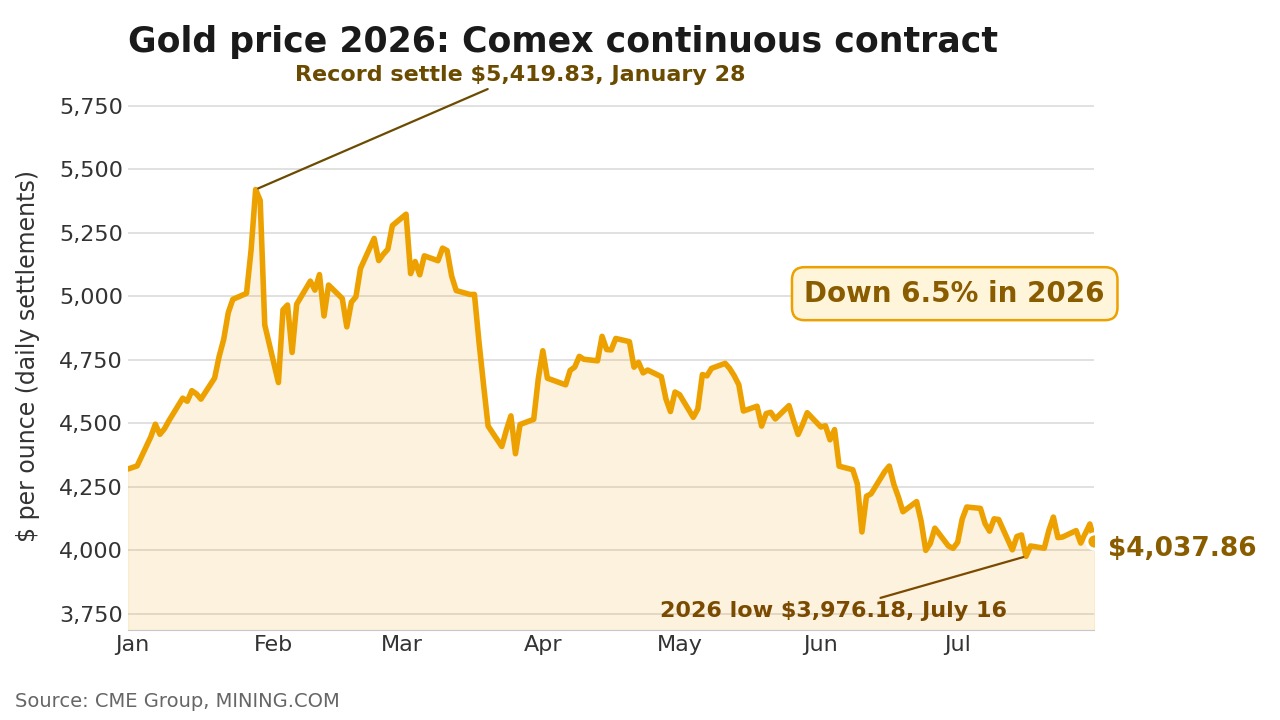
Gold handed back Thursday’s post-Fed bounce on Friday, the Comex continuous contract sliding 1.6% to $4,037.86 an ounce by late morning in New York as the dollar clawed its way back above 100 after a 2.4% drop the day before. December gold, which has taken over the bulk of the Comex volume as the market rolls forward, was down 1.5% at $4,099.50. September silver fell 2.8% to $57.35 an ounce, deepening its 2026 loss to more than 19%.
The deeper drag is the rate risk that has not gone away. The Federal Reserve held its benchmark rate at 3.50% to 3.75% on Wednesday over three hawkish dissents, and with oil above $90 and Middle East hostilities feeding inflation expectations, traders still put the odds of a September increase at 63%. For a metal that pays no yield, that probability is enough to cap rallies. “Gold struggles to regain meaningful momentum and remains in the corrective phase of a broader structural bull market,” independent analyst Ross Norman told Reuters.
Even with Friday’s slide, gold is on course for its first monthly gain since February. It is still down 6.5% for the year and a long way from the $4,506.29 average price of the second quarter, the period covered by the World Gold Council’s Gold Demand Trends report published Thursday.
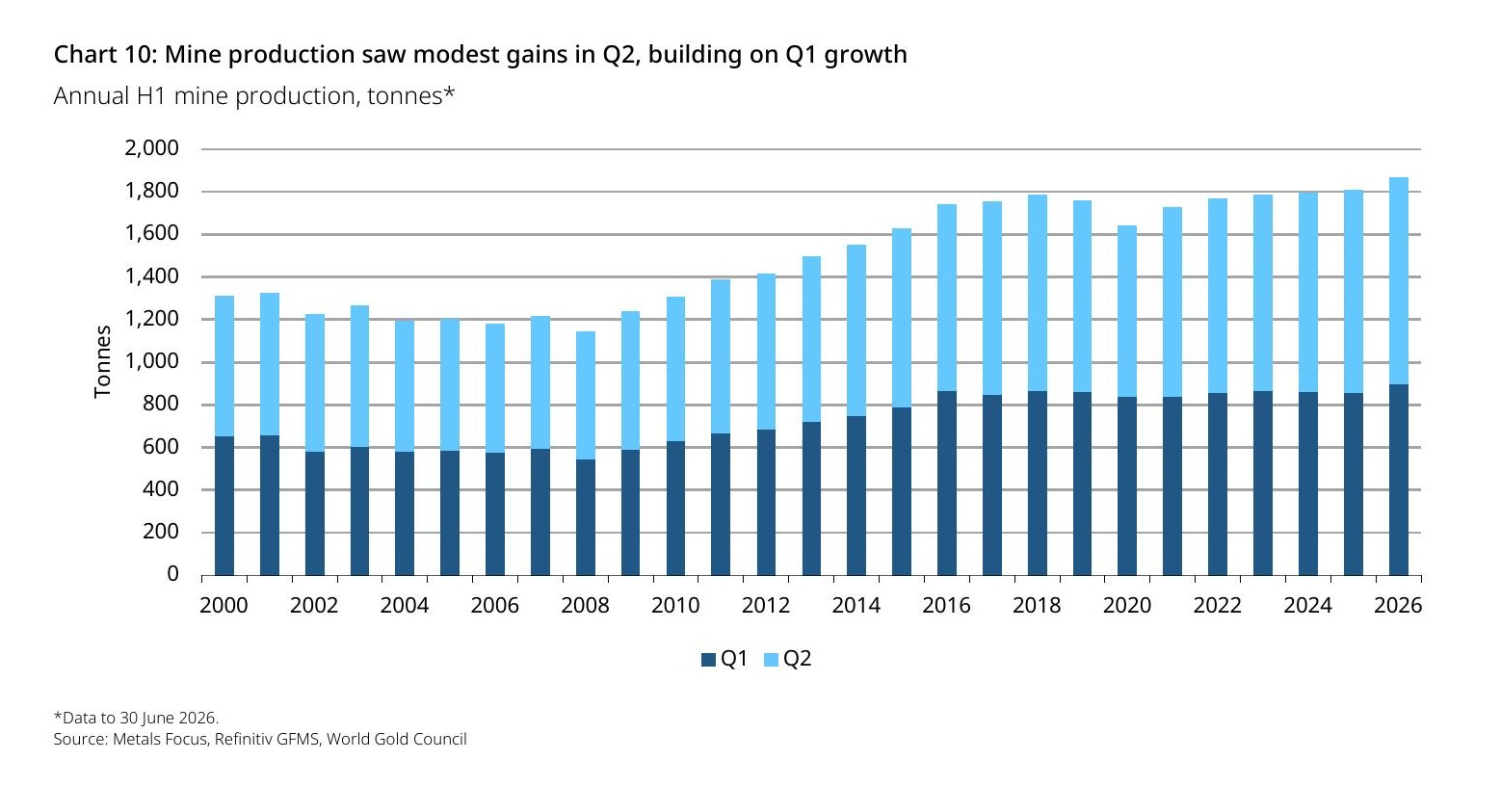
The world’s gold miners have never pulled more metal out of the ground, and it has never cost them more to do it. Mine production rose 2% year on year to 966 tonnes in the second quarter, an all-time high for a June quarter and 2% above the previous record of 948 tonnes a year earlier. First-half output of 1,867 tonnes was also a record, 3% above H1 2025’s 1,808 tonnes.
Industry all-in sustaining costs, meanwhile, hit a record $1,785 an ounce in the first quarter, the most recent period for which the data is complete, up 5% quarter on quarter and 16% year on year. The WGC attributes the increase to higher royalties and corporate overheads, a reminder that a rising gold price feeds back into the cost line through the royalty take. Producers are hardly being squeezed: with gold averaging $4,872.90 in Q1, the implied margin was close to $3,100 an ounce.
The cost pressure is not done building. The council flags the first signs of higher energy prices stemming from the Middle East conflict showing up at some operations, with a bigger impact expected in the quarters ahead, a warning that echoes Gold Fields’ own oil-shock alert and the cost inflation running through Australian producers. Miners also kept dismantling their hedges, de-hedging an estimated 23 tonnes in a tenth successive quarterly decline in the industry hedge book as legacy contracts struck far below spot came off the books.
The output gains came from a handful of countries. Canada led with a 29% rise as new and expanding operations including Agnico Eagle’s Detour Lake ramped up. Chile added 24% on Gold Fields’ Salares Norte reaching steady state and newly commissioned projects such as Rio2’s Fenix. Burkina Faso rose 17% on higher mill throughput at West African Resources’ Kiaka and a first full quarter of hard rock at Orezone Gold’s Bombore, and Ghana gained 8% as Newmont’s Ahafo North ramped up alongside Asante Gold’s Bibiani.
Against that, Mexico dropped 23% as Newmont’s Peñasquito moved to Phase 8 and lower-grade stockpiles, a mine the WGC does not expect back on higher grades until 2028. Nicaragua fell 33% on lower Equinox Gold output, US production fell 12% on mine sequencing at Barrick’s Carlin and lower grades at Kinross, and China lost 8% to safety stoppages after a fatal accident in Shandong. Metals Focus, which supplies the WGC’s production data, also lifted its historical estimates again, adding 117 tonnes to cumulative global output since 2013 as artisanal and small-scale mining data improves.
Recycling went the other way, falling 6% to 326 tonnes as the quarter-on-quarter price drop discouraged selling back. Total supply was therefore flat at 1,269 tonnes, and the council expects only modest growth from either source this year, constrained by long project lead times, limited near-market stocks and the absence of widespread financial distress.
“High prices will keep pressure on jewellery volumes, though consumers may continue to hold rather than sell, with recycling showing little sign of increasing,” said Louise Street, senior markets analyst at the World Gold Council and a lead author of the report.
Central banks stage the rebound
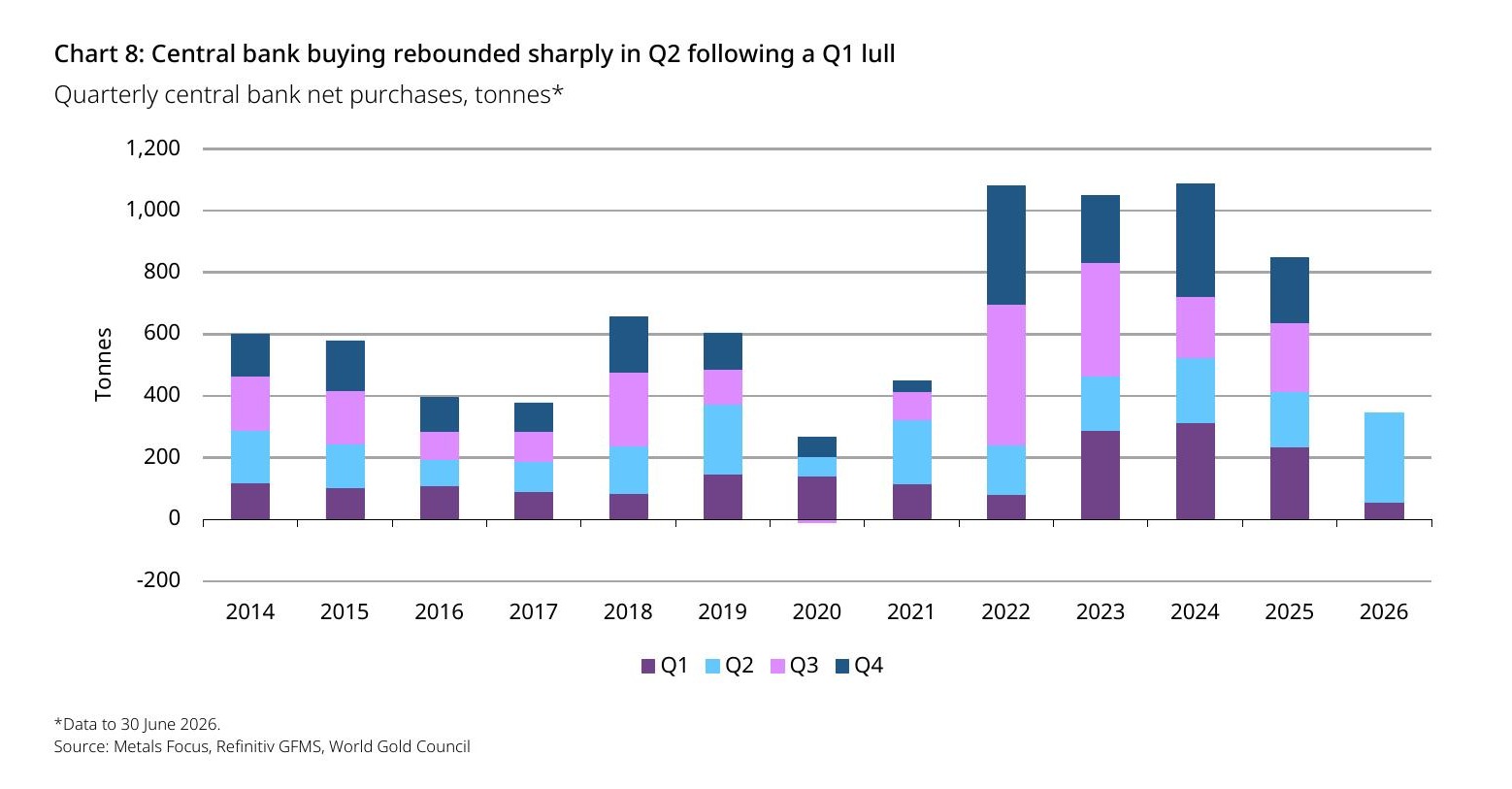
The official sector delivered the quarter’s upside surprise. Net purchases totalled 289 tonnes, up 62% year on year, a fivefold increase on a revised Q1 figure of 57 tonnes and a record high for a second quarter.
The National Bank of Poland was the largest buyer, adding 51 tonnes to take reserves to 632 tonnes and first-half purchases to 82 tonnes, edging closer to its 700-tonne target. The People’s Bank of China added 33 tonnes, its largest quarterly addition since the fourth quarter of 2023, lifting reported holdings to 2,346 tonnes. Smaller additions from Uzbekistan, Kazakhstan, Jordan and the Czech Republic followed the familiar pattern of breadth beyond the biggest holders. Selling all but stopped: Russia led at 22 tonnes and Turkey, Q1’s largest seller, disposed of just 4 tonnes.
The rebound still did not undo the Q1 hole. First-half net demand of 345 tonnes was the lowest for a first half since 2022, and the WGC expects the full year to finish below the 2025 total. Intent has not shifted: in the council’s latest reserves survey, 89% expected global reserves to rise over the next year and a record 45% planned to add to their own.
“Central banks will remain significant buyers, albeit at a slightly slower pace than we’ve seen over the last four years,” Street said.
Investors take a step back
Total demand including OTC was unchanged at 1,269 tonnes in Q2, taking the first half to 2,522 tonnes, up 2% and worth a record $380 billion, with central bank buying and OTC growth covering for the retreat in ETFs.
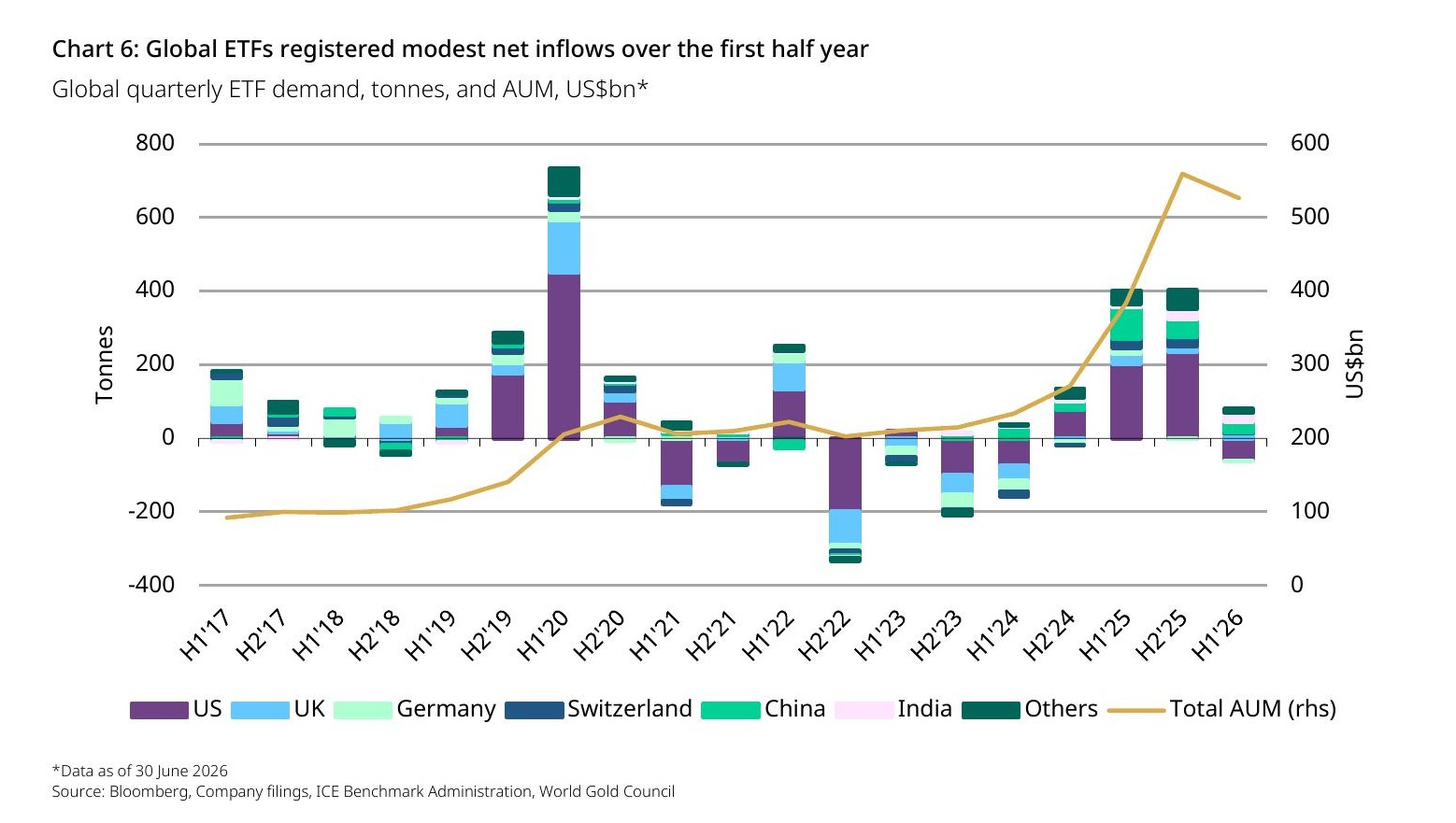
Investment excluding OTC fell 46% to 262 tonnes. Physically-backed ETFs reversed course, shedding 45 tonnes and cutting the H1 increase to 18 tonnes, with the damage concentrated in June, when investors cut holdings by 74 tonnes. North American funds lost 61 tonnes over the half, the region’s weakest first half since 2013, while Asian funds, the standout of the half with a record 70 tonnes of inflows, gave back 15 tonnes in Q2.
Bar and coin investment held up better, broadly unchanged at 307 tonnes and worth $44.5 billion against $33.3 billion a year earlier, with China taking 107 tonnes for a record first half. The category doing the real work is the one nobody can see directly: OTC and stock flows reached 327 tonnes in Q2, up 91% year on year, for a first-half total of 571 tonnes.
Investment should still drive demand growth through the rest of 2026, the council says, though the mix is shifting towards OTC activity and Asian buyers. Western exchange-traded funds remain the weak link, facing the opportunity cost of holding gold with the US 10-year TIPS yield edging towards 2.5% and markets pricing one rate hike in October. A hike, the council argues, “is not a guaranteed negative for gold.”
Jewellery pays more for less
Jewellery remains the casualty of high prices. Global demand fell 17% to 278 tonnes, with China down 28% to 50 tonnes, its lowest second quarter since 2004, and India down 15% to 75 tonnes. Spending told the opposite story, the value of jewellery demand rising 14% to $40 billion in Q2 and 22% to $86 billion over the half as consumers bought lighter, lower-carat pieces. Technology firmed to 80 tonnes, AI demand offsetting weak consumer electronics.
That leaves the second half where the council says it will be settled, on the strength and composition of investment demand rather than on any surge in available metal.
{{ commodity.name }}
{{ post.title }}
{{ post.date }}
Comments