Op-Ed: Giving credit where it’s due — The US finally gets rare earth strategy
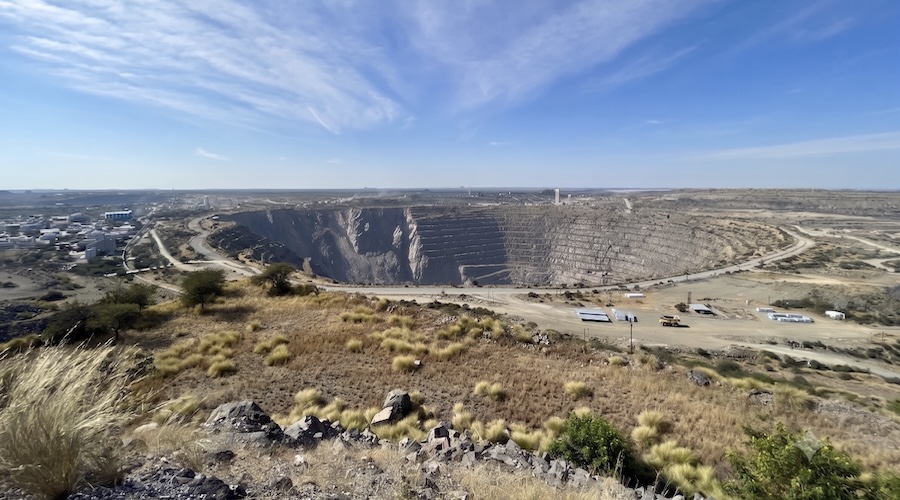
For years, the West has treated rare earths as a mining problem when, in reality, they are a chemistry problem—and recent US investments suggest Washington may finally be starting to understand the difference.
Whenever China’s dominance of rare earth elements (REEs) dominates the headlines, the response is almost always the same: build more mines. It is an intuitive answer, but also an incomplete one. Political rhetoric about securing critical minerals or competing for strategic deposits overlooks a fundamental metallurgical reality. Not all rare earth deposits are created equal. Success depends not on how much ore sits in the ground, but on whether it can economically produce the specific elements industry actually needs.
The geological trap
Much of the West’s rare earth strategy has been built on the mistaken assumption that REEs are a single commodity. They are not. Although the 17 rare earth elements occur together in nature, their commercial value is anything but evenly distributed. Nearly all of the economic and strategic value lies in two magnet metals—Neodymium (Nd) and Praseodymium (Pr)—which underpin permanent magnets used in electric vehicles, wind turbines and defence systems.
Most hard-rock rare earth deposits, however, are dominated by Lanthanum (La) and Cerium (Ce), which typically account for 60% to 70% of the ore. These lower-value elements must still be mined, processed and separated before producers reach the valuable magnet metals.
That creates what might be called the geological ratio trap.
Producing more Nd and Pr inevitably means producing even larger volumes of La and Ce. The tonnes increase, but the economics often do not. Unless operators can economically dispose of, process or monetise those unwanted elements, additional production simply raises costs without generating proportional revenue. A steakhouse cannot stay profitable if it loses money on 70% of every animal it buys.
The challenge becomes even greater once market demand, offtake constraints and geopolitics are added to the equation. The difference between a large rare earth resource and a strategically valuable one is far wider than many investors appreciate.
This is why ionic adsorption clay deposits command such strategic attention. Rather than requiring energy-intensive crushing and roasting, the rare earths are weakly attached to clay minerals and can be recovered through relatively simple chemical leaching. Better still, these deposits naturally contain much higher proportions of Nd, Pr and valuable heavy rare earths such as Dysprosium (Dy) and Terbium (Tb). Geological fortune, however, has largely confined the world’s premier ionic clay deposits to China.
Understanding that geology is not an academic exercise. It is essential to determining whether a rare earth project is commercially viable.
A different signal
Against that backdrop, one recent US investment deserves far more attention than it has received.
The project is Phalaborwa in South Africa’s Limpopo Province—a 35-million-tonne stack of historic phosphogypsum generated during decades of fertiliser production.
At first glance, it hardly resembles the sort of project expected to anchor America’s critical minerals strategy. Yet it may prove far more significant than another announcement of a giant rare earth discovery.
Phalaborwa has already undergone the most expensive stages of mining. Previous operators extracted the ore, crushed it and chemically processed it to recover phosphoric acid, leaving behind a vast surface stockpile containing recoverable rare earths. In effect, decades of mining created an artificial orebody that avoids much of the capital and energy burden faced by conventional hard-rock projects.
Rainbow Rare Earths has added another twist. Its proprietary cerium-depletion process is designed to remove roughly 65% of the low-value Cerium before final rare earth production, improving the overall economics rather than simply accepting the natural geological ratios. The phosphogypsum feedstock also contains negligible Thorium and Uranium, removing another common challenge for rare earth developers.
The result is a project targeting operating costs below $30 per kilogram of Nd and Pr.
That is why Phalaborwa matters.
Its significance lies less in the resource itself than in what it says about Washington’s changing priorities. Rather than backing another large resource based primarily on total rare earth tonnage, the US has supported a project designed around favourable metallurgy, lower processing costs and commercially attractive magnet metal production.
That represents a subtle but meaningful shift in thinking.
Economics over geography
The broader geopolitical implications are difficult to ignore.
Through its $50 million equity commitment, Washington has backed a project in South Africa despite ongoing diplomatic tensions with Pretoria. The message is clear: secure access to competitive, China-independent magnet metals wherever the economics make sense.
That is a more realistic objective than attempting to build an entirely domestic rare earth industry. Geological endowment cannot be legislated, and the economics of processing remain stubbornly indifferent to political borders. Supply-chain resilience is increasingly about building reliable international partnerships rather than insisting every link sits within national boundaries.
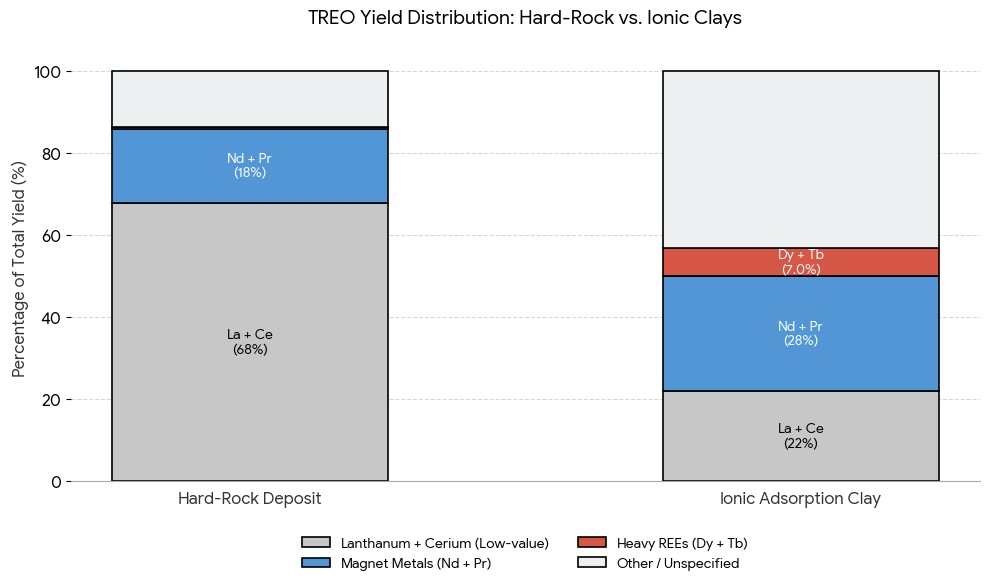
Comparison of Total Rare Earth Oxide (TREO) yield distributions by deposit type. Hard-rock deposits are heavily weighted by low-value liabilities (La+Ce), while ionic clays yield a superior proportion of magnet drivers (Nd+Pr) and premium heavy REEs (Dy+Tb). Data compiled from the US Geological Survey (USGS); the International Energy Agency (IEA); and Russo et al., 2025.
Phalaborwa also challenges another long-held assumption. For years, Western policy largely focused on finding the next major deposit. This investment suggests policymakers may instead be asking a more important question: which projects can actually compete with China on cost and product mix?
That distinction could prove far more consequential than simply discovering another large resource.
The bigger picture
None of this means the US has solved its rare earth challenge.
Phalaborwa alone will not dismantle China’s vertically integrated industry, nor does it eliminate the need for separation capacity, downstream manufacturing, secure offtake agreements or additional commercially viable projects. Like every mining project, it must still prove its technical and economic case.
But recent developments suggest Phalaborwa is unlikely to be an isolated decision. Washington’s subsequent commitment of $500 million to the US-Africa Strategic Investment Program points to a broader strategy of using private-sector investment to strengthen critical mineral supply chains rather than relying solely on traditional government aid.
If so, the importance of Phalaborwa extends well beyond one project.
It marks one of the clearest signs yet that US policymakers may finally be looking beyond headline resource size to focus on the harder questions of metallurgy, processing economics and supply-chain resilience. Those are the same factors that have underpinned China’s dominance for decades.
Whether this strategy ultimately succeeds remains to be seen. But it reflects a far more sophisticated understanding of the rare earth industry than the simplistic race to develop the biggest deposit.
The next decade of critical minerals strategy is unlikely to be decided by who owns the most rock. It will be decided by who can most efficiently deliver the right rare earths, in the right proportions, at commercially sustainable costs outside China’s supply chain.
Dr. Nicholas Vafeas is an economic geologist specializing in critical raw materials, mineral value chains, and strategic resource investments.
More News
{{ commodity.name }}
{{ post.title }}
{{ post.date }}
Comments