A market, a state, and a treaty
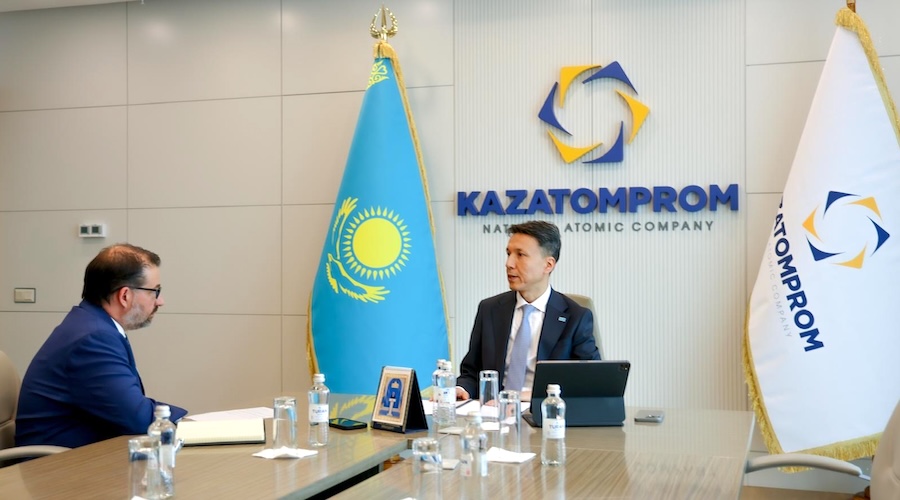
Inside an interview with the CEO of Kazatomprom, the world’s largest uranium producer.
The first thing you see in the lobby of Kazatomprom’s headquarters in Astana is a price. Not the company’s share price, the number most corporate lobbies display, but the spot price of uranium, glowing on a screen beside the day’s world headlines. I almost walked past it. It is a subtle detail, yet it tells you the most: a company that hangs its own share price on the wall is keeping score by how the market judges quarterly performance, while Kazatomprom keeps score by the broader market it serves. For the largest uranium producer on Earth, those have quietly become the same number.
That convergence is why the company matters far beyond Central Asia. Kazakhstan mines roughly 40% of the world’s uranium, most of it through Kazatomprom, which makes this state-controlled producer the most important supplier of the fuel behind the nuclear revival that Western utilities and AI data-centre builders are now counting on. It mines the cheapest way there is, by in-situ recovery, dissolving uranium underground and pumping it to the surface without the cost of a pit or a shaft. When the most important supplier of a suddenly fashionable commodity is also among the lowest-cost, what it chooses not to do matters as much as what it does.
What Kazatomprom chooses, year after year, is restraint. Since its 2018 listing in London and on the Astana International Exchange, it has run what it calls a value-over-volume strategy: it will not flood the market with cheap uranium, even though its costs would let it bury higher-cost rivals if it tried. It holds supply back and lets the price carry the value. The market has rewarded the discipline, and the London-listed stock has risen roughly sevenfold since the IPO. The restraint is the strategy, and it is posted on the lobby wall.
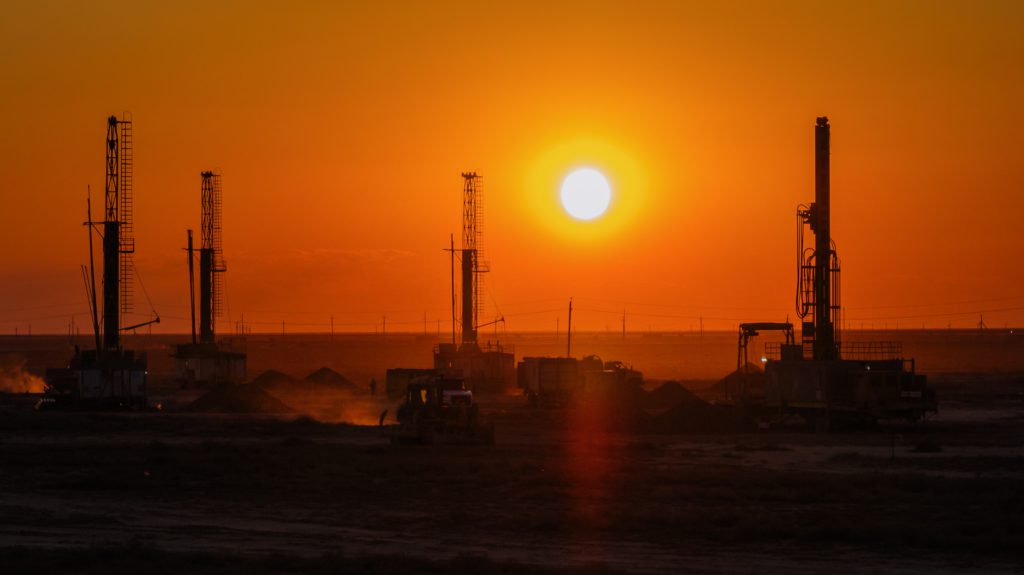
That discipline is easier to admire than to execute, because Kazatomprom answers to an unusually crowded room. It is three-quarters owned by the Kazakh state, through the sovereign wealth fund Samruk-Kazyna, and roughly one-quarter floated on public exchanges, including London. So a single company has to satisfy a market, with its disclosure rules and its sometimes impatient shareholders; a state, which owns a controlling interest and uses it as a calling card for the country; and a treaty, the non-proliferation regime that governs every gram of nuclear material it touches. A market, a state, and a treaty, each pulling in its own direction with its own agenda. That is the pressure the man who runs the company lives under.
The man is Meirzhan Yussupov, who became chief executive in 2023 after rising through the company’s finance side, including a turn as its CFO. It shows in how he talks. He reaches for payback periods and rates of return the way other executives reach for slogans, and when I asked whether Kazatomprom would build out the parts of the fuel cycle it does not yet control, his first instinct was to explain why a London-listed company cannot make that call regardless of the financial numbers. The conversation was open and easy, which made the one constraint on our meeting all the more telling.
I was met on the ground floor, my credentials checked, and taken to a conference room on the twentieth floor beside Yussupov’s office, where the Kazakh flag and the company flag flank a wall with the company name, which in English translates to “national atomic company.” I started to set up a video camera. There had been a miscommunication, I was told by his staff, gently and without any edge. The company had agreed to an interview, not to video. A still photograph was fine. Live footage was not.
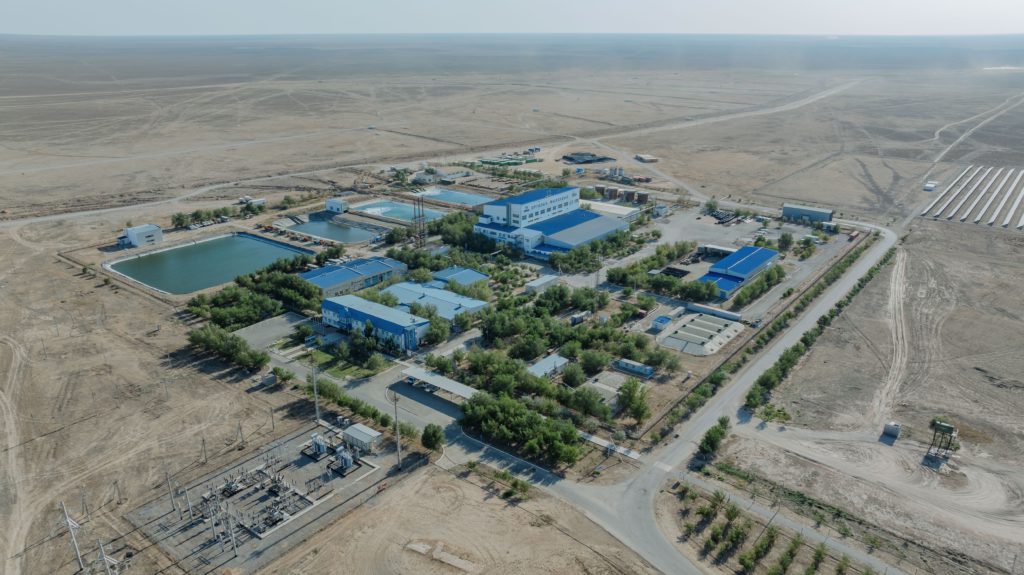
The distinction is the whole story in miniature. A photograph cannot carry an unscripted, market-moving sentence to the London exchange. A live video can. The line between what I could capture and what I could not was the market, drawn across a conference room. His caution was never the man; it was the obligations of the office. He opened by reminding me that a listed company has to be careful, and 40 minutes later he closed by noting that his investor relations team warns him against saying anything that is not already public. In between, he answered everything I asked.
But first, he turned the tables. Before I could begin, he was the one asking the questions. Was it my first time in Kazakhstan? How did I find it? I told him the truth, that Astana was nothing like I had expected: a clean, fast-rising city of cranes and new light rail that my driver said would have been unrecognizable a decade ago. A big step, he agreed. Then he asked, with a trace of a smile, whether I had watched Borat before coming. I had not. Worth seeing, he said, not for the film but for what it shows about the way the West pictures his country, a misunderstanding that, it turned out, he thinks about a good deal.
So the question worth asking, across the table from a man whose every sentence has to clear a market, a state, and a treaty, is what he will say plainly, on the record, when you put it to him directly. Here is what he said.
A few exchanges from the conversation appear below, lightly edited and condensed. The full interview runs separately.
- How are you thinking about production discipline versus market share?
- We have our “value over volume” strategy, which we adopted many years ago, ever since we went public in 2018. … We don’t want to flood the market with cheap uranium. That’s how we create value for our stakeholders, for future generations, and for our country. … We think there will be enough space for everyone, with this nuclear renaissance and the potential AI demand.
- Does Kazatomprom want to move further downstream in the fuel cycle?
- Absolutely. We have this dream of having the whole nuclear fuel cycle within Kazakhstan. … Enrichment is more strategic and more difficult; it’s related to the non-proliferation regime, so only the five permanent Security Council members have access to those technologies. … Because we’re a London-listed company, we can’t enter or invest in a project regardless of the financial numbers. If the payback period, IRR and NPV are good enough, we go. If not, we wait.
- How do you see Kazatomprom’s role in representing Kazakhstan to investors?
- We say Kazatomprom can serve as an example of investing in Kazakhstan, in the Kazakh economy, because our share price has increased sevenfold since we went public. It shows we have a stable legislative environment and strong legislation that protects investors’ rights. … We’re not only on the LSE but also on the Astana International Exchange, which is governed by common law, familiar to the Western world. … We see ourselves as an example.
- What does the West most misunderstand about Kazakhstan?
- When you’re in the US, Kazakhstan, Pakistan and Afghanistan all sound the same, somewhere in the middle of nowhere. When friends come from the US and other parts of the world, they say, “We didn’t know it’s so big.” It is big. … There aren’t many direct international flights here, because nobody flies over Russia now. We used to fly to Frankfurt in roughly five hours; now it’s eight.
Full interview: Kazatomprom CEO Meirzhan Yussupov on uranium markets, China and nuclear growth
* Erik Groves is a contributing analyst for MINING.COM and Corporate Strategy and In-House Counsel at Morgan Companies. He recently attended the 16th International Mining and Metallurgy Congress and Exhibition (AMM) in Astana, Kazakhstan. He will be sharing insights gathered at one of Central Asia’s most important mining events.
{{ commodity.name }}
{{ post.title }}
{{ post.date }}
Comments