Kazatomprom CEO Meirzhan Yussupov on uranium markets, China and nuclear growth
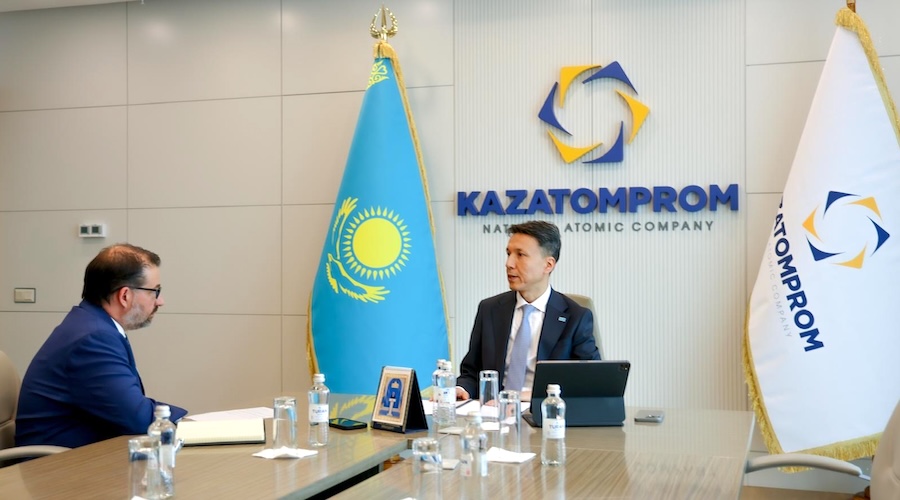
* This is the complete conversation behind the feature A market, a state, and a treaty.
Meirzhan Yussupov, chief executive of Kazatomprom, the world’s largest uranium producer, sat down with MINING.COM in Astana for a wide-ranging interview on production discipline, AI-driven demand, the nuclear fuel cycle, trade routes, and Kazakhstan’s place in the market. The transcript has been lightly edited and condensed for clarity.
Yussupov: So, is it your first time in Kazakhstan?
MINING.COM: It is.
Yussupov: Oh, really? And how do you find it?
MINING.COM: Completely different than I expected. I’m used to American cities, and this is such a clean city, cranes on every building, new light rail going up. The driver from the airport said ten years ago you wouldn’t recognize any of this.
Yussupov: It’s been a big step. Have you watched the Borat movie before coming?
MINING.COM: No, not yet. I was told it wasn’t accurate at all.
Yussupov: No, it’s just interesting to see the way they think about us.
MINING.COM: How is Kazatomprom thinking about production discipline versus market share in the current price environment?
Yussupov: We have our “value over volume” strategy, which we adopted many years ago, ever since we went public in 2018. We stick to that value over volume strategy, which means we think about market discipline: we don’t want to flood the market with cheap uranium. That’s how we create value for our stakeholders, for the next generations, and for our country. On market share, we are concerned about it, but not that much. We might welcome anyone who wishes to enter the uranium market, but it’s not that easy. We welcome all newcomers, and we think there will be enough space for everyone, with this nuclear renaissance and the potential AI demand, electricity demand, the demand for stable, 24/7 power that is also zero-emission, in large quantities.
MINING.COM: Utilities are re-contracting amid projections of major new demand, including data centers and AI. What is Kazatomprom seeing in customer contracting behavior?
Yussupov: It is changing. A few years ago you’d face a somewhat relaxed attitude from our partners and clients. Now they are more concerned about security of supply. But we have to differentiate by where clients are located. Asia is growing tremendously, China being the largest growing market. India has very ambitious goals, they have this SHANTI Act; they aim to build 100 gigawatts of nuclear power by 2047. In the Middle East, the UAE already has operating reactors at Barakah, built by the Koreans, and Saudi Arabia is also voicing that it will be constructing nuclear. Eastern clients are less price-sensitive, looking decades ahead. Western ones have been in the industry for many years and are a bit more price-sensitive. But overall there’s increasing interest in uranium and a change in contracting behavior.
MINING.COM: Kazakhstan leads the world in uranium production, but most conversion and enrichment capacity is elsewhere. Does Kazatomprom have ambitions to move further downstream in the fuel cycle?
Yussupov: Absolutely. We have this dream of having the whole nuclear fuel cycle within Kazakhstan. We have mining and preliminary processing. We’re missing conversion and enrichment, but we have pellet production, we basically bake pellets like cookies, at our plant in eastern Kazakhstan, and out of pellets we make fuel assemblies that we export to China. Enrichment is more strategic and more difficult, it’s related to the non-proliferation regime, so only the five permanent Security Council members have access to those technologies, because of dual use. For now, of course we want this within our country, but to what extent we’ll be able to get the technology is the question. We still seek options, talking to all our partners, the US, Europe, Russia, China. We strictly stick to the non-proliferation regime and are fully compliant; the question is to what extent others want to share their technology. Conversion is more commercial, less geopolitical. For many years the conversion market wasn’t really there, margins were very thin and payback periods very long, so it didn’t make sense for us. But now we’re exploring it, because we obtained conversion technology from one of our partners, and we’re looking at how we could start a conversion facility here. The decision depends on project fundamentals, metrics and the market, because we’re a London-listed company, we can’t enter or invest in a project regardless of the financial numbers. If the payback period, IRR and NPV are good enough, we go. If not, we wait. And we’ll take the decision in light of our strategy of transforming into a vertically integrated company.
MINING.COM: How is Kazatomprom diversifying its transport and delivery routes, with the Trans-Caspian corridor and the TRIPP corridor in view?
Yussupov: We have a diversified sales portfolio, and like any business that doesn’t want to put all its eggs in one basket, we also have diversified routes. For Eastern clients, China, we deliver to the border; for Russia, we deliver to Russia, no problem. For Western customers, we deliver across Russia to St. Petersburg port, or the other option is the Middle Corridor, the Trans-Caspian route. We’ve been using this route for seven or eight years, and the share of our traffic that goes through the Trans-Caspian depends on customers’ preferences. For example, across 2023, 2024 and 2025, of the production we delivered to Western markets, sometimes it went up to 65%, sometimes 60%, sometimes slightly less than 50% went through the Trans-Caspian. And once TRIPP is operable, we’ll look into those options too.
MINING.COM: Is there a waiver in place for the St. Petersburg route up to 2028, with a window after that where it gets less certain?
Yussupov: I think there’s a misunderstanding. The Russian ban is specifically for Russian uranium produced and enriched in Russia. In our case, we’re just using their territory. I won’t give the name, but some of our Western partners prefer the Middle Corridor over the Russian route, but if needed, they can use the Russian routes; there’s no ban as such.
MINING.COM: So that 2028 deadline is something else?
Yussupov: It’s something else.
MINING.COM: How do you see your customer mix evolving, Eastern versus Western markets, over the next decade?
Yussupov: China, they say every year they bring 8 to 10 reactors into operation. Right now they’re number two globally, with about 62 reactors, and by 2030 they target more than 100. The US has 94 reactors, so China wants to be number one. They’re aiming at 150 by 2035 and potentially 200 by 2040, it’s crazy. So theoretically you’d expect more demand from China. But Kazatomprom has a diversified sales portfolio. Now we try to keep, on average, 50% Asia, 25% Europe, and 25% Americas (North and South, we also sell to Brazil and Argentina, and for the first time in our history, sold to Canada, OPG, Ontario Power Generation; the Canadian market was Cameco’s market, but we sold to them last year). Apart from China, we have Japan restarting, South Korea, India, and Bangladesh, who we expect at some point will come to the market.
MINING.COM: Does production discipline benefit the broader market, not just your shareholders?
Yussupov: Yes, absolutely. We’ve always told our investors, because we are a 25% [publicly] listed company, if there’s big demand, we try to increase production, but we don’t want to flood the market. Compared to last year, we’re growing 10%, and we’ve been growing since 2023, increasing production little by little. But from time to time you see hiccups, Japan, for example; Fukushima was unexpected, like force majeure.
MINING.COM: Nuclear is base-load power, a point that gets lost in the green-energy conversation. If the world is going to decarbonize, is there a way around it?
Yussupov: No, absolutely, we’ve been telling this story since our IPO. If you’re talking about energy transformation, you can’t do it without nuclear. Wind depends on wind; solar depends on the sun. You must have base load for stable operation of the grid, 24/7, readily available, no dependence on weather. And plus, AI growth consumes energy like crazy.
MINING.COM: Officials at the C5+1 spoke about how nimble Kazatomprom was in 2022, adjusting trade and product flows without disruption. Can you talk about that?
Yussupov: In terms of our supply chain, operations is always operations; sometimes unexpected things happen, but we have mitigation measures. They were talking about a shortage of sulfuric acid, but we were able to source it from neighboring countries. That doesn’t mean we’re closing down production. We position Kazatomprom as the reliable supplier of uranium for many years ahead. We tell clients: if you want to be sure to have your pounds of uranium 15 or 20 years from now, come talk to us, don’t talk to traders. A nuclear power facility isn’t something you can just turn off and on; you have to be sure you’re supplied for years ahead. It’s a club, not a closed club, but we know each other.
MINING.COM: Trust is a word I’ve heard a lot.
Yussupov: Trust is very important. We position ourselves as a reliable partner, and we’ve never failed our deliveries. Sometimes hiccups happen, but we’ve overcome those difficulties.
MINING.COM: Kazatomprom says something not just about the company but about the nation; it is the only major publicly traded mining company on an international market out of Central Asia. What is your role in spreading the word about Kazakhstan?
Yussupov: This is actually how we explain it to our government officials. When we talk to investors who buy our shares, we say Kazatomprom can serve as an example of investing in Kazakhstan, in the Kazakh economy, because our share price has increased seven-fold since we went public. It shows we have a stable legislative environment and strong legislation that protects investors’ rights. By the way, we’re not only on the LSE but also on the Astana International Exchange, which is governed by common law, familiar to the Western world. The government is doing a lot to attract investors. We understand our role, we’re also representing our country, so we try to do our best, and to be compliant with all applicable regulations: for listing, for non-proliferation, for the International Atomic Energy Agency. We have a Low Enriched Uranium (LEU) Bank within Kazakhstan, a sign of the international community’s trust toward Kazakhstan, located within our facility at the Ulba Metallurgical Plant. So we see ourselves as an example.
MINING.COM: Is there anything you think the West generally misunderstands about Kazakhstan?
Yussupov: Because of the geographical distance, I think, when you’re in the US, Kazakhstan, Pakistan and Afghanistan all sound the same, somewhere in the middle of nowhere. When friends come from the US and other parts of the world, they say, “We didn’t know it’s so big.” It is big. Our government is heavily investing in tourism, we have beautiful mountains, and the ski season runs from October and November to late March, depending on the weather, a one-hour drive from Almaty to Shymbulak resort. There aren’t many direct international flights here, because nobody flies over Russia now. We used to fly to Frankfurt in roughly five hours; now it’s eight.
* Erik Groves is a contributing analyst for MINING.COM and Corporate Strategy and In-House Counsel at Morgan Companies. He recently attended the 16th International Mining and Metallurgy Congress and Exhibition (AMM) in Astana, Kazakhstan. He will be sharing insights gathered at one of Central Asia’s most important mining events.
{{ commodity.name }}
{{ post.title }}
{{ post.date }}
Comments